
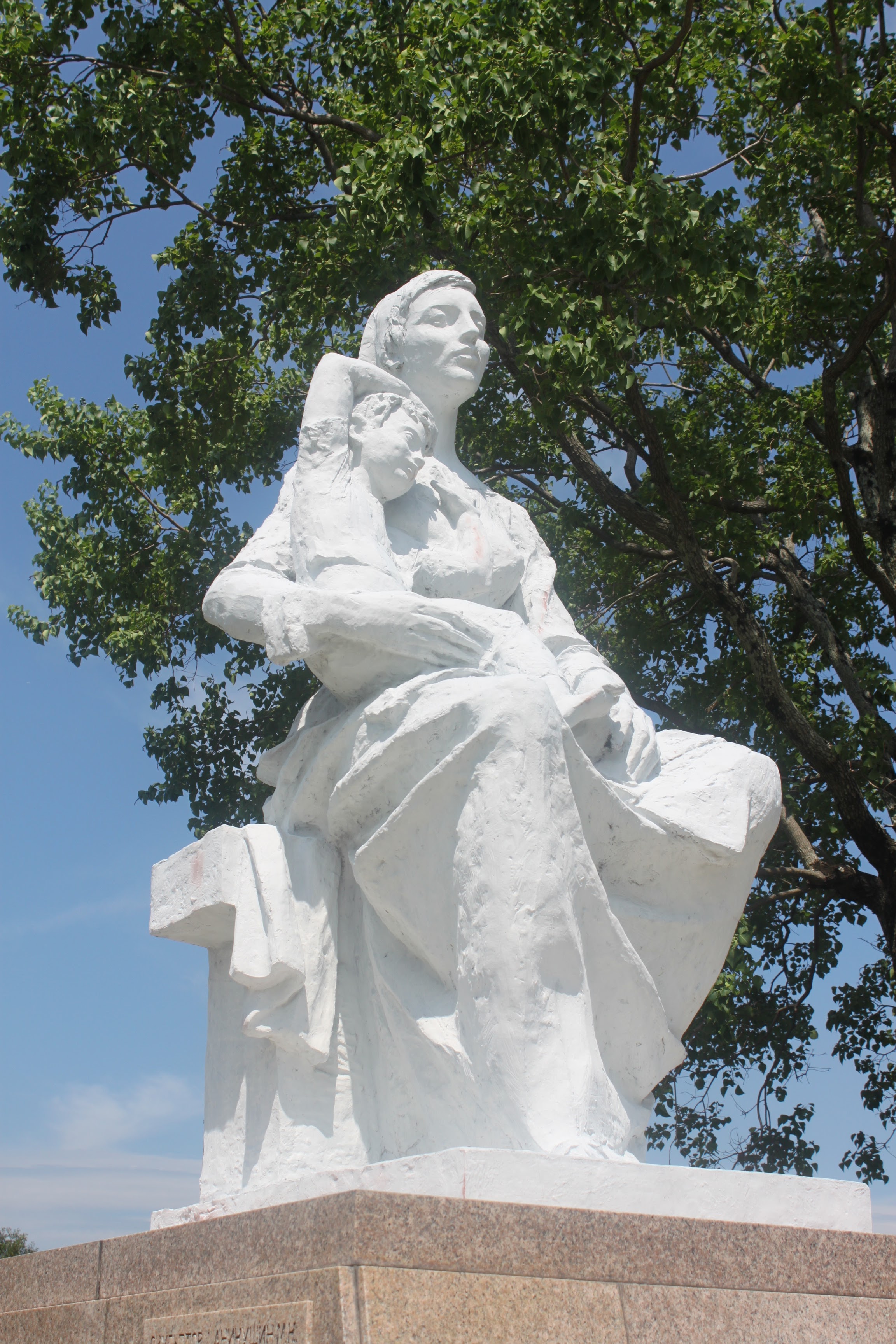
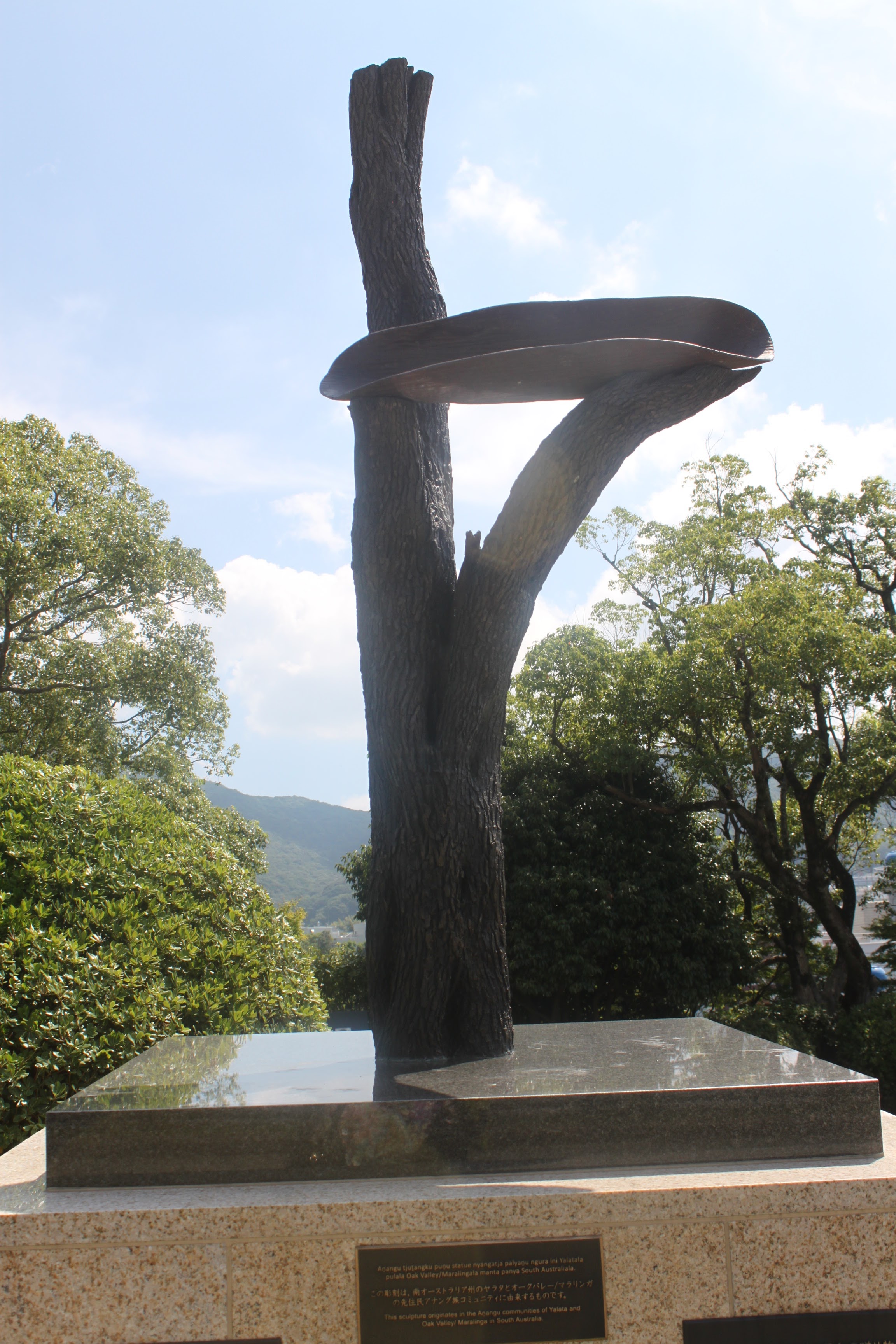
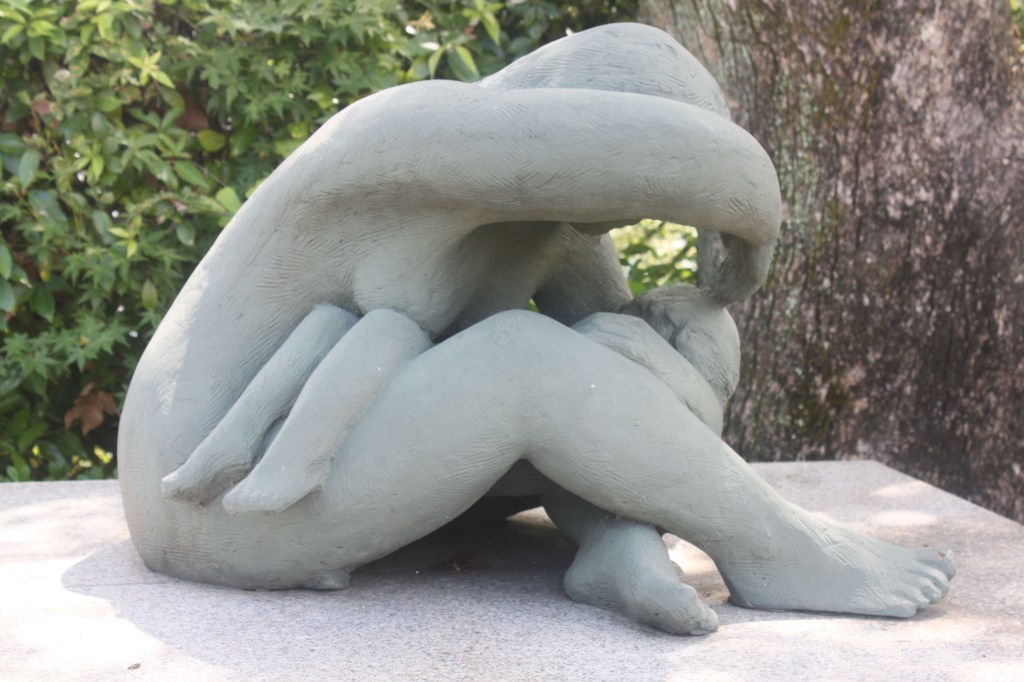
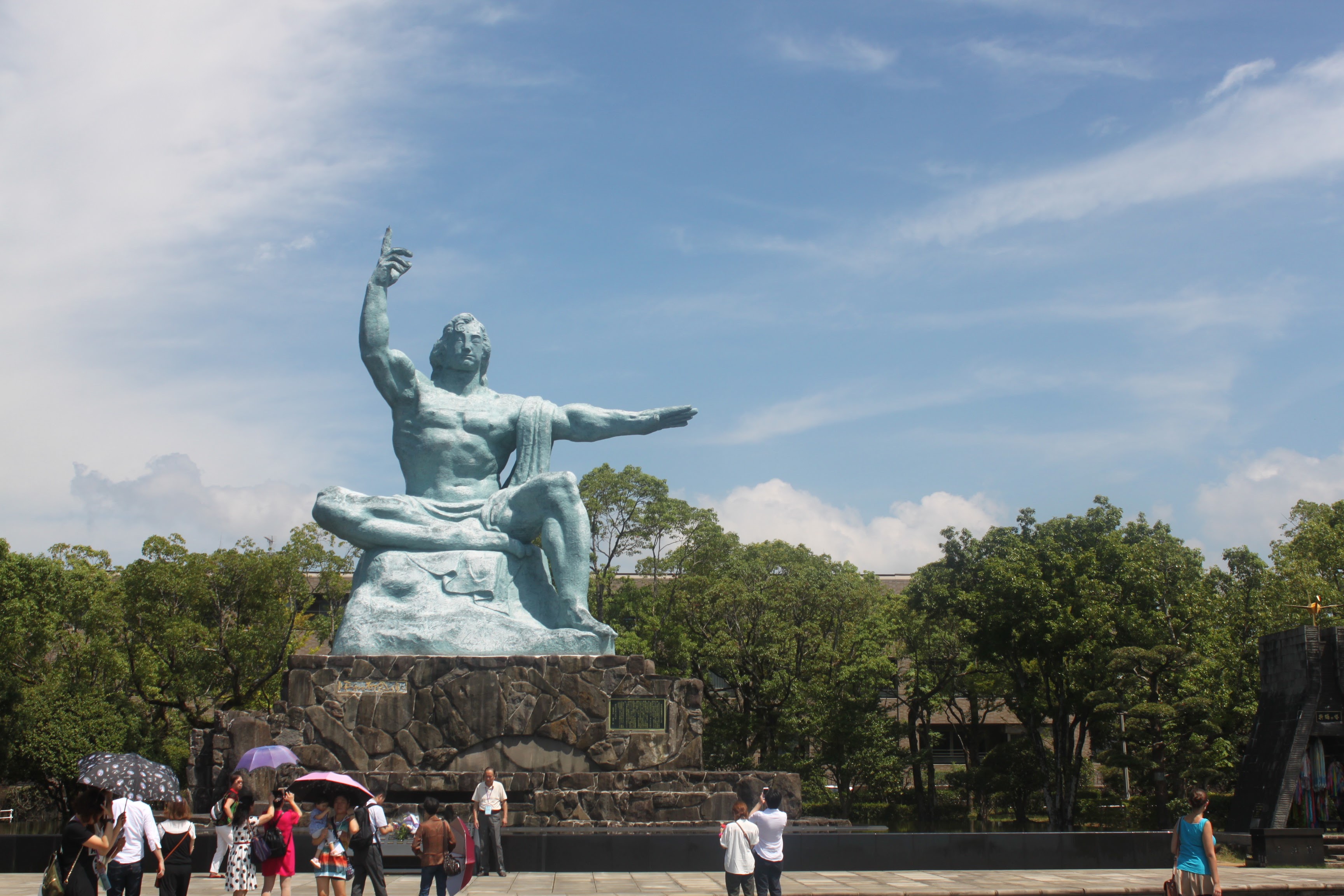
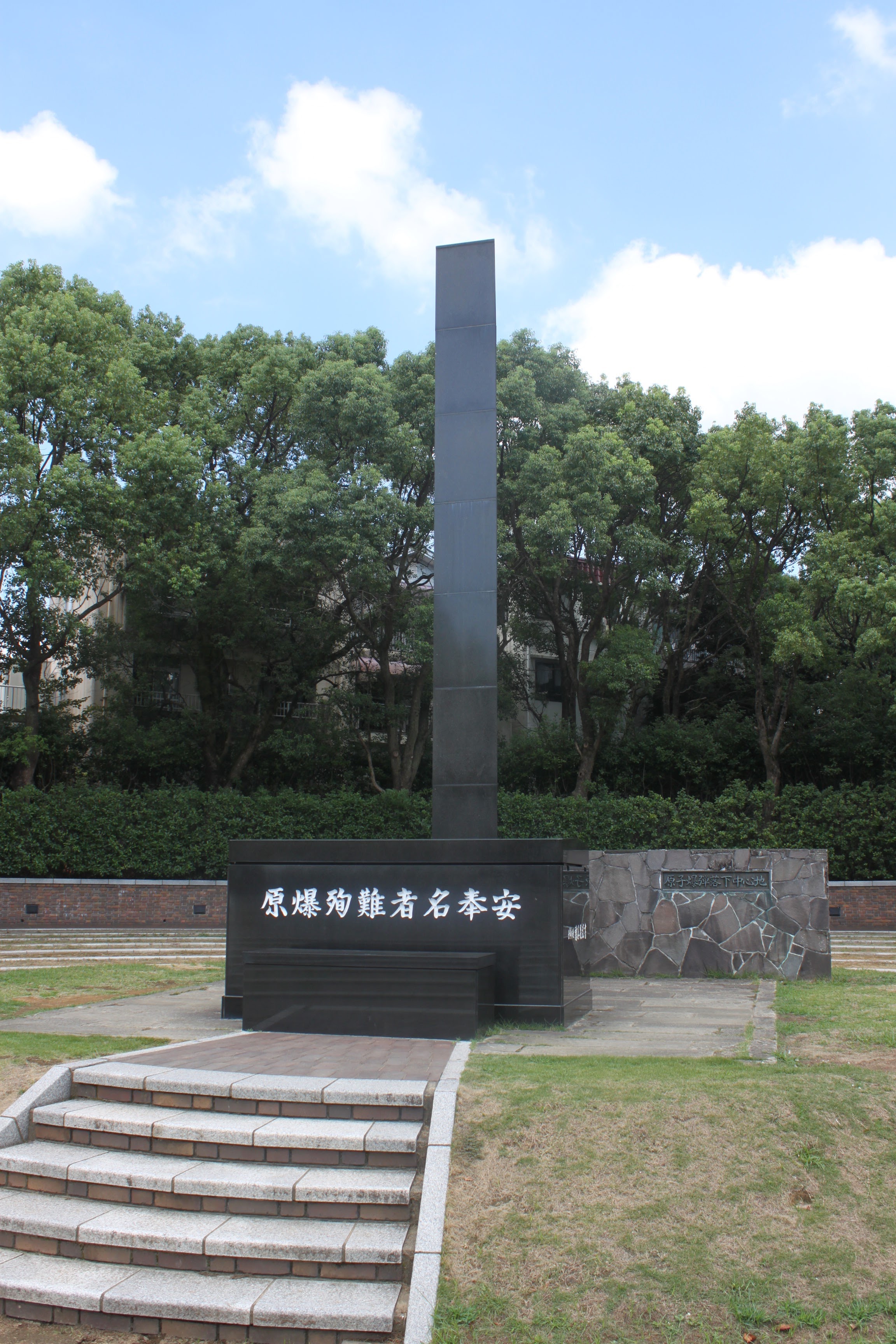
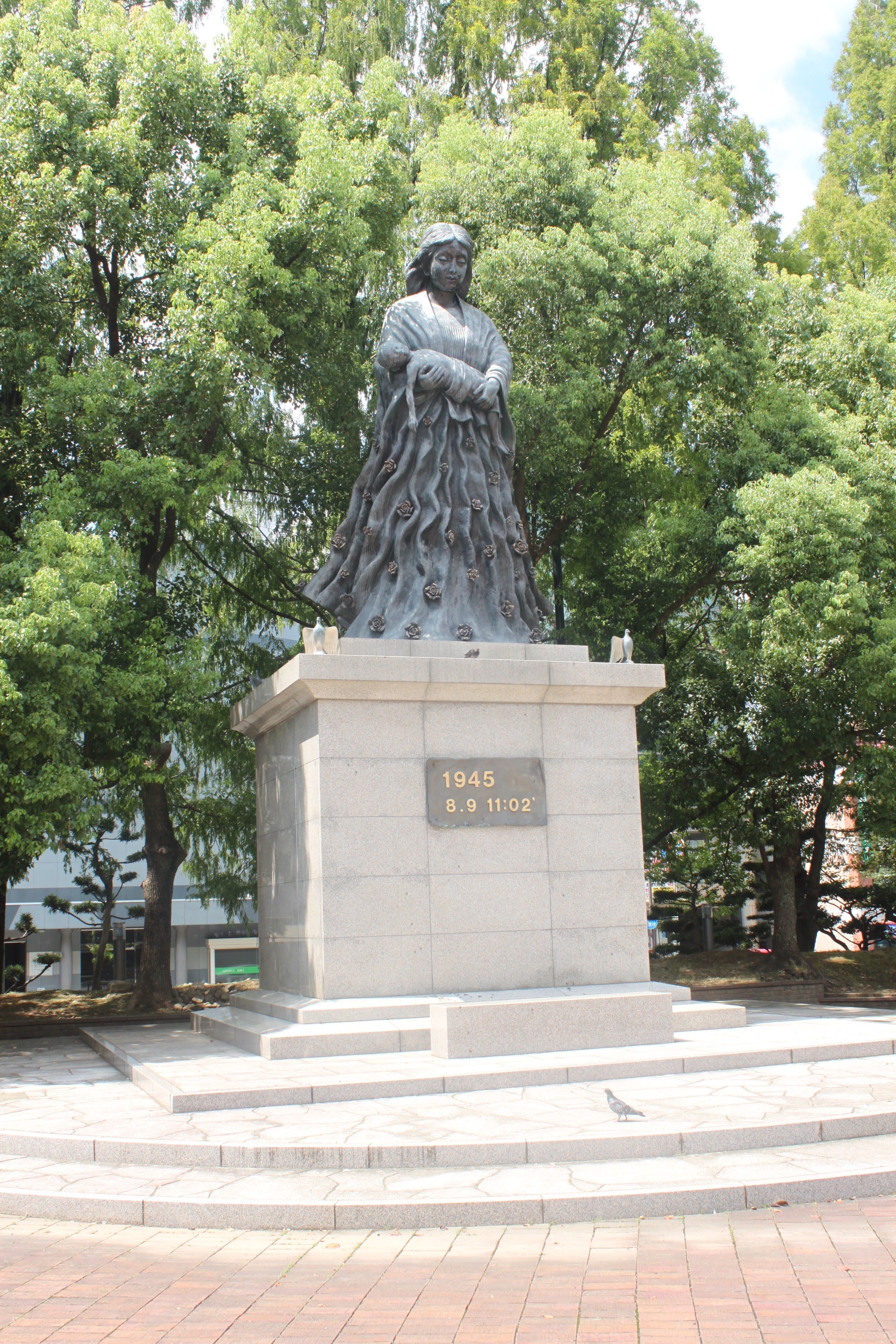
From the Atomic Bomb Epicentre, it is just a short walk to Nagasaki Atomic Bomb Museum. The walk takes you past a number of sculptures, including the Flame of Peace.


“The women at home prayed for victory as their men departed for the battlefields. But then the blood of countless peoples was shed on the vast continent and the far away islands.
Finally, in 1945 as the war escalated, it brought the tragedies of the Okinawa Islands followed by the inhuman atomic bomb attacks over Hiroshima on the 6th and Nagasaki on the 9th of August.
Ah! On that unforgettable day, in an instantaneous blast of indescribable heat, the bodies of tens of thousands of men and women, mothers and children were hideously torn and burned to death.
After more than forty years, the agony continues over [???] rot! Danger of a second nuclear war permeate our very existence. The earth stands on the brink of total oblivion.
We must not allow any more war! Nor the use of atomic weapons! Let us guard our precious green earth and preserve all life of every kind.
We erect this relief, still nearing the bursting cries on that day of each of those women long silenced in death. Bringing together all the turmoil from the depths of their tortured hearts and minds, we pledge ourselves never to repeat this disaster. ”
The Flame of Peace.
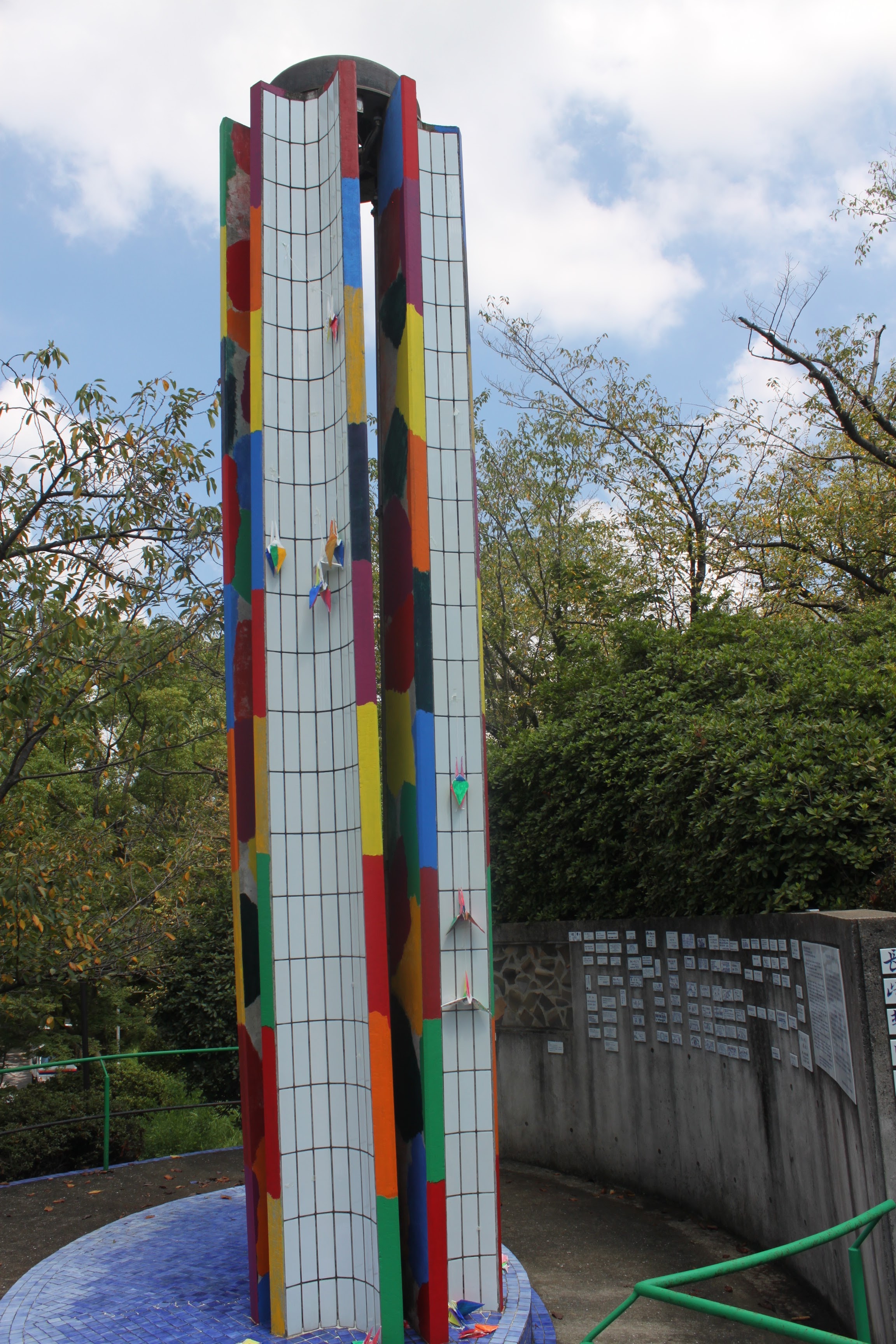
“This is a pledge that Nagasaki will be the last city to suffer an atomic bombing.”
The flame was sent from Mount Olympus in Greece in August 1983, one of the rare times that it has been sent forth, other than for the Olympic Games. In Ancient Greece all warring factions stopped fighting whilst the Olympic flame was lit. This flame will be kept burning until all the nuclear weapons in the world have been abolished.
The Nagasaki Atomic Bomb Museum

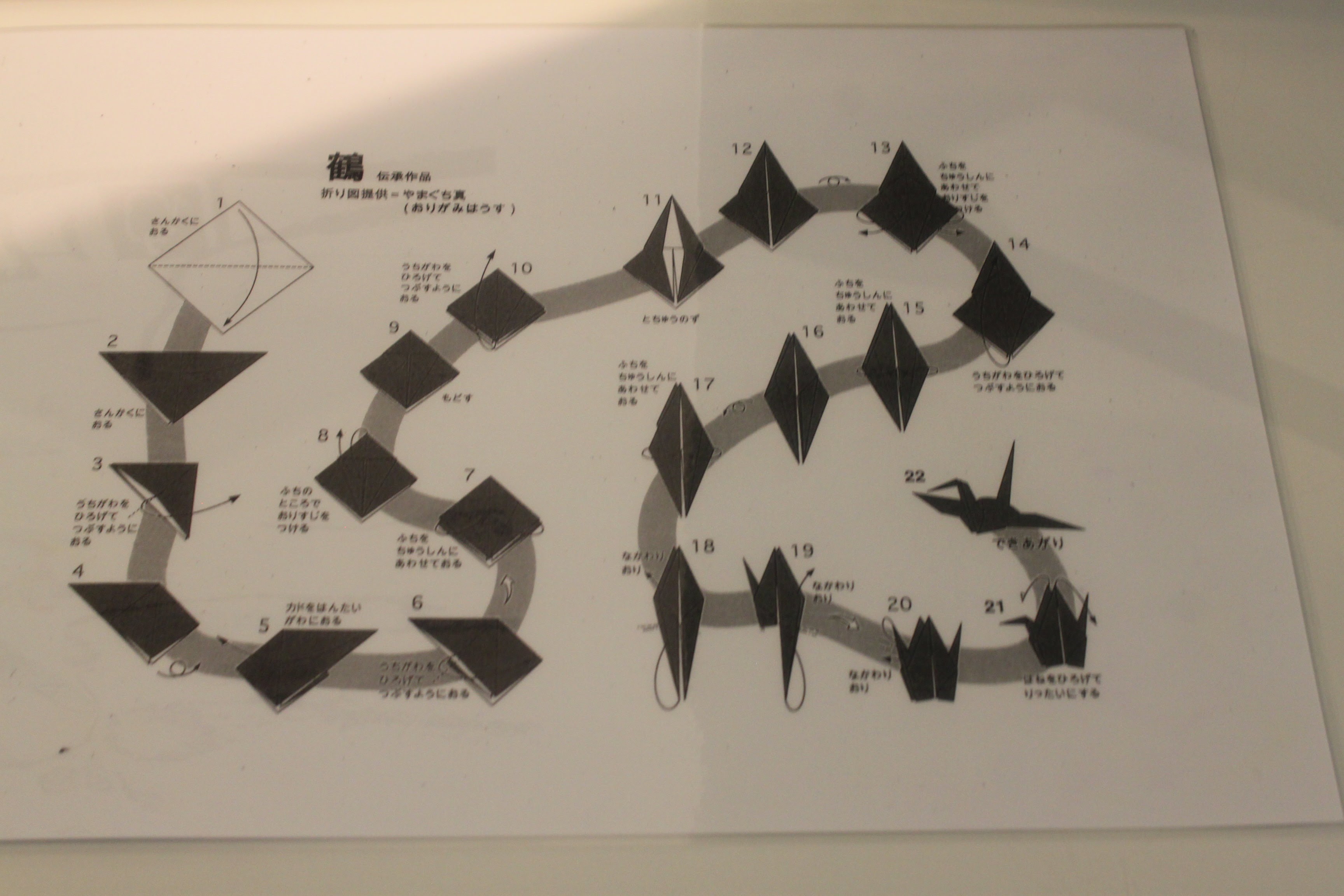
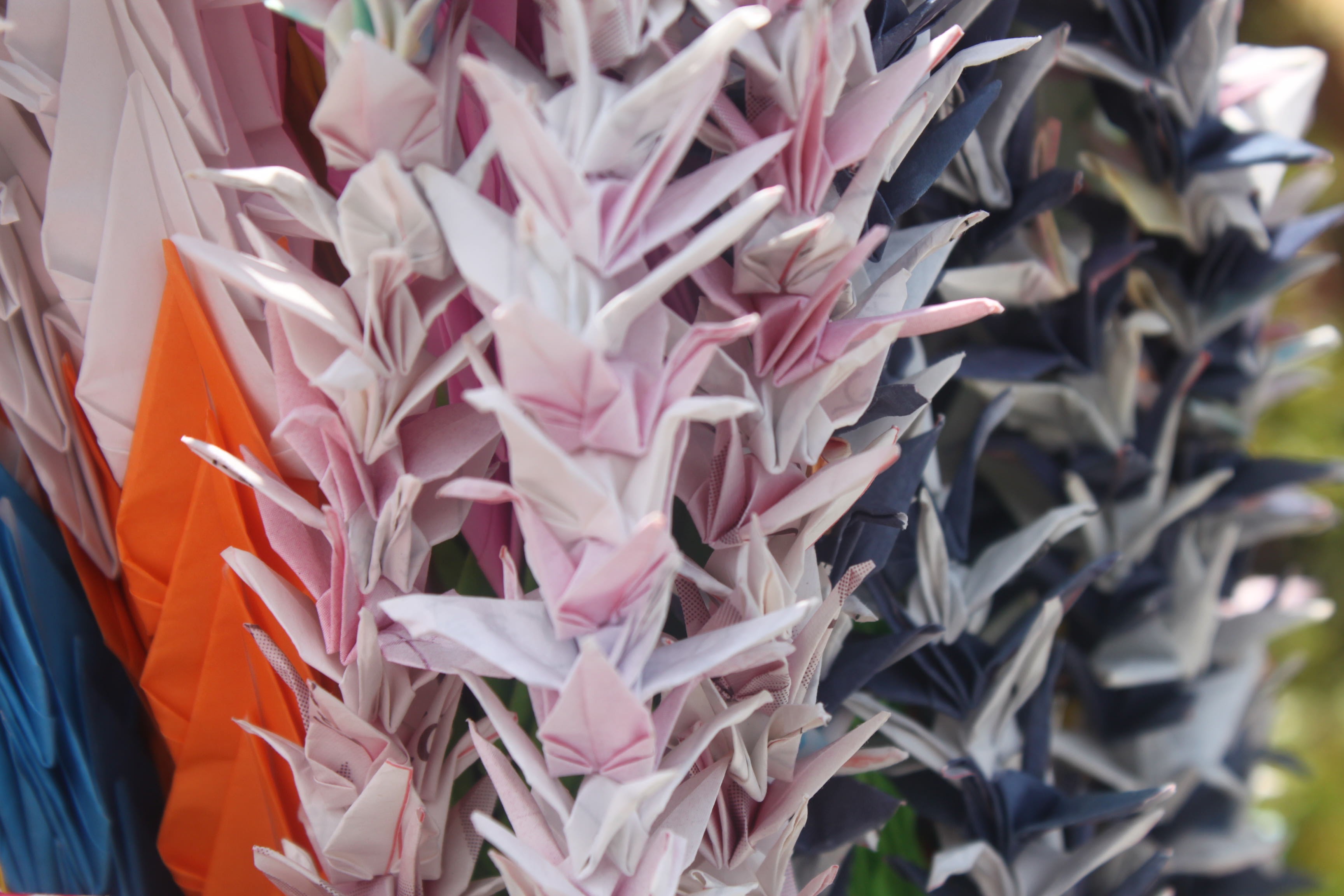
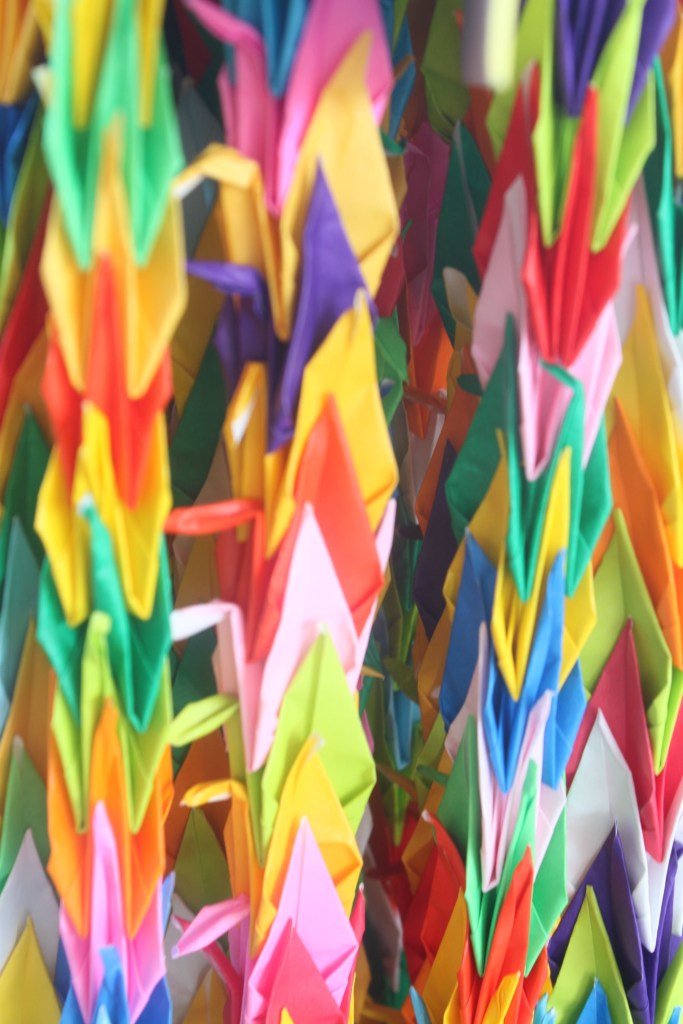
Just inside the entrance to the museum, we were met with more strands of threaded cranes, this time with helpful instructions on how to fold them in both Japanese and English.

As you enter the exhibition hall, you are confronted with a shattered wall clock with its hands stuck at the fateful hour of the explosion, 11:02. It was found in a house some 800 metres from the epicentre, near the Sanna Shinto Shrine in Sakamoto-machi. Time then takes a detour back to a period before the bomb

to the arrival of Portuguese ships in 1571 in the port of Nagasaki, through the port’s exclusive relations between Holland and China when Nagasaki was Japan’s only, barely, open port from 1641 to 1859. It was in Nagasaki that students slowly gathered from all over Japan to gradually acquire Western Knowledge. The interaction increased with the greater opening of Japan in the Meiji period from 23rd October 23rd 1868 to 30th July 1912, during which Japan moved from a feudal society to a highly modern, highly industrialised one under Emperor Meiji.

With the 19th Century opening up, Western-style buildings stood side-by-side with traditional Japanese ones and the foreign settlements bustled in the late 19th century. Nagasaki gradually changed from a trading port to a centre of shipbuilding over this period, making it a target for bombing by 9th August 1945.

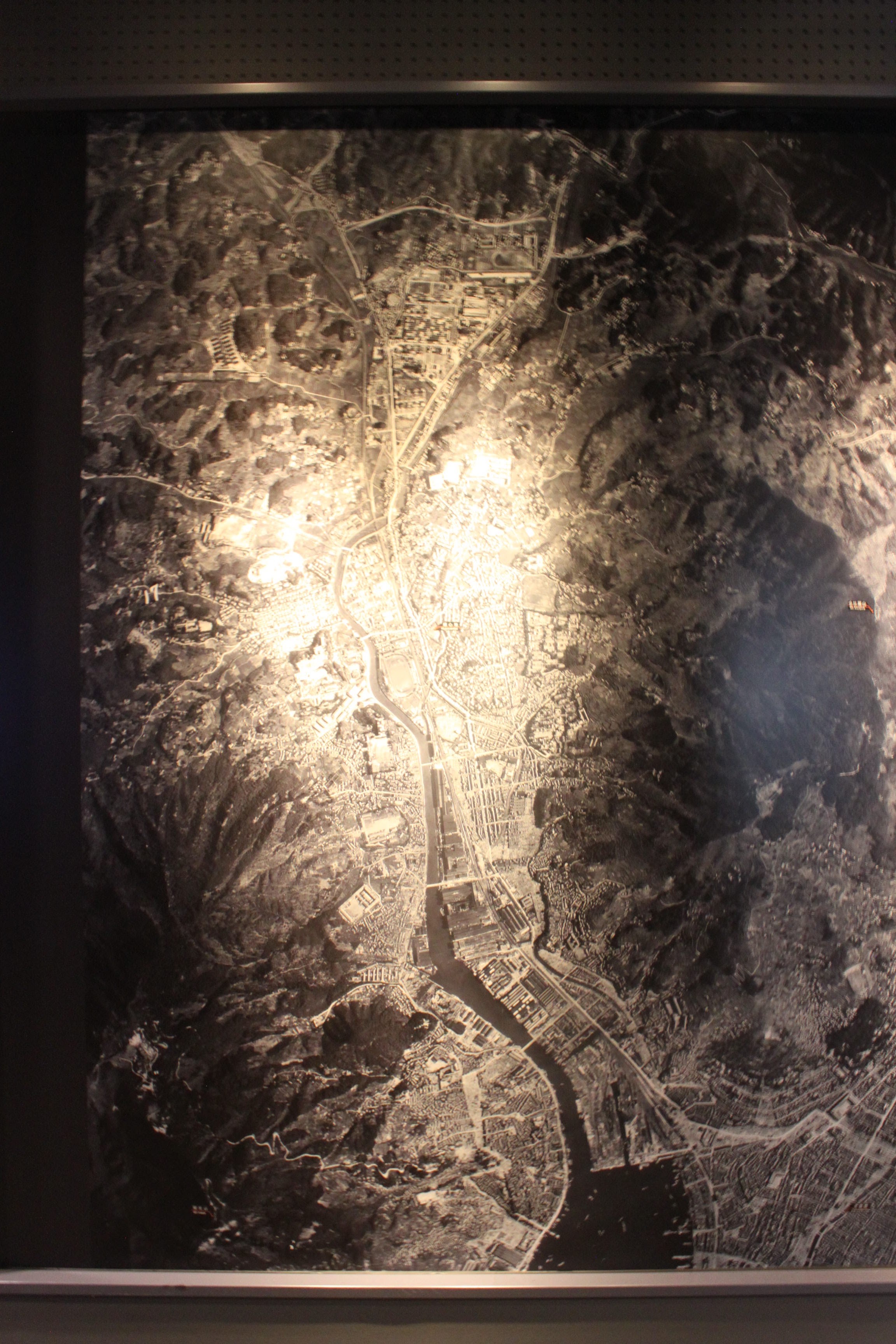


In the Urakami district of Nagasaki, around the Cathedral, Christian missionary work had been fermenting since the arrival of the Basque Francis Xavier. He was a co-founder with Ignatius of Loyola of The Society of Jesus, The Jesuits, in 1540 where they made private vows of poverty, chastity and obedience to the Pope, and also vowed to go to the Holy Land to convert infidels. Xavier found his infidels further afield than most, leading an extensive mission across Asia, mainly within the Portuguese Empire, travelling to and evangelising in Japan, Borneo and China before he died aged 46. The Christian mission was established at Urakami from the latter part of the 16th Century, but when Christianity was outlawed in 1587 the converts went underground, until the ban was finally lifted in 1873. The faithful then started to build the grandest church in East Asia, completed it in 1914, bar the twin 26m high church spires which were completed in 1925. Just 20 years later the atomic bomb blew down the spires and reduced the church to a hollow shell.
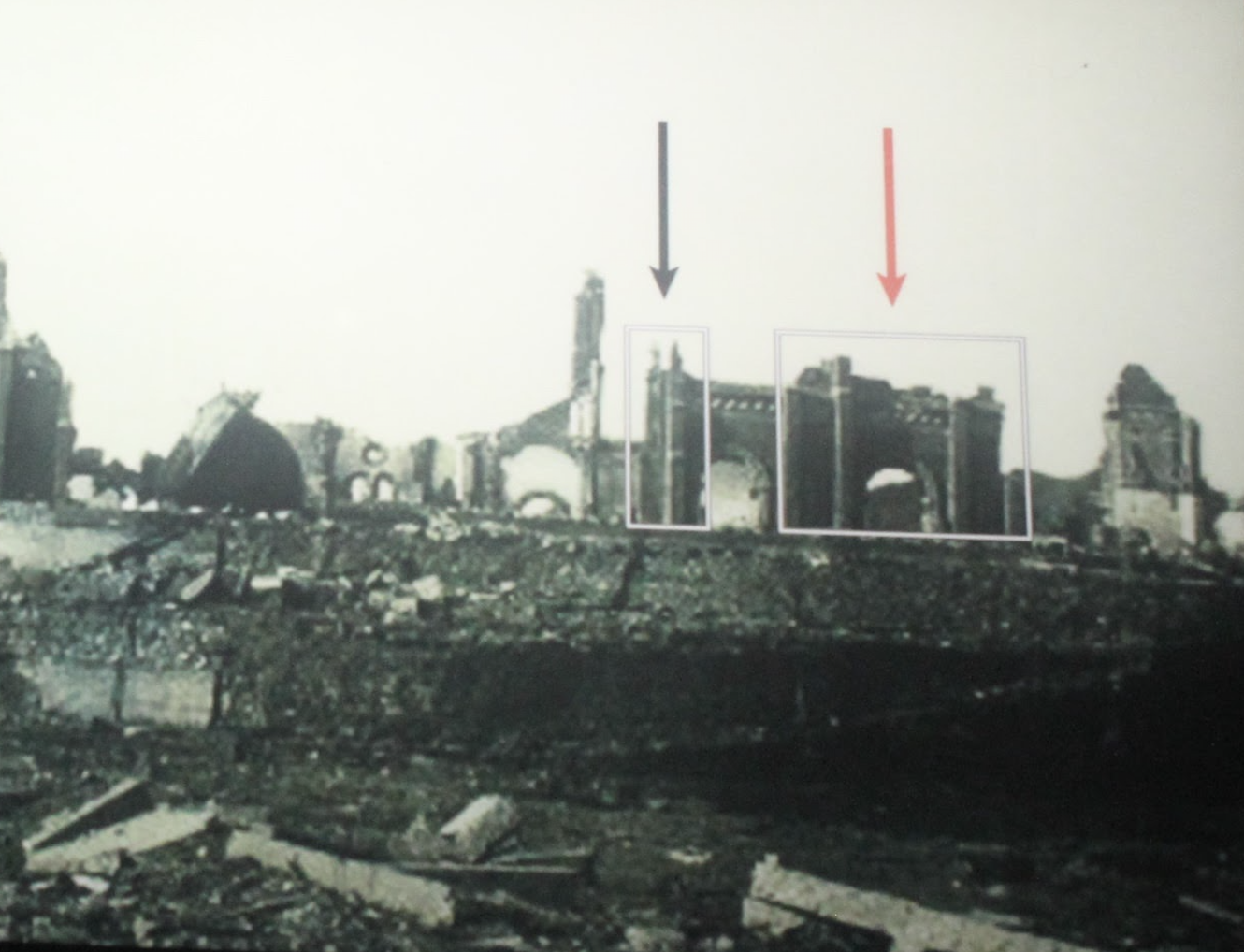
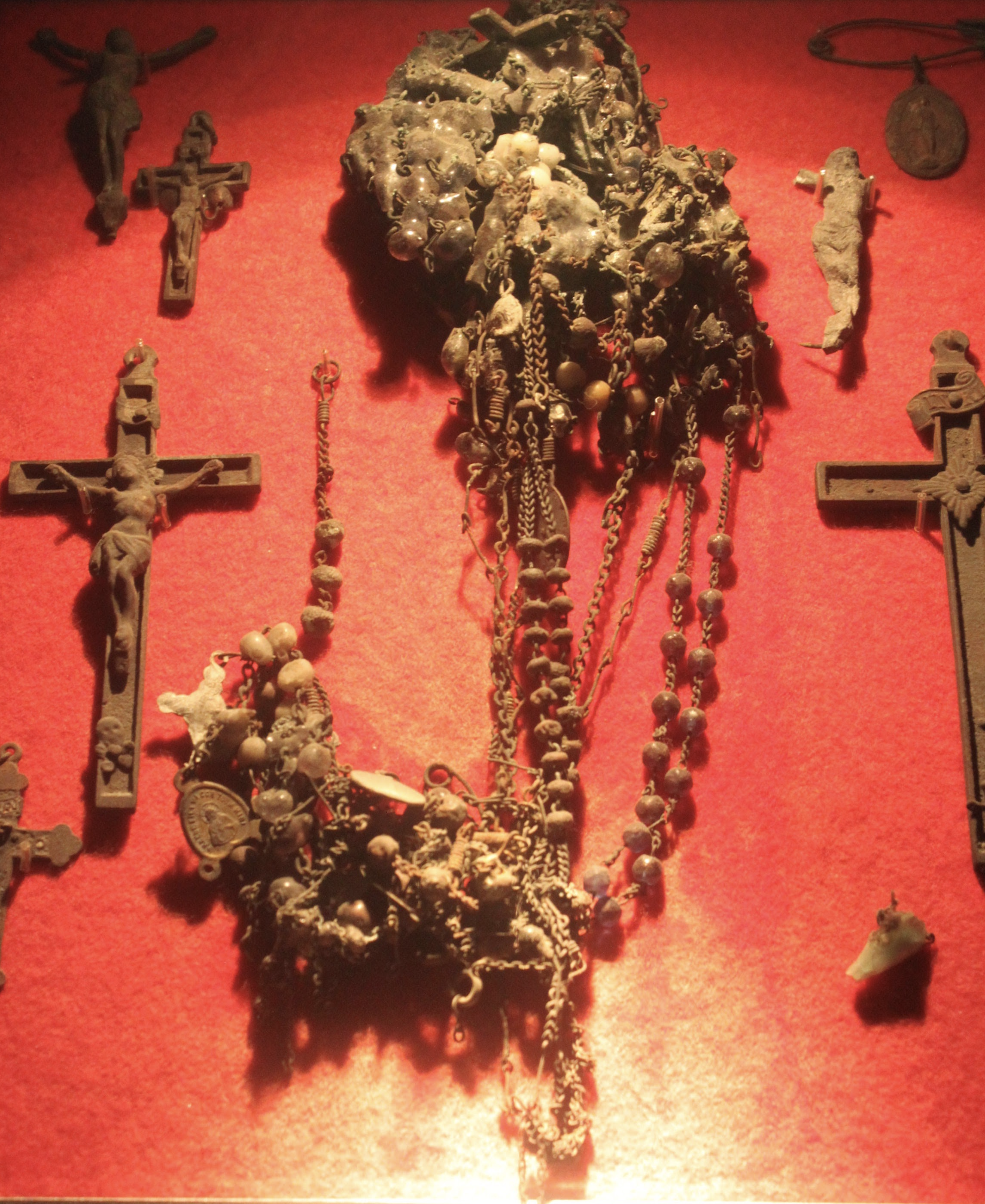
One of the largest Catholic churches in East Asia at the time, Urakami Cathedral was located only some 500m northeast of the epicentre and suffered almost complete destruction by the atomic bomb. As at the Peace Park, a section of the Cathedral’s southern walls that withstood the blast has been rebuilt within the museum, the section in the museum indicated by the red arrow, that at the Peace Park by the black arrow. The statues were blackened by the heat rays and fire, and the stone pillars were pushed out of alignment. At the time of the explosion, two priests at the Cathedral were busy hearing confession and several parishioners were waiting their turn to be heard. All died under the rubble as the building collapsed. A couple of rosaries were later recovered from the amongst the debris.

A melted rosary was also recovered from a house some 500m from the epicentre, its glass beads melting like toffee in the ferocious heat. It belonged to a woman, who had been visiting a relative’s house next to the church at the time of the explosion. It was found in the rubble by the woman’s daughter searching through the ashes of the house the day after the explosion. She treasured the rosary for many years, as a memento of her mother, before donating it to the museum on the 40th anniversary of the bombing.
Testimony of a Survivor: I don’t know what happened, only that there was a bright flash of light. Then everything was destroyed.
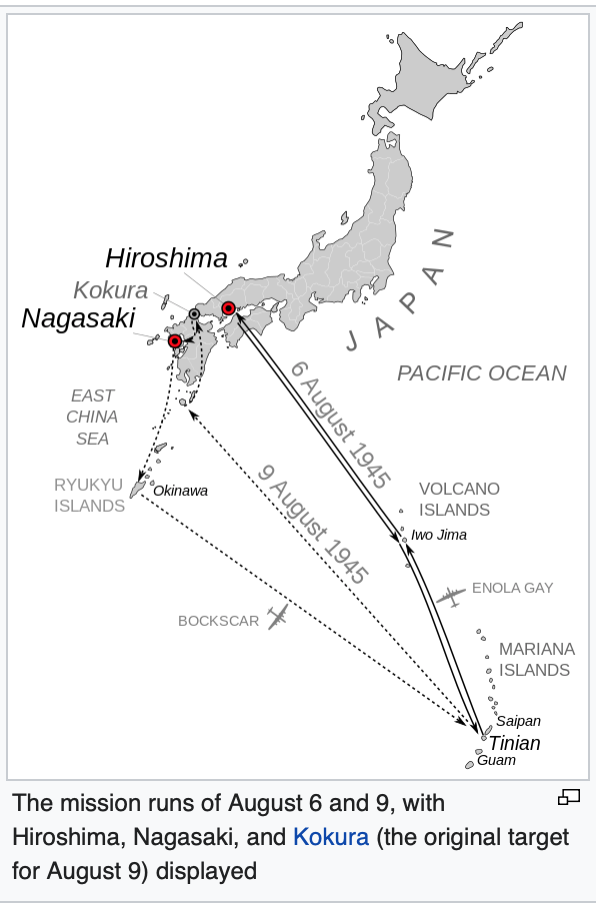
Both atomic bombs, the one for Hiroshima and the one destined for Nagasaki, were loaded onto their respective B-29 Superfortress bombers on Tinian Island, one of the islands of The Commonwealth of the Northern Mariana Islands. The Bockscar was loaded on 6th August, the day that the Enola Gray dropped the Little Boy bomb – a gun-type fission weapon that used Uranium-235 – on Hiroshima. On 8th August 1945, Field Order No 17 was issued by the 20th US Air Force Headquarters on Guam calling for its use the following day on either Kokura, the primary target, or Nagasaki, the secondary target. Originally destined for Kokura, now in the southern outskirts of Fukouka, the smoke cover prevented a visual sighting of the target, so Major Charles Sweeney abandoned the primary target of his bombing raid and flew south west to his secondary target of Nagasaki and dropped his bomb, a Plutonium implosion-type nuclear weapon.

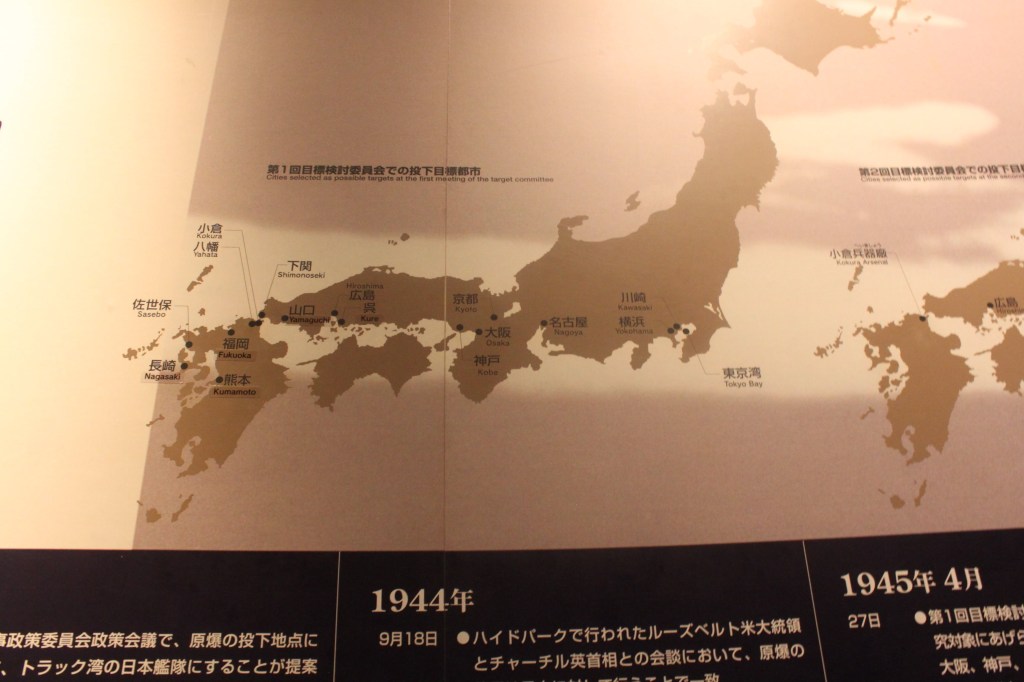
At that time, 9th August 1945, Nagasaki City had a population of approx. 240,000. Estimates of casualties up to the end of December 1945, 73,884 had died and 74,909 were injured.
(Source: 1950 study by the Committee for the Preservation of Atomic Bomb Artifacts).
These casualties were inflicted by Fat Man, nicknamed as such because of its shape, a replica of which stands in the museum. It was 3.25m long, 1.52m in diameter and weighed 4.5T. Explosives imploded the core of plutonium, which set off a chain reaction equivalent to 21kT of TNT.

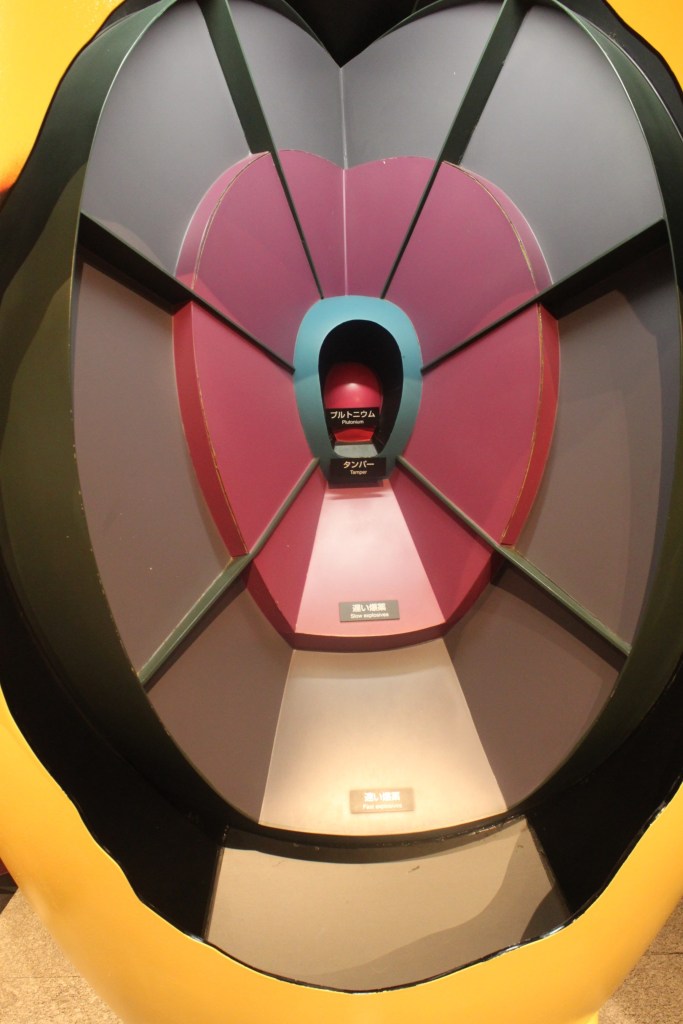
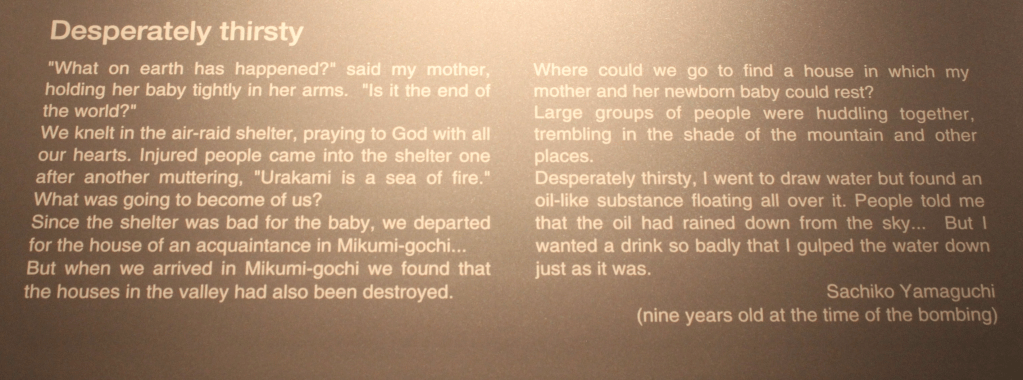
The explosion actually occurred up in the sky 500m above the epicentre, creating a force equivalent, it is said, to 5,200 trucks each carrying 4 tons of dynamite, all of which were huddled together and detonated simultaneously, all the while producing radiation, which did further harm.

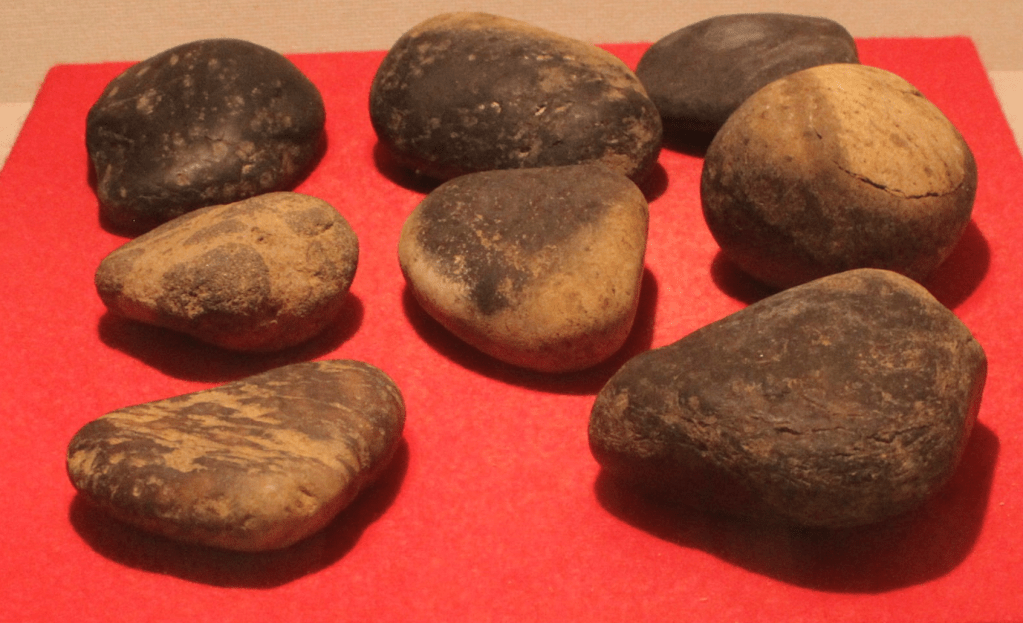
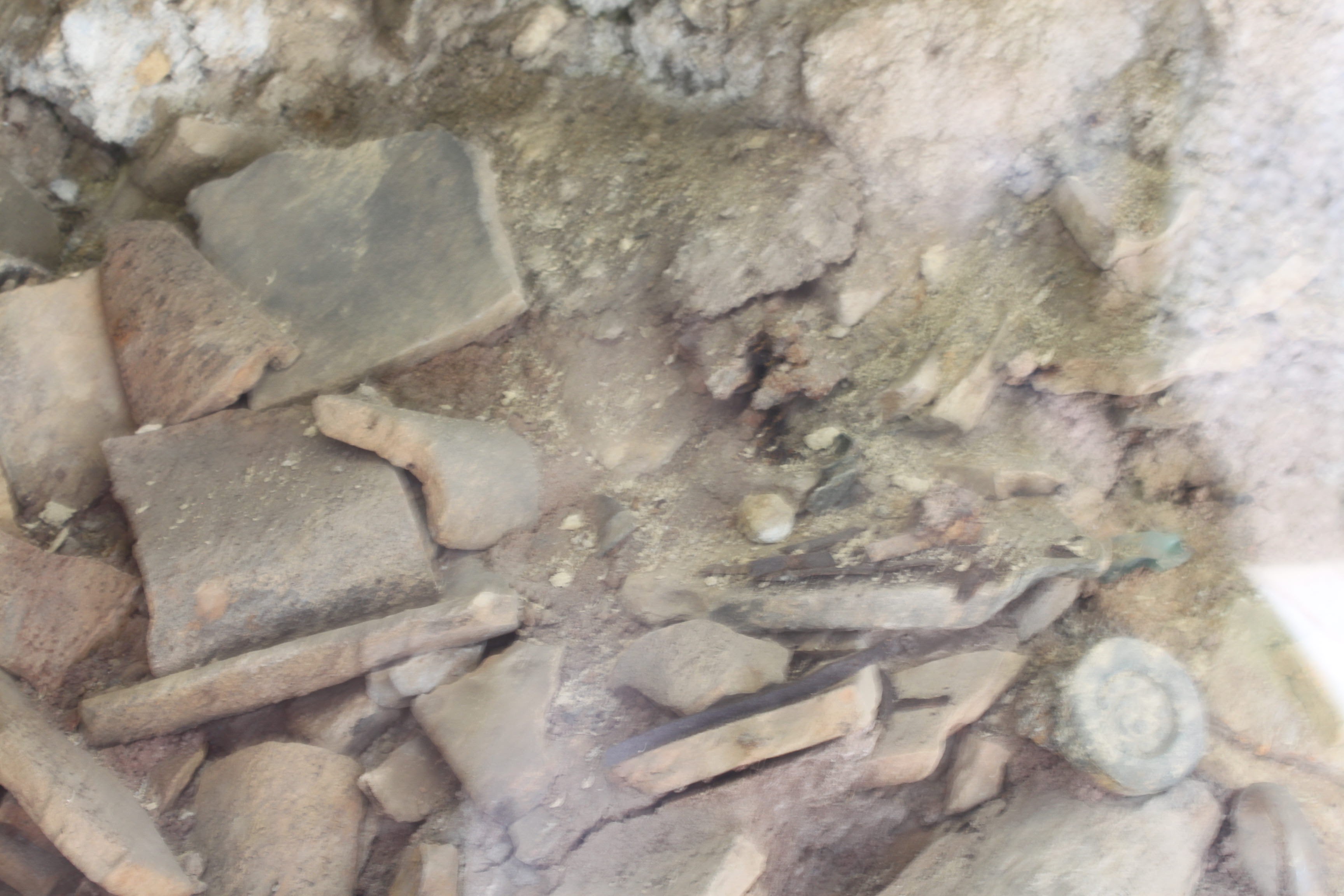
In the area near the epicentre, everything combustible burst into flames as a result of the tremendous flash of heat. Glass melted, ceramic roof tiles bubbled and rocks turned black, leaving permanent evidence of the ferocity of the flash.
Although the temperature decreased with distance, clothing, telephone poles and trees as far as 2 km from the epicentre were burned or scorched.
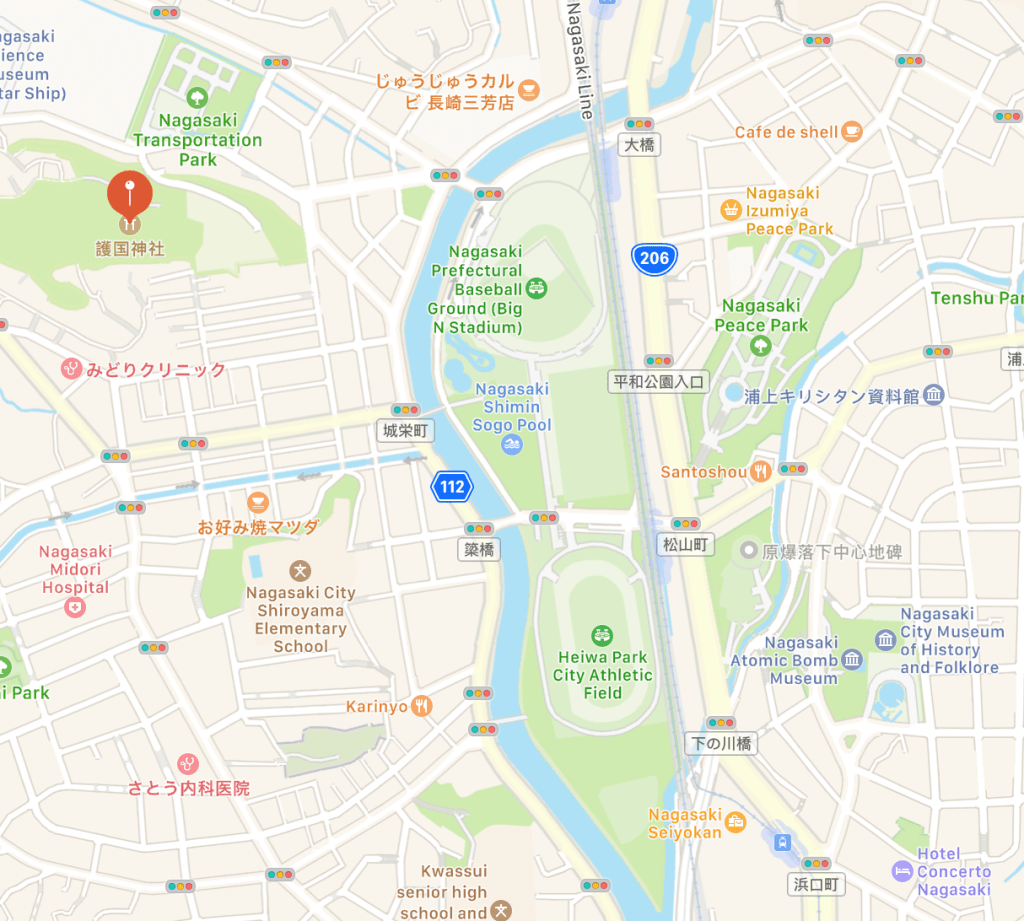
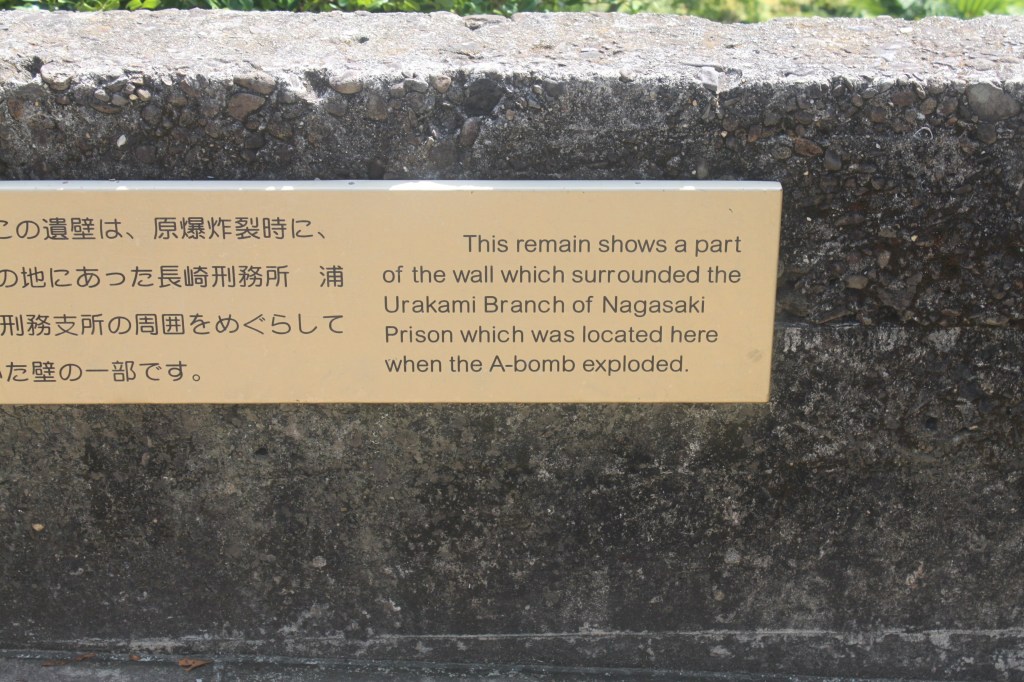
The explosion scorched stones such as these gathered from a garden at Gokoku, on the other side of the river from prison, now the location of the Nagasaki Peace Park. Surfaces exposed directly to the heat rays burned and changed colour, but unexposed areas retained their original colour. The burning flash led to silhouettes being left on surfaces throughout Nagasaki.
The instantaneous flash of heat at 11:02, effectively branded the city, capturing a moment in time in a way unlike any other.

A lookout had just come down from the roof of the Nagasaki Fortress Headquarters, some 4.4km from the epicentre, as the bomb exploded. The tarry coating of the wooden walls of the HQ exposed to the flash, burned and evaporated. Those parts of the wooden wall “protected” by the ladder and the lookout kept their tar coating creating this silhouette of the lookout and his ladder on a wall.

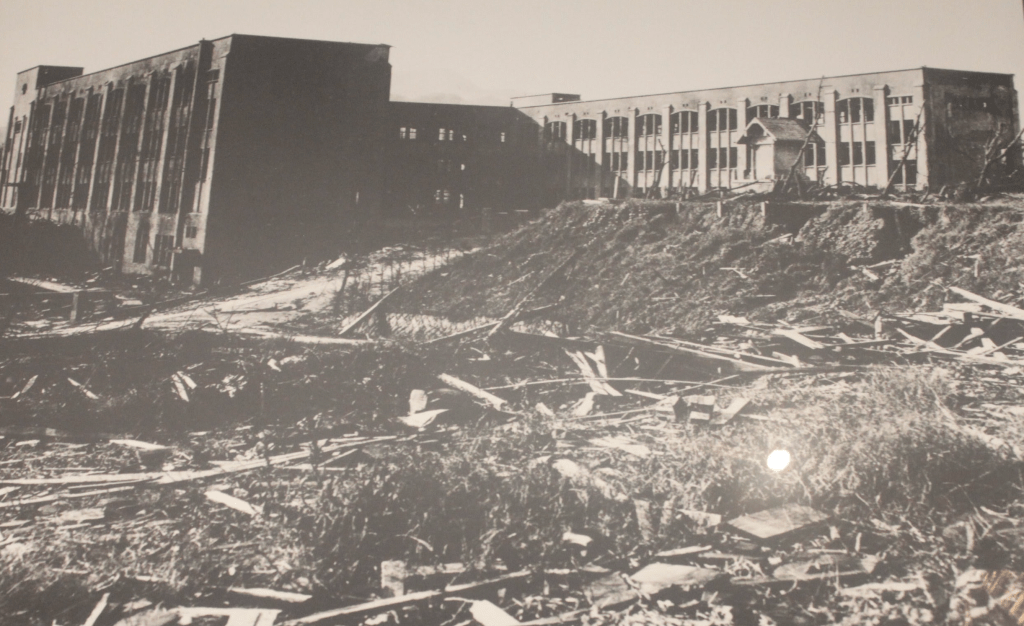


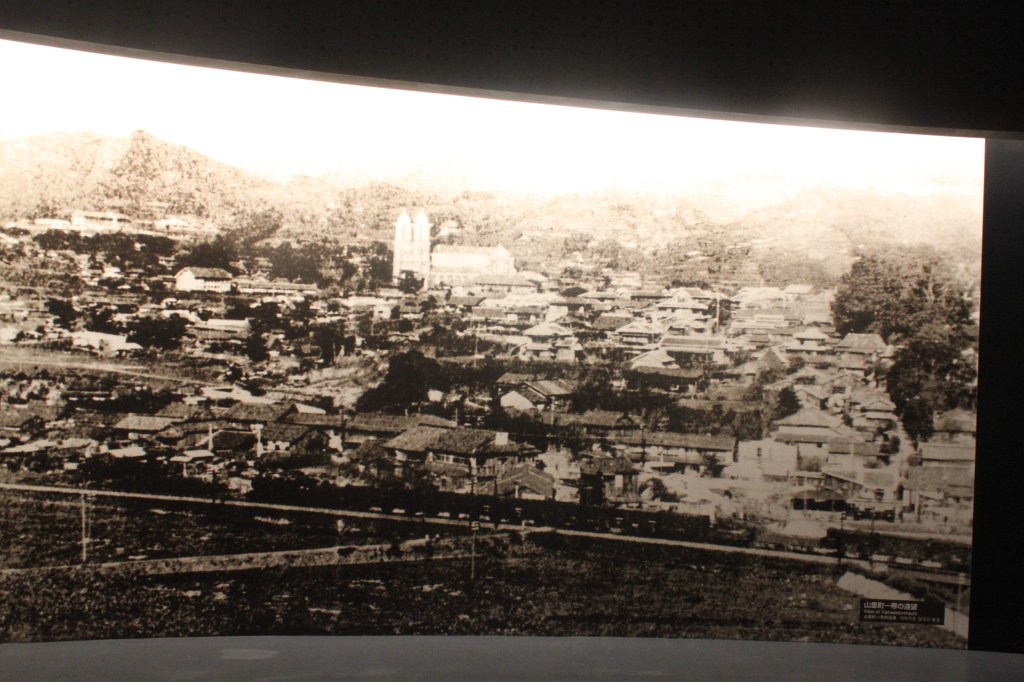
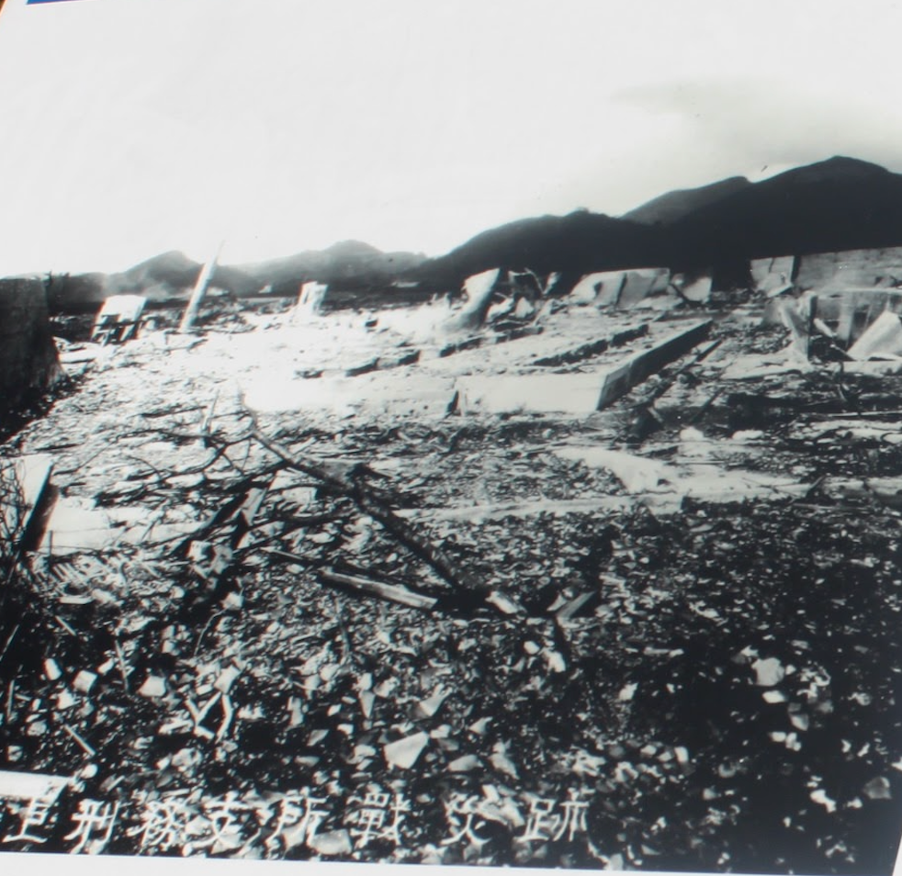
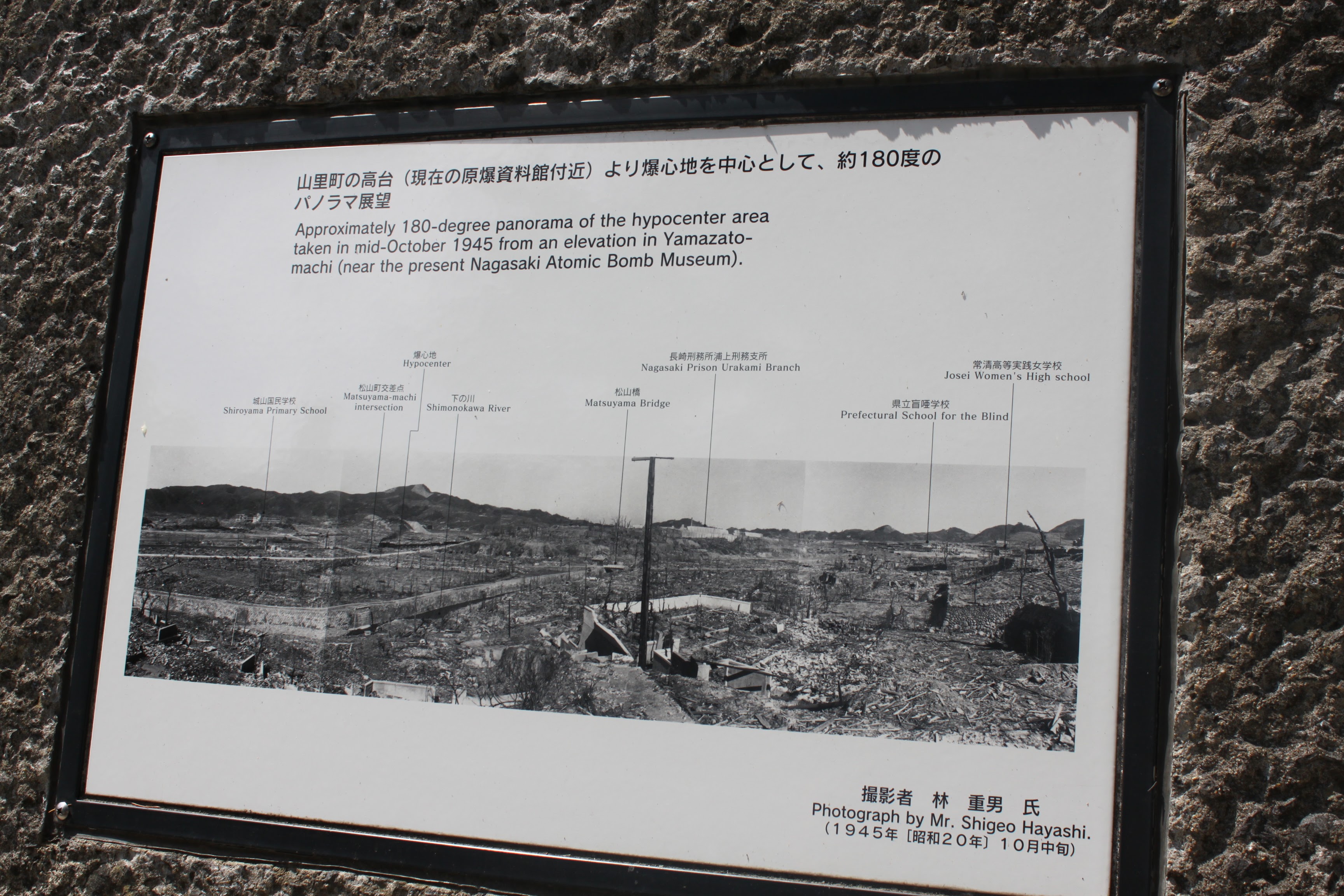
This view of Yamazato-machi facing Shiroyama-machi was taken from the opposite side of the hill from where Nagasaki Atomic Bomb Museum now stands.
The damage caused by the initial flash of heat and blast was aggravated by subsequent fires. These levelled neighbourhoods where the blast had inflicted only partial damage. In total, 12,900 houses burned to ashes and another 5,509 were partially burned. The fire also increased the number of victims. Many people trapped under fallen debris, who had suffered only external injuries, died as the fire raged through the city.

The flash of heat generated by the atomic bomb caused isolated fires that grew into a conflagration that raged through the traditional wooden buildings of Nagasaki. Centred on Urakami district of the Cathedral and extending 3.5km south of the epicentre, the fires fanned by a south-westerly wind reduced about one-third of the city of Nagasaki to ashes (the area marked in beige on the map).
Around 6pm the wind changed direction, and the fires started to lose fuel – the Conflagration dying out around midnight.
The heat generated over a short span of a few seconds showered down on unshielded people and caused terrible burns for those further away. In the area near the epicentre, it is believed that the heat instantly carbonized human bodies and vaporized their internal fluids. Further out in particularly severe cases, the skin came off in sheets, revealing the subcutaneous tissues and bones. The burns were fatal within a distance of 1.2km.
The Atomic Wind

The velocity of the blast wind generated by the atomic bomb was 170m/s at a point 1km from the epicentre. Compare that with the fiercest of typhoons which only reach speeds ca 80m/s. It is estimated that the ground beneath the explosion was subjected instantaneously to a pressure of between 6.7 and 10 metric tons per square metre. The blast pulverised all buildings near the epicentre, travelling 3.7km after 10 seconds and 11km after 30 seconds. The wind lost strength at this point but it was reported that a window was broken on Iojima island way to the south.
Mitsubishi Arms Factory Ohashi Plant about 1.3 km north of the Epicentre
The Mitsubishi Factory was the target of the bomb. It was devastated.

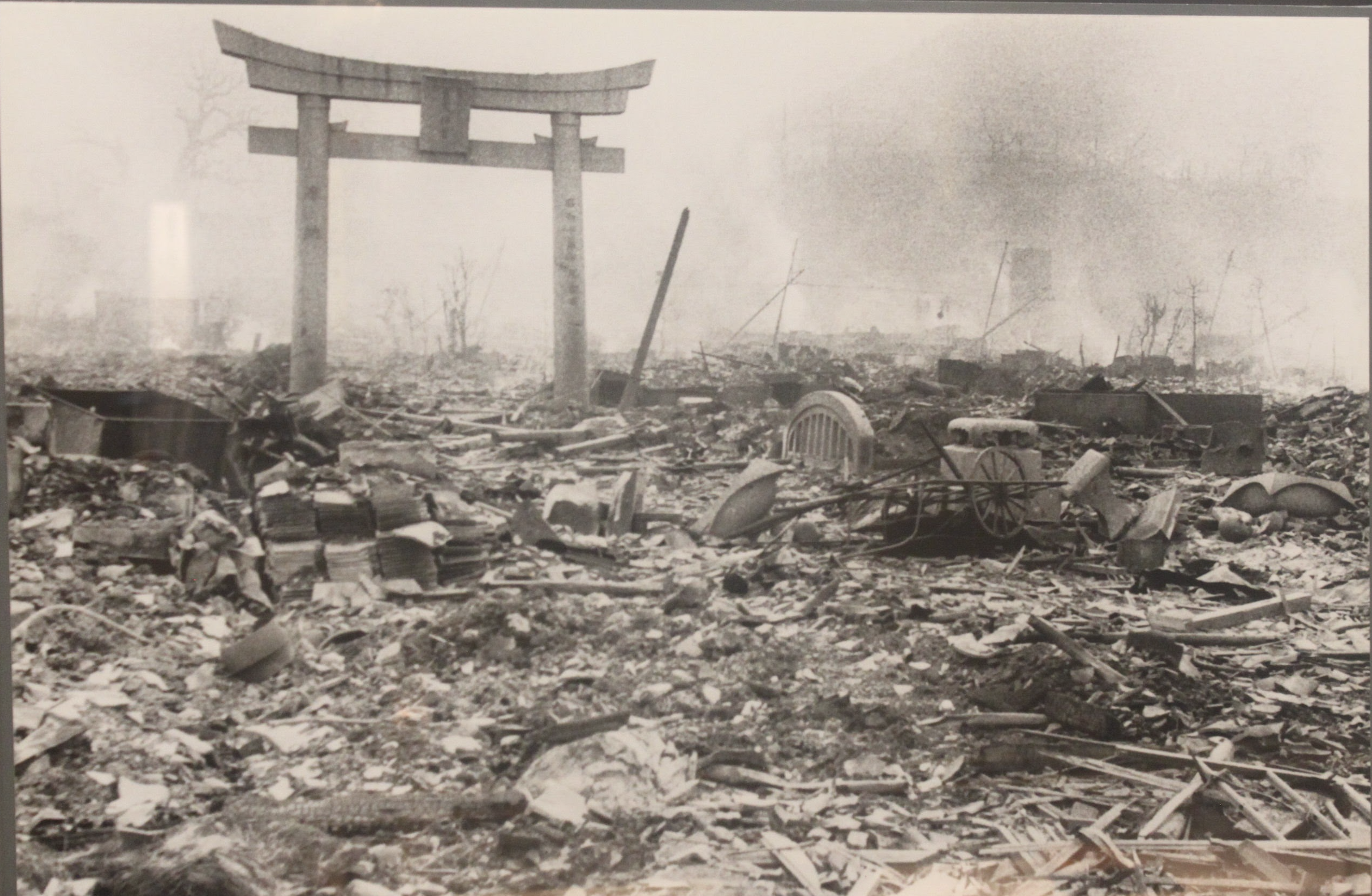

The Iwakawa-machi district of Nagasaki is near central railway station. Whist all around it was devastated, the first gate of Sanno Shinto Shrine, about 800m south of the epicentre remained standing. The nuclear wind hit it directly from the side, which meant that it withstood the blast. All around it collapsed and burned.
The One Day After The Bomb


The Effects of Exposure to Radiation
Radiation exerts physical and genetic effects on humans. Physical effects in the person exposed, while genetic effects appear in his or her children and grandchildren, that is, in second and third generation survivors.
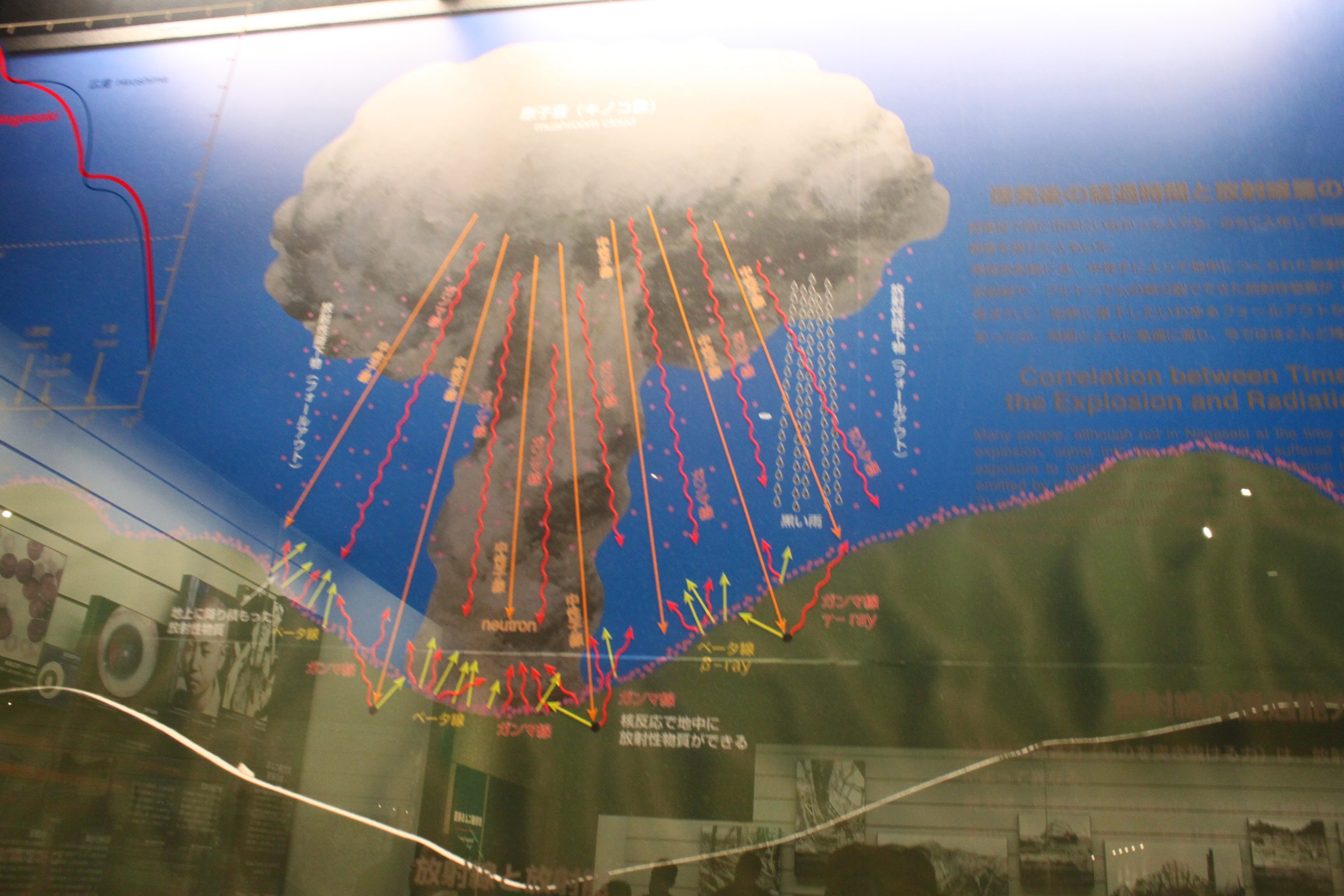
The radiation released by the explosion of the atomic bomb penetrated human bodies and destroyed cells in various tissues. The extent of injuries depends on the radiation dose, but the vast majority of all people within a distance of one kilometre from the epicentre died. This included people without external injuries. The effects of radiation on survivors of the initial blast continued for many years – indeed until today. The radiation inflicted deep internal injuries of various kinds and varying manifestations over time.
Disorders of the Acute Phase:
Radiation-induced disorders in the acute phase appeared immediately after the bombing. Particularly severe among people exposed at short distances from the epicentre, the disorders include nausea, diarrhoea, fever, subcutaneous haemorrhage and stomatitis. The victims’ condition steadily deteriorated and deaths became frequent after about one week. (LH Graph)
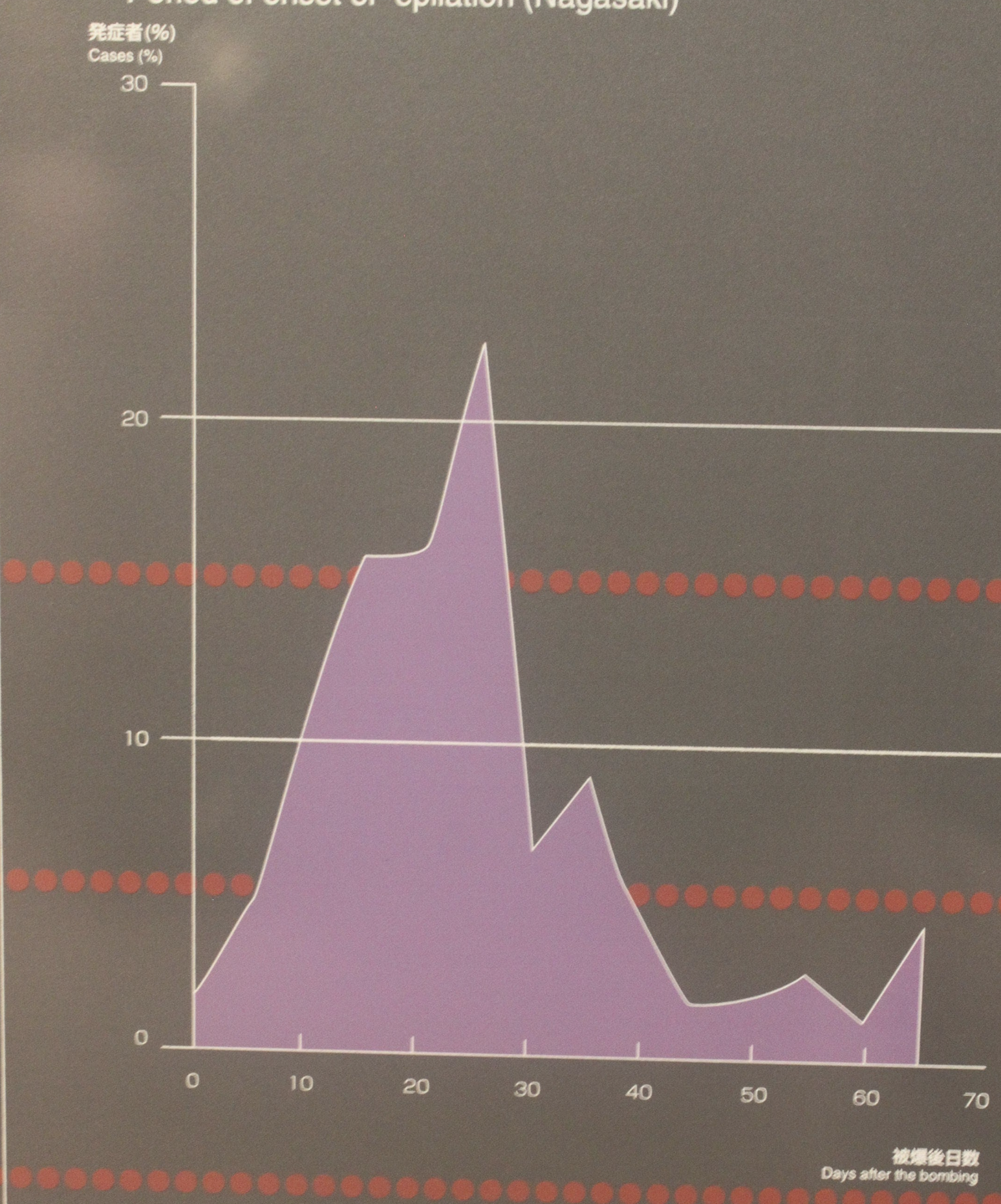
Epilation (hair loss) appeared from about one week after exposure and reached a peak at three weeks. This symptom was observed frequently in directly exposed persons, and it continued for one to two weeks. The survivors, who had been exposed to invisible radiation, suffered great anxiety to see their hair coming out in handfuls, but it began to grow back from eight to ten weeks after the bombing. (RH Graph)
Atomic Bomb Cataract
Atomic bomb cataracts appeared about 10 months after exposure to the bombing in the early cases. The incidence was higher, the shorter the distance from the epicentre, and severe cases tended to appear earlier than mild cases. In some people the cataracts did not appear for several years. Cataracts (the lens of the eye becoming crystalline) are usually associated with age, but the atomic bomb cataracts appeared in people of various ages.
Microcephaly
Radiation also affected children in the womb. Miscarriages and stillbirths were frequent, and some newborns suffered from a condition called “microcephaly” (small head syndrome). Microcephaly occurred relatively frequently among children exposed in the uterus at a gestational age of less than 16 weeks. The brain is small due to growth disorders, and structural deformities are also observed. Many cases of microcephaly were accompanied by other symptoms such as congenital cataracts.
Leukaemia
The incidence of leukaemia, a disease known as “cancer of the blood” peaked in 1951, six years after the atomic bombing. The blood and blood-forming tissues are vulnerable to radiation, and the incidence of leukaemia increases in proportion to the dose. There is also a correlation with age, people exposed at a young age suffering from the disease at a relatively early stage. Studies continue on atomic bomb-related leukaemia, but no leap in the incidence level has been observed since 1951.
Cancer
Leukaemia was not the only radiation-induced disease. The atomic bomb survivors have lived in fear of various kinds of cancer from ten years after the bombing to the present day. It is not clear why the cancer remains latent for such a long period. Further research is needed to shed light on the effects of the atomic bombings.
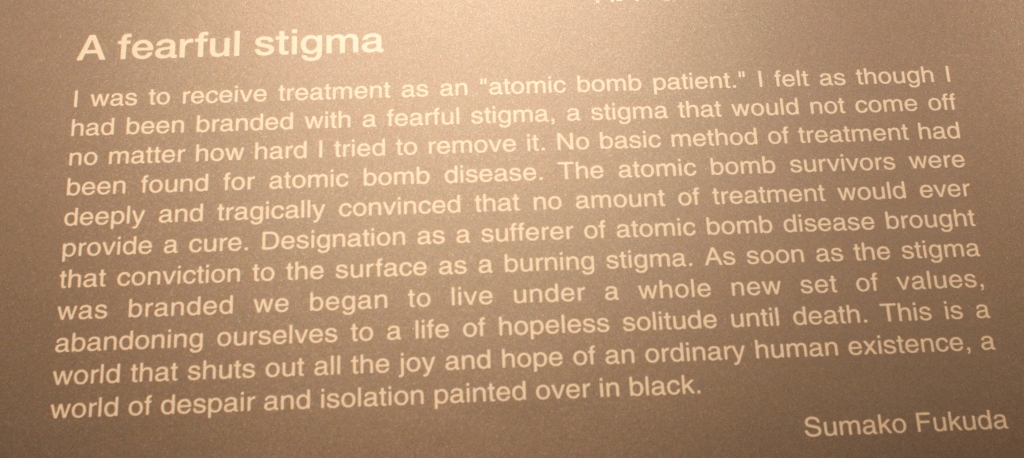
Psychological effects such as post-trauma stress disorder (PTSD) due to the brutality of the atomic bomb experience have caused lifelong suffering among survivors.
Radiation sickness was noted among people exposed beyond 2km, a fact that indicates the need to take both direct exposure and residual radiation into account.
With regard to the children of parents exposed to the atomic bomb (second-generation survivors), studies conducted from the late 1940s have revealed no evidence of increased abnormalities.
Eyewitness Accounts



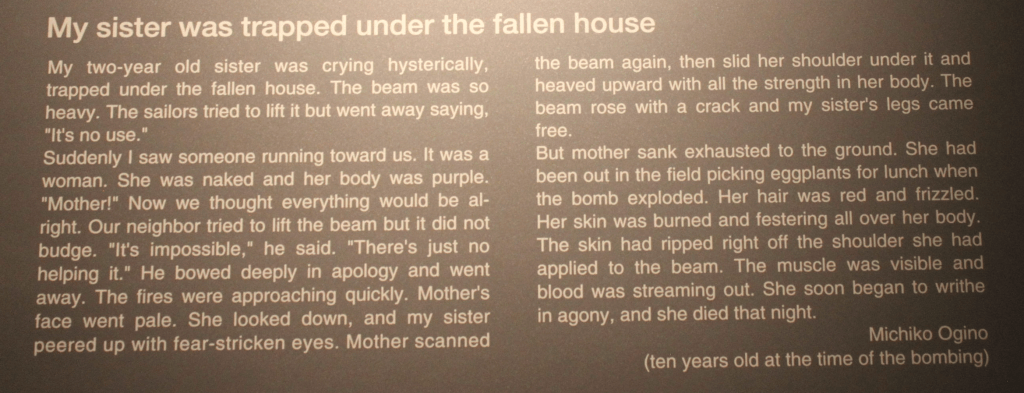
Foreign Atomic Bomb Survivors in Nagasaki
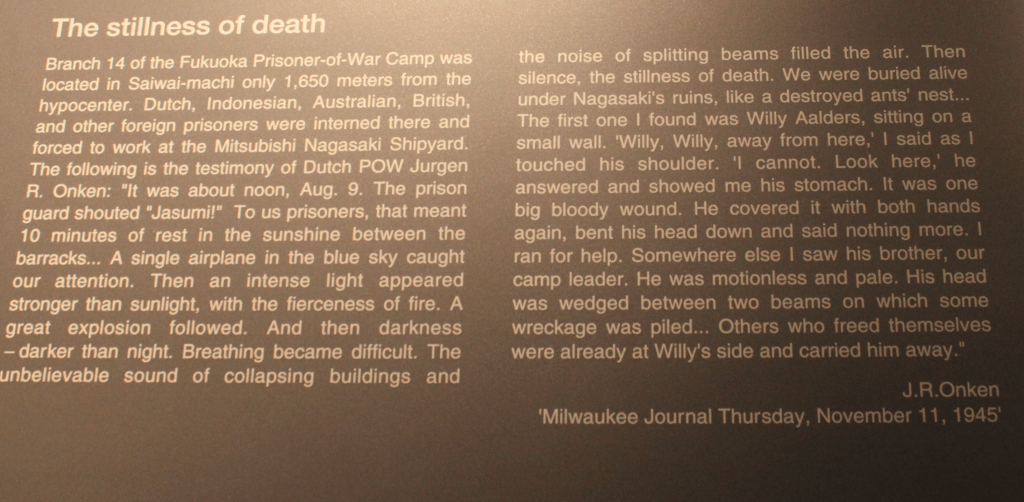
A large number of non-Japanese people, especially Koreans, who had been brought by force to work in munition factories, etc., were exposed to the Nagasaki atomic bombing. The victims also included many Chinese and Taiwanese people, Christians, Christian missionaries and foreigners interned as enemy nationals.
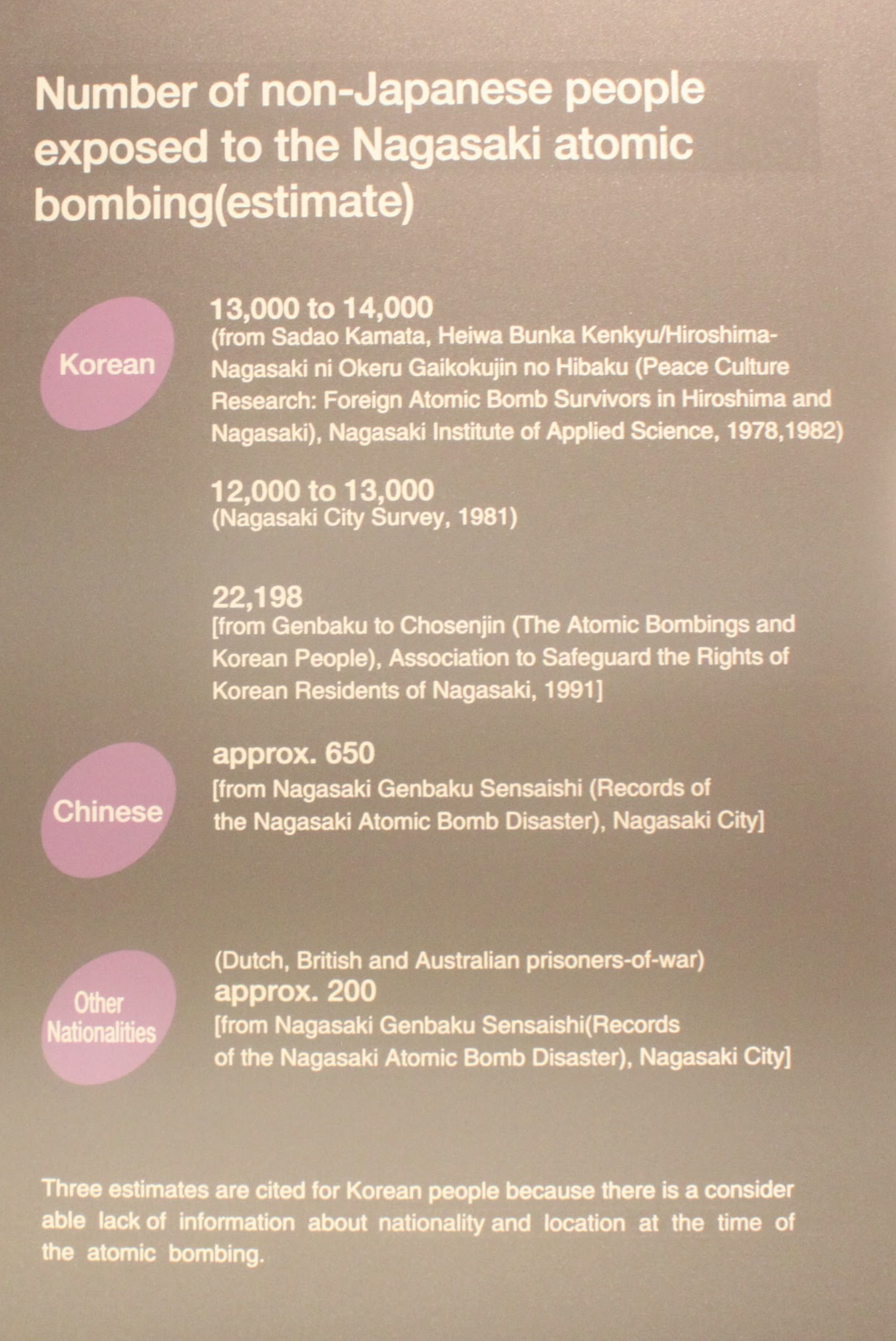
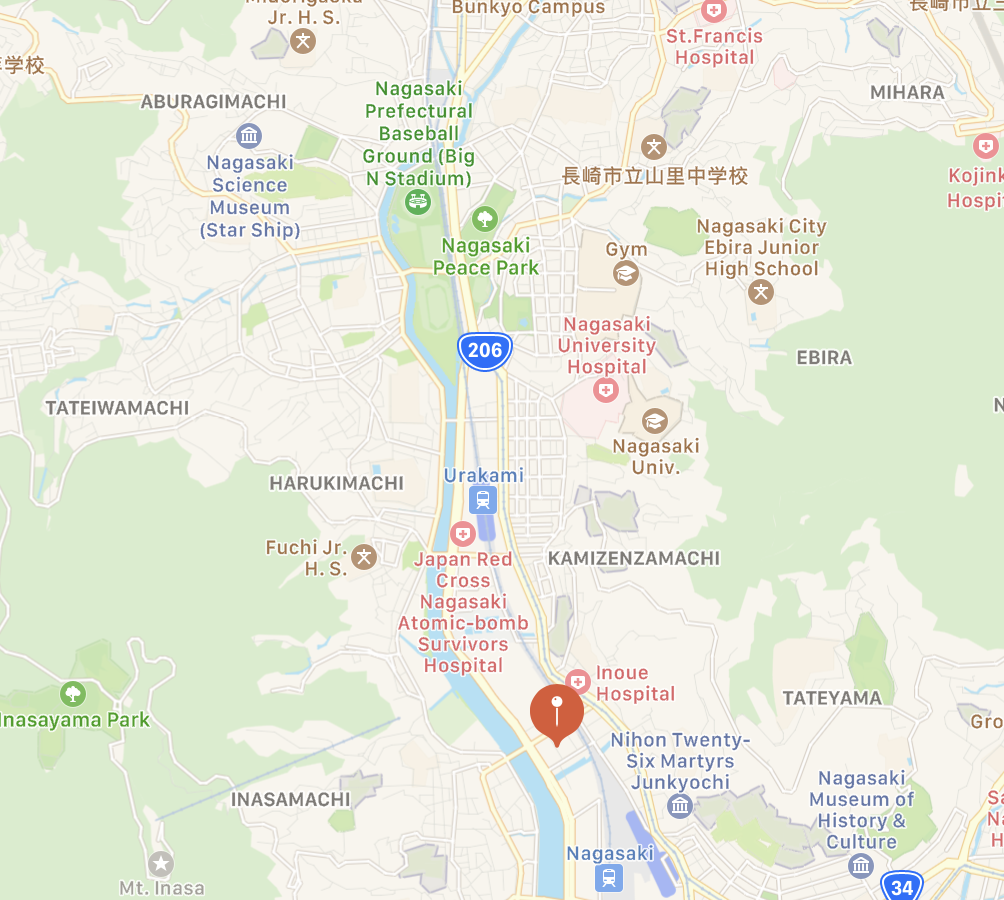
At Branch No 14 of the Fukuoka Prisoner-of-War Camp in Saiwaimachi (north of the main railway station), the British, Dutch, Australian and other Allied prisoners were exposed to the atomic bombing. Only rough estimates can be made about the number of foreign atomic bomb victims and survivors.


The War Between Japan and China, The Pacific War and World War II
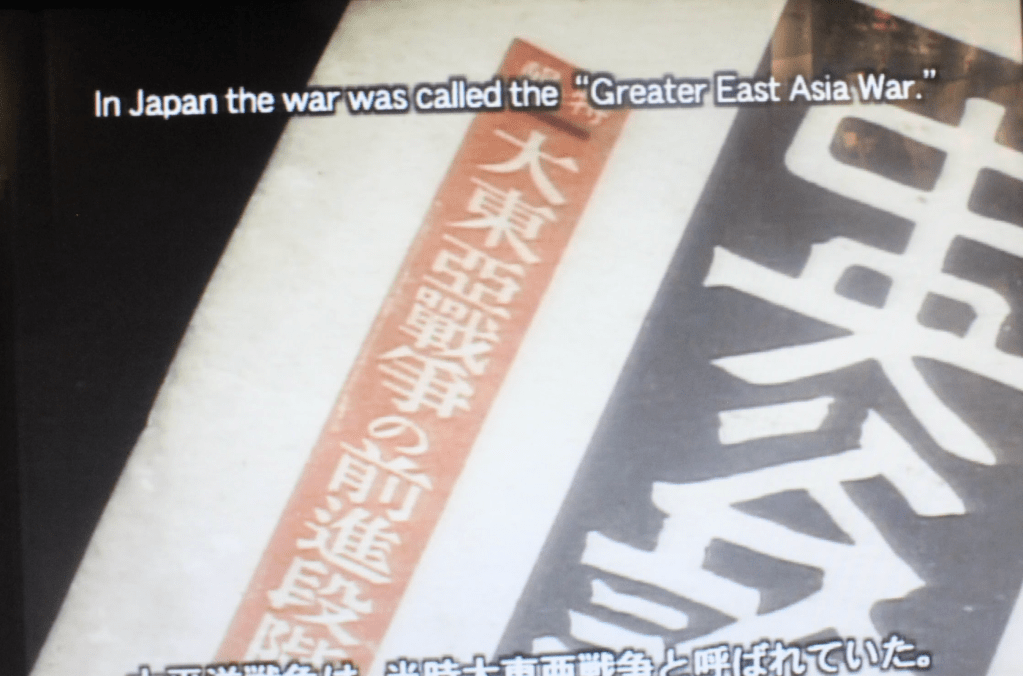
Japan was engaged in war constantly for 15 years, first from the Manchurian incident in September 1931 to the outbreak of war with China, and then Pacific War which ended in August 1945.
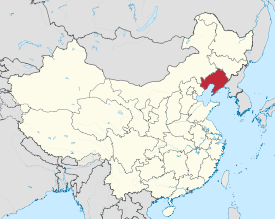
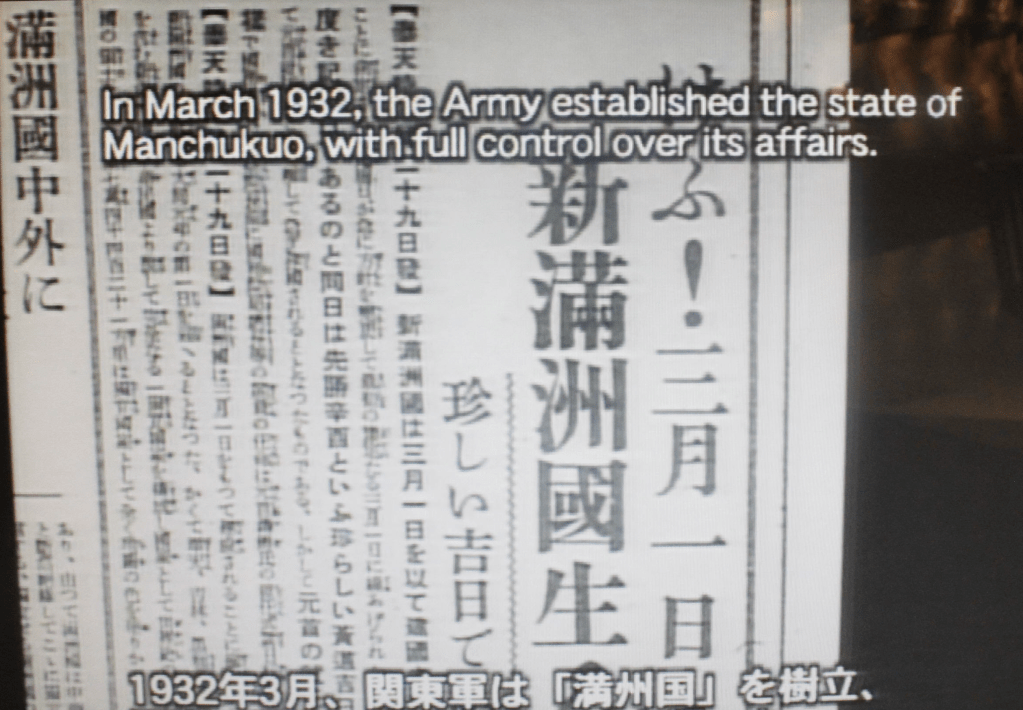
The direct action in Manchuria began with the assassination of its warlord Zhang Zuolin by Japanese extremists in June 1928, followed by occupation of the Liadong Peninsula (coloured red below) by the Japanese Kwantung Army. The Manchurian Incident in September 1931 was a false flag event in which the Japanese Kwantung Army alleged that Chinese soldiers had tried to bomb a South Manchurian Railway train.
https://www.britannica.com/place/Empire-of-Japan/The-Manchurian-Incident
It led to the formation of Manchuko by the Japanese, with the installation of their Manchu puppet the last of the Manchurian Qing Dynasty Emperors, PuYi, who had, as a child, been the Last Emperor of China.

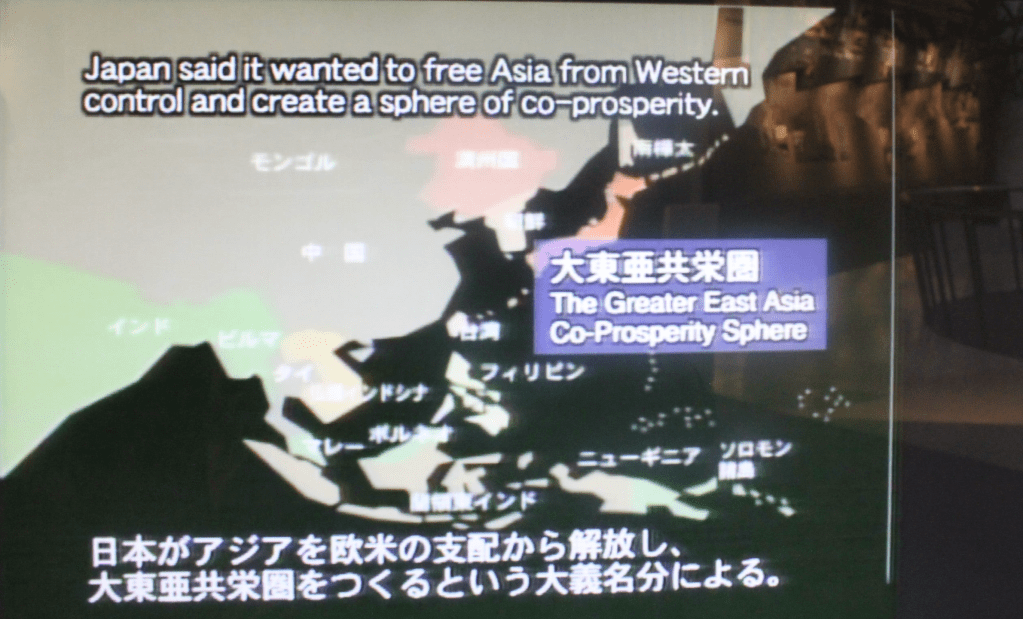
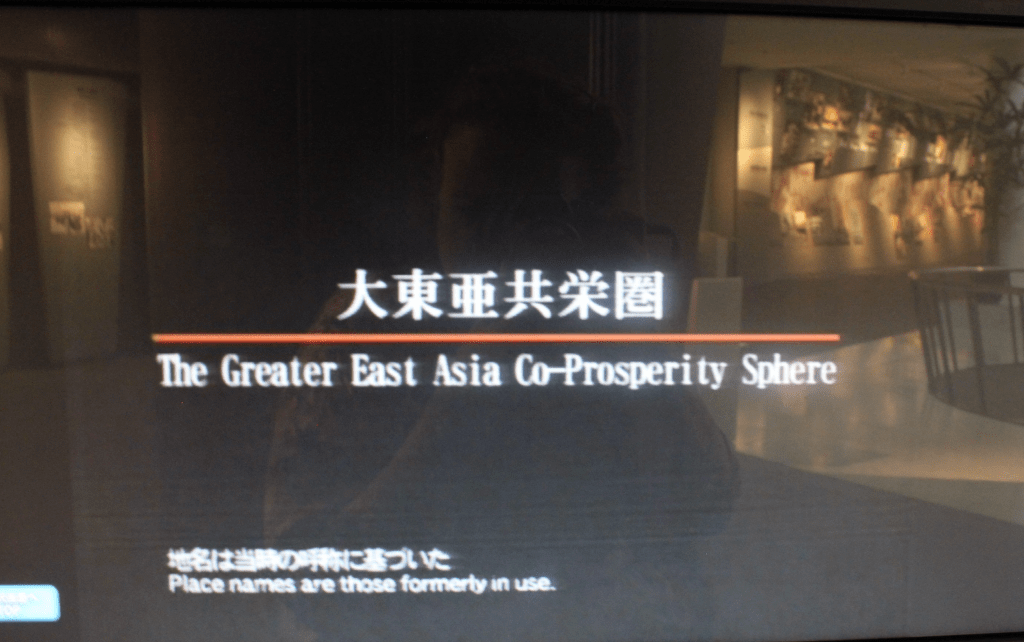
The prolongation of the war with China caused the enforcement of a controlled economy and government domination by Japan, i.e. fascist. Its policy of southern expansion by creating the Greater East Asia Co-Prosperity Sphere brought Japan into conflict with America, Britain, France and The Netherlands and led to the Pacific War. The people of other Asian nations were also dragged into conflict and victimized in various ways.





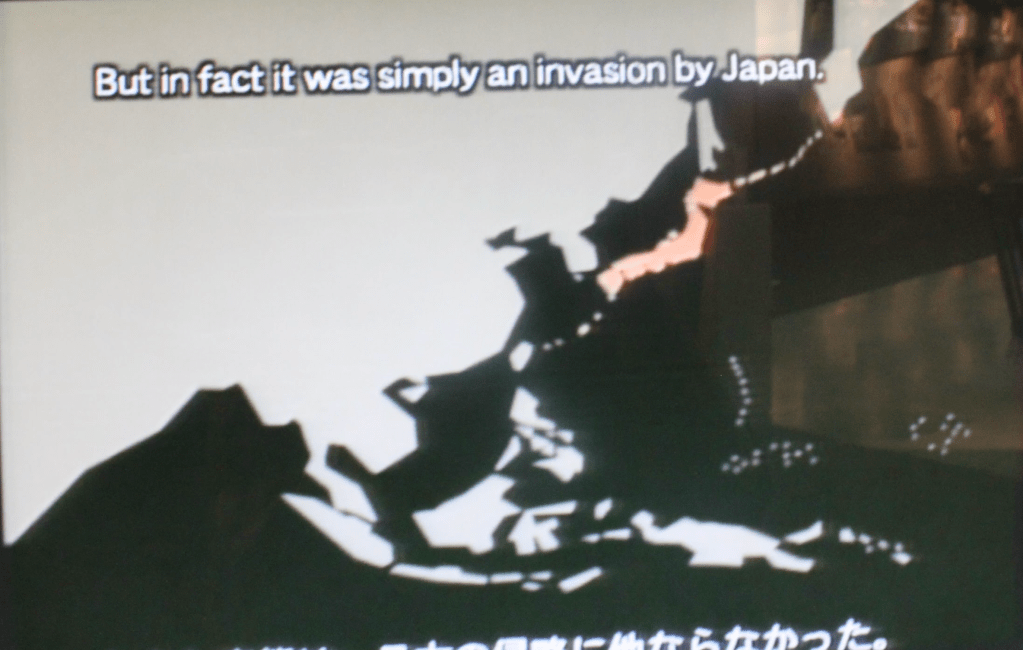
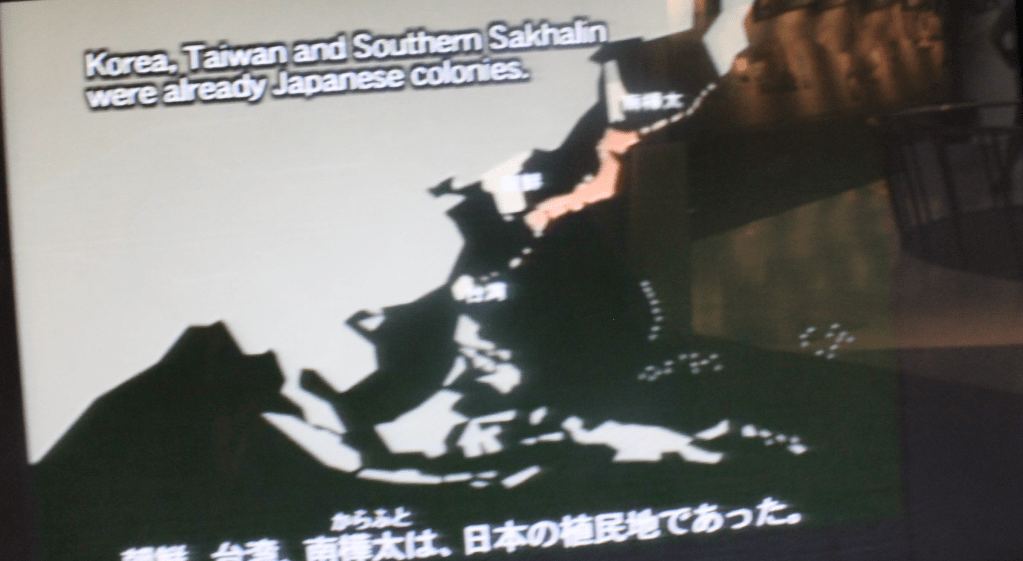


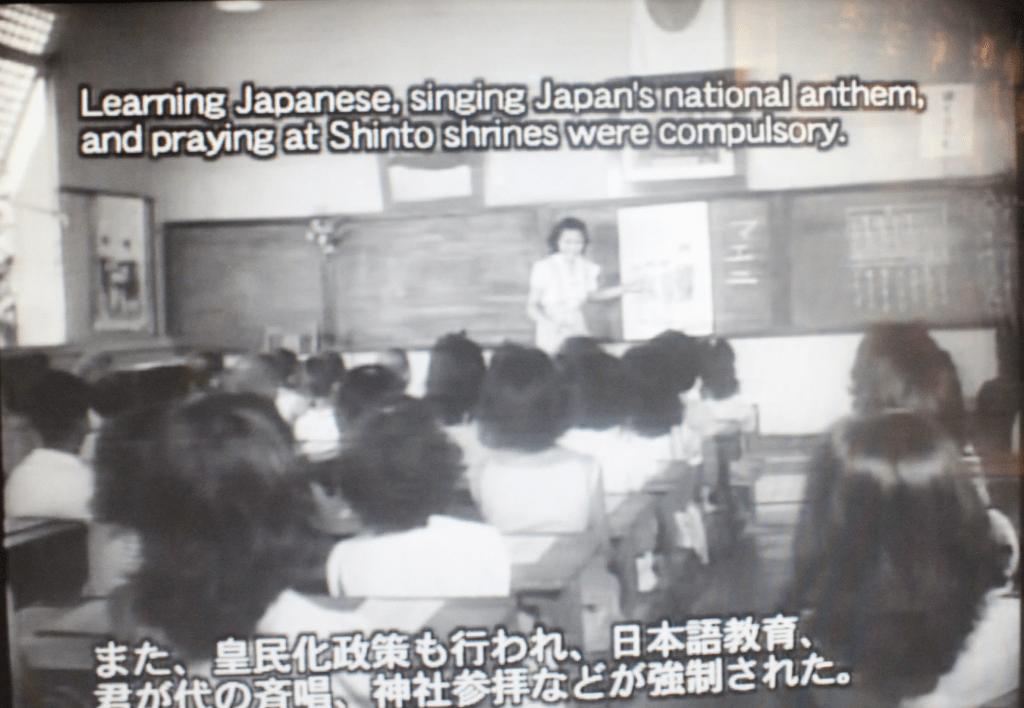


The museum is interesting to visit and very informative about the direct effects of a plutonium implosion-type nuclear weapon.
The last display wall of the museum depicted the history of nuclear weapons and their development to the present day.

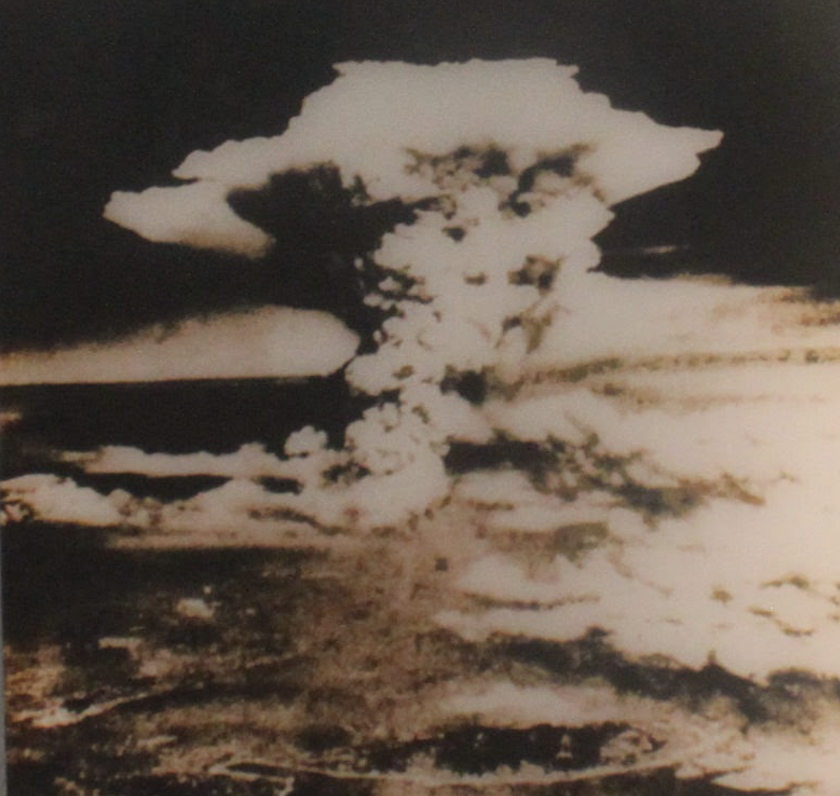

1945 July The US Conducts the world’s first nuclear test at Alamogordo, New Mexico
Aug Atomic bombs are dropped on Hiroshima and Nagasaki on the 6th and 9th
1946 Jun-July The US conducts a nuclear test at Bikini Atoll. The Atomic Energy Commission is established
The Baruch Plan and Gromyko Plan are proposed
1949 Sept The U.S.S.R. announces its success in the testing of an atomic bomb
1950 Jan U.S. President Truman orders the manufacture of hydrogen bombs
Aug A B-29 bomber loaded with nuclear weapons crashes in the US and gunpowder explodes
1951 Nov The Us Conducts a nuclear test in the Nevada desert with the participation of ground forces
1952 Oct Britain conducts its first nuclear test at Monte Bello Island
Nov The U.S. conducts the world’s first hydrogen bomb test at Eniwetok Atoll
1953 Aug The U.S.S.R. conducts its first hydrogen bomb test
1954 Mar The U.S. conducts a hydrogen bomb test (Bravo) at Bikini Atoll
(the Daigo Fukuryu-maru [No. 5 Lucky Dragon] is exposed)
1997 May The U.S. opened its subcritical nuclear test facility to the media. The photograph shows the test site in the Nevada desert. Among the nuclear powers, only the USA disclosed the number of subcritical nuclear test (27) it has conducted.


1998 May India conducted a nuclear test in the desert in the western state of Rajastan Crater formed by an Indian Nuclear Test
2003 Jan North Korea announces its withdrawal from the NPT
Feb The President of Iran announces enriched Uranium production
Apr The US Department of Defence is found to have begun research on earth-penetrating weapons
May The US Congress lifts a 10-year ban on the development of small scale nuclear weapons
Nov Enriched Uranium is detected at Natanz and other Iranian nuclear facilities
2004 Feb A “nuclear black market” involving Pakistani scientist Dr A Q Kahn is found to exist.
2005 Feb North Korea officially announces its acquisition of nuclear weapons
Sept The US decides not to alter budget funding for the development of earth-penetrating weapons in 2006.
2006 North Korea announces a successful nuclear test.

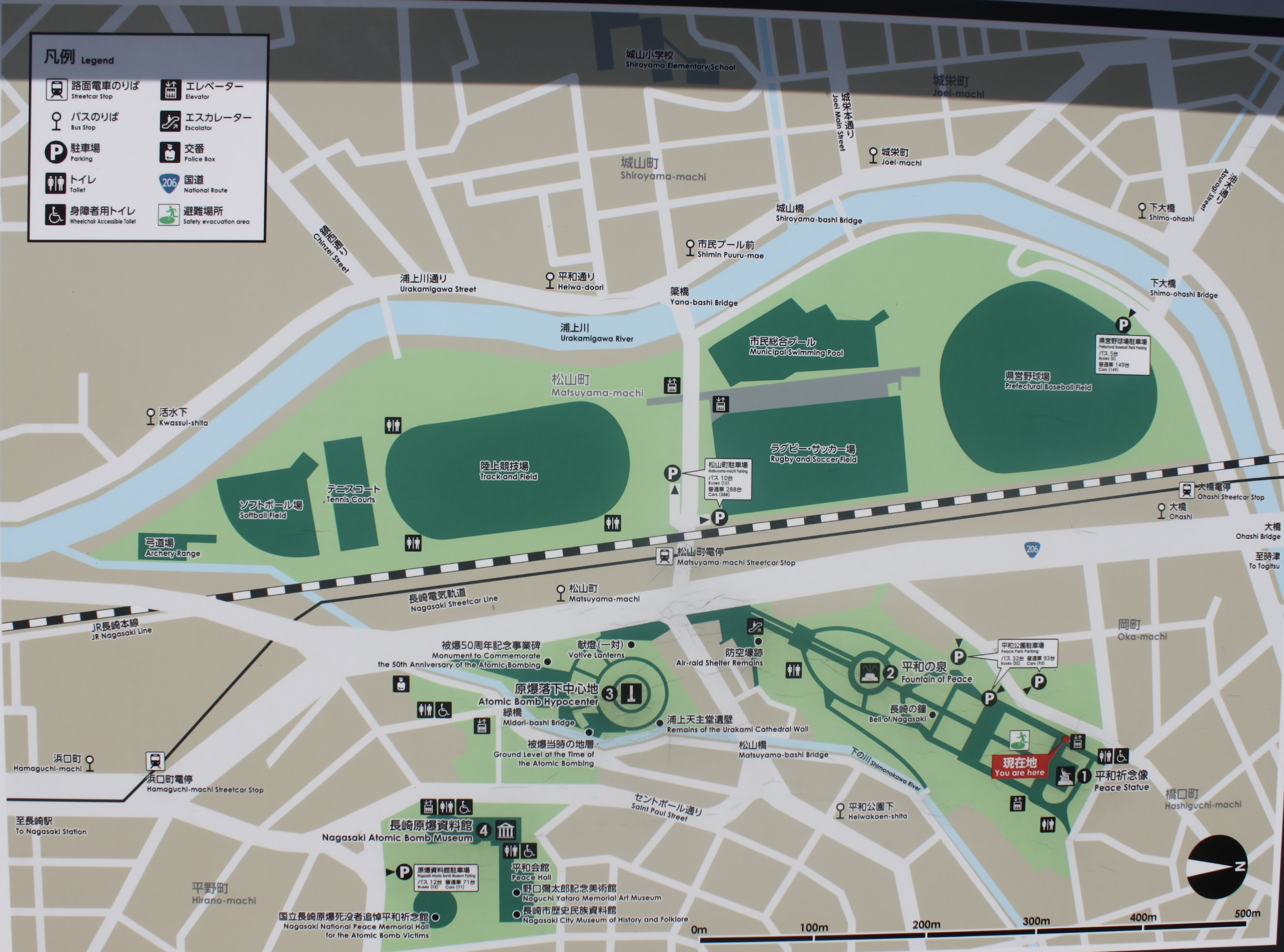
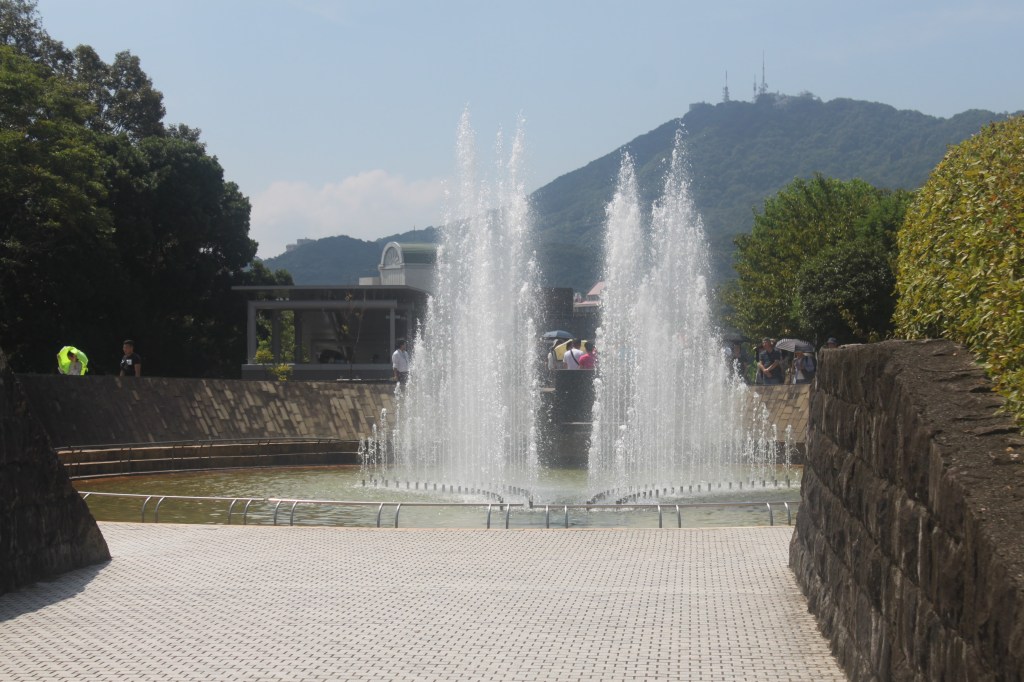
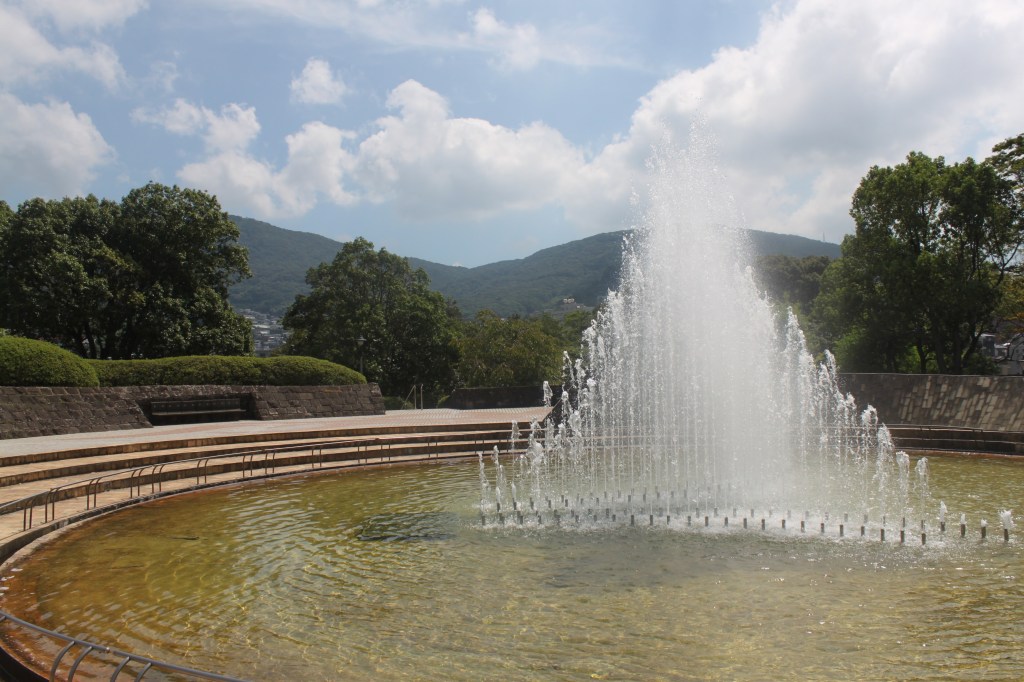
The Nagasaki National Peace Memorial For the Atomic Bomb Victims
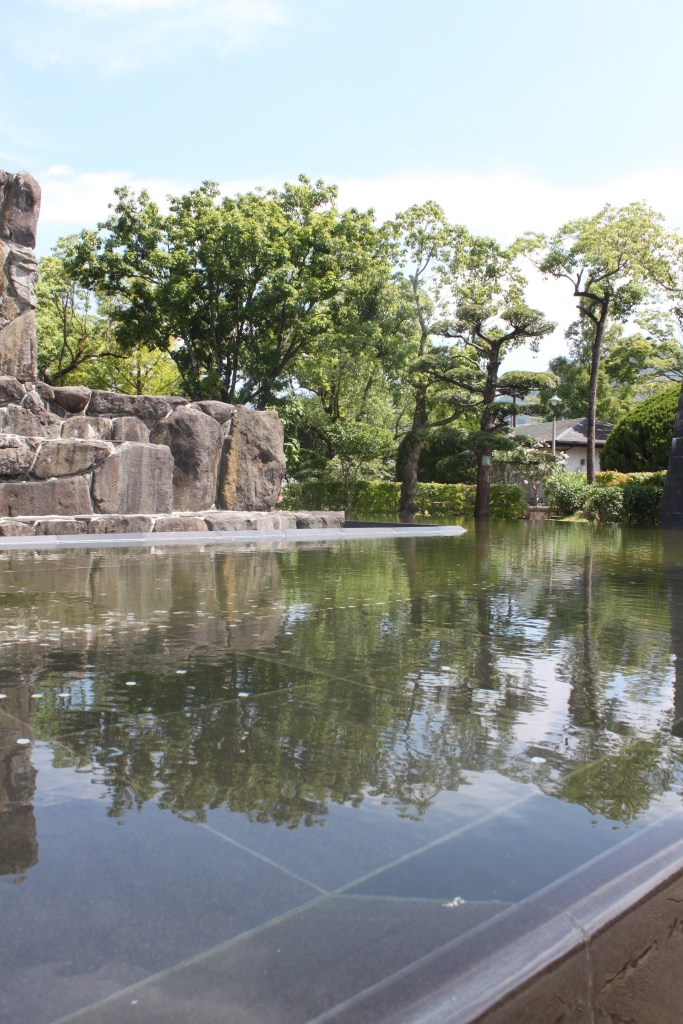
Outside the Museum is the best place of all – the reflective pool above the Nagasaki National Peace Memorial for the Atomic Bomb Victims. It allows time for reflection, and although the water calmed me, I was still felt unsettled about what I had seen and read that morning.

I had an unease about this recounting of the Nagasaki Bombing, not just of the damage done to Nagasaki itself or its people, that was real enough, but the whole story of the Atom Bomb that I was being told, both in the red brick museum and the Peace Park before it. I couldn’t quite put my finger on it at the time, but there was something that made me feel that things weren’t quite right.
But what was it that didn’t stack up?




















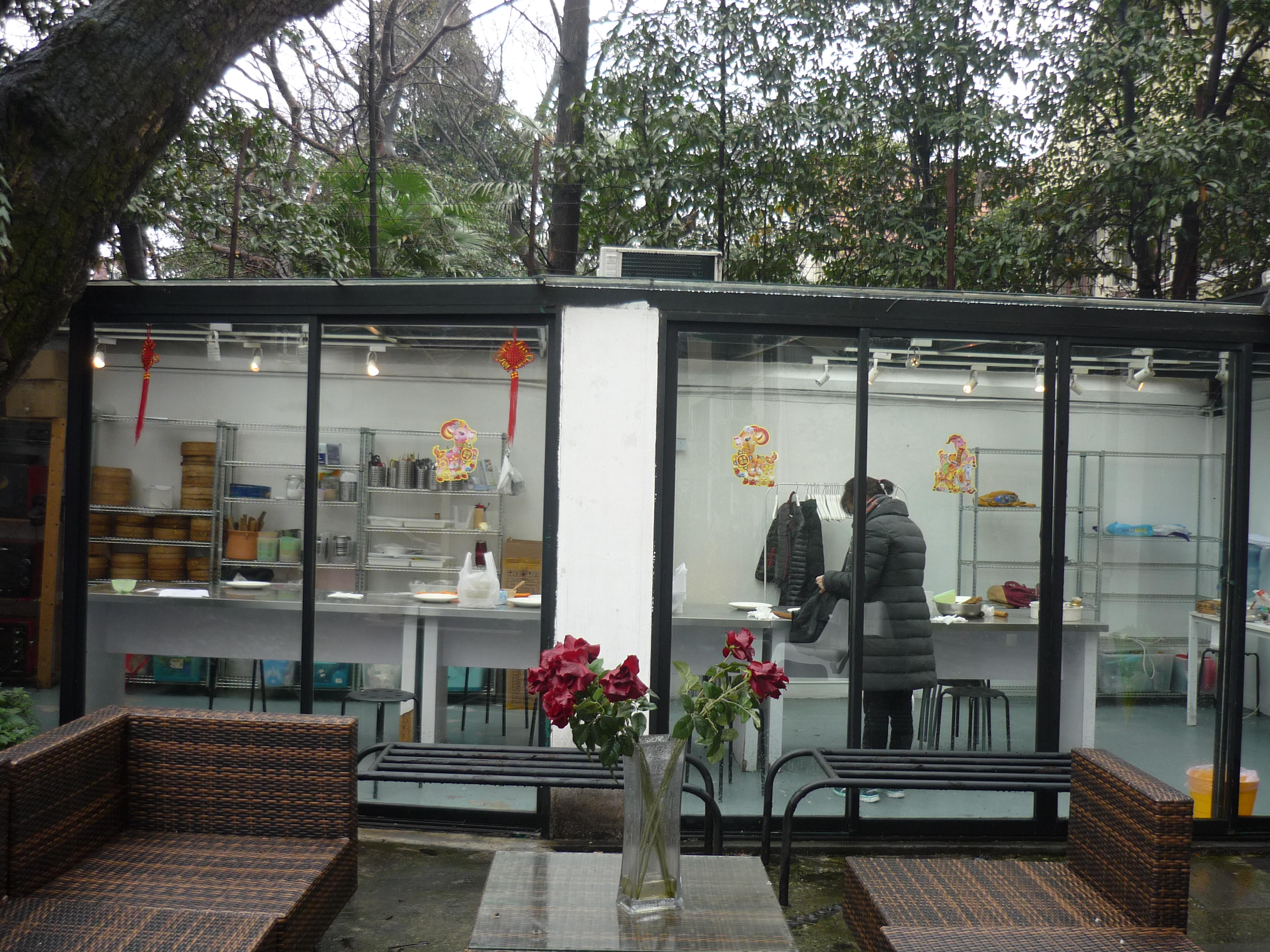 Apart from sightseeing, writing and quilting one of the things that has kept me off the streets of Shanghai has been my cookery lessons at The Chinese Cooking Workshop. Just after we arrived I reported to you my first Dim Sum lesson in which I learnt to make Spring Onion Pancakes and Pumpkin Dumplings. Since then I have done another 19 more Dim Sum classes and so in theory I can make for you the following 40 dim sum dishes: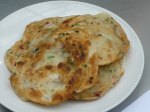


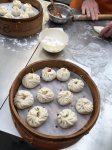
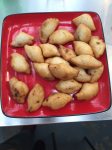
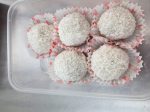
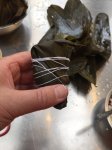
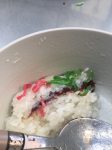



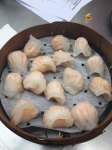
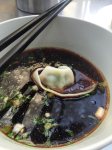
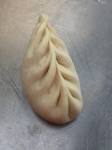
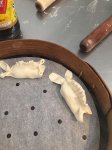
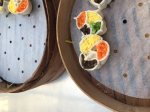
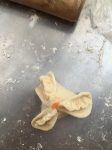
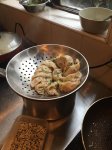


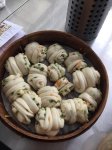
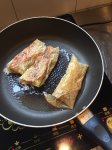
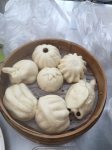

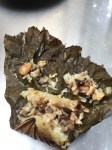
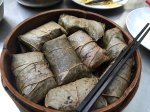
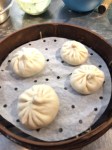
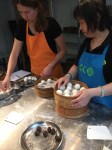

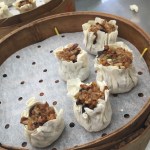
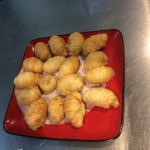

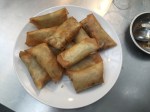
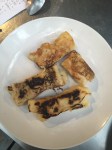
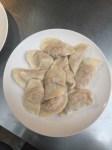
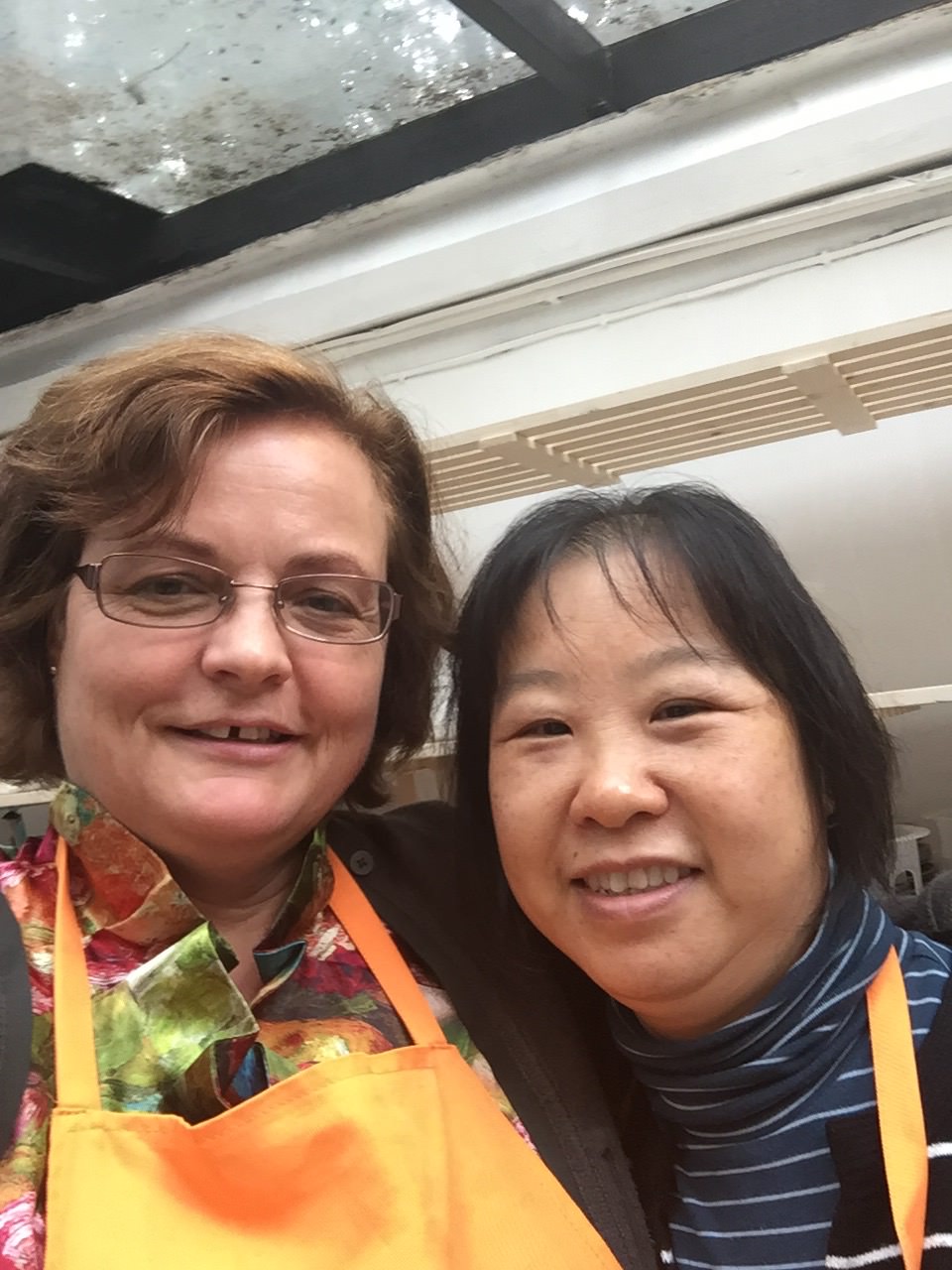 Some of them taste wonderful. Others do not. Some are dumplings, some are buns, others are wraps and still more are desserts and soups. The fillings run from pork meat to seafood from vegetables to rice. Some are steamed, some are deep fried. Some I overcooked, others I did not. The wraps can be made from bean curd, leaves, bread dough or pastry. With wheat flour, rice flour or potato flour. In general we learned to make the wrappers from scratch, from piles of flour and water. Some used hot water at this stage, others cold. Dim Sum dishes are often served with a sauce. This can vary from simple soy sauce or rice wine vinegar to the more complicated hot chilli sauce, ginger soy sauce, plum or black bean sauce. I was helped all the way by this kind lady, who speaks about as much English as I do Chinese (not a lot) and whose favourite term (like a lot of stall traders with limited English here) “looky, looky”. But we got by, making as you can see, some quite complicated shapes, essentially out of flour and water paste, all the while translating my left-handed versions from her right-handed ones. Once we are back in the UK I shall no doubt get out the tiny rolling pins I have acquired and make them again. And if you are interested, I expect I could give you a lesson or two.
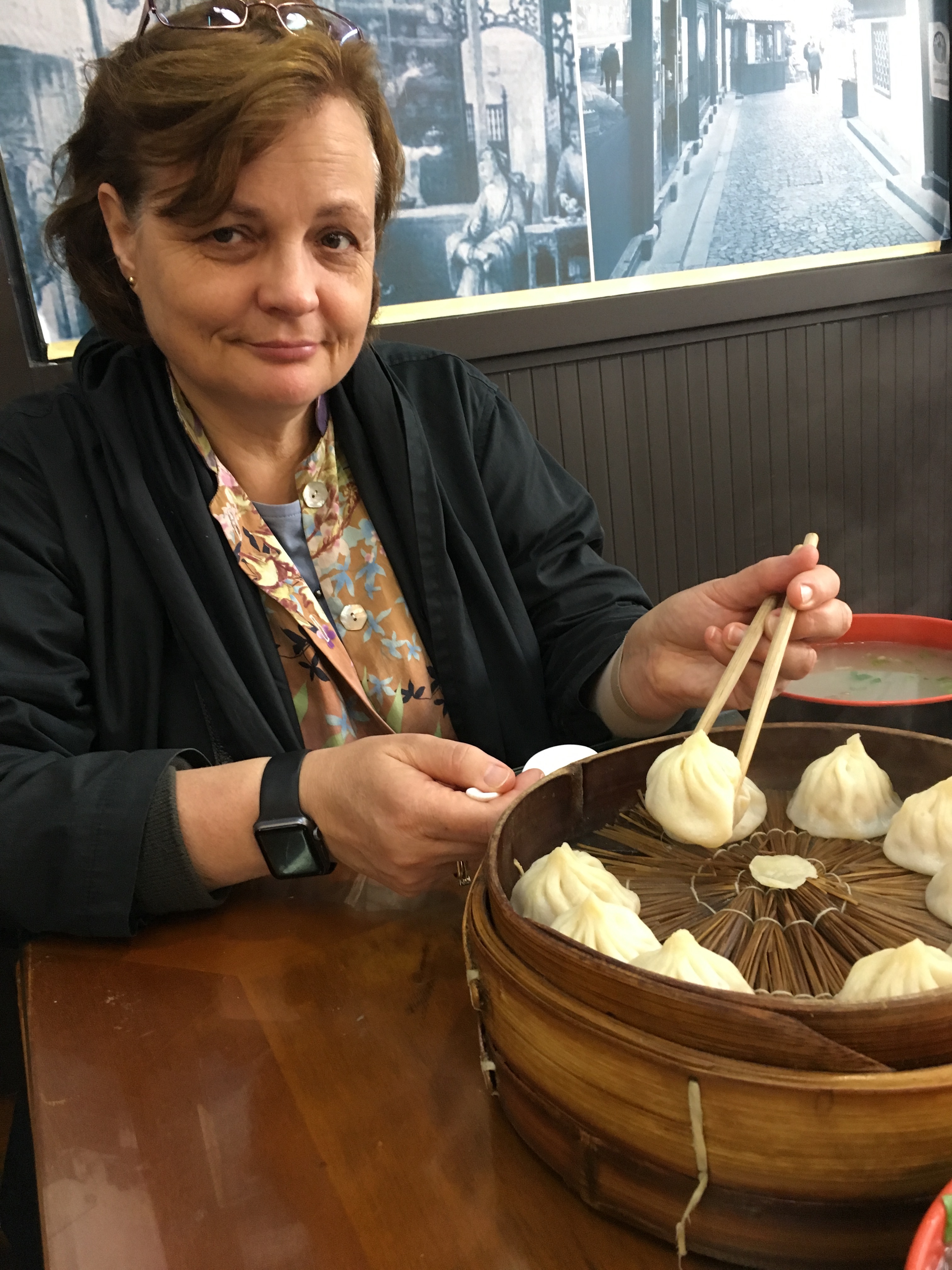 Taking Dim Sum is a Cantonese tradition, eaten as a brunch with lashings of tea. Last year we had Dim Sum with one of Rozy’s friends, Joyce, in Hong Kong and we have been to lunch with American friends – the husband is of Cantonese descent who took us to their favourite Dim Sum restaurant in Shanghai on the 3rd floor of IAPM shopping Mall over the top of Shaanxi Nan Lu Metro Station. (I think they have done quite a bit of research on the topic). Dim Sum is said to be related to the earlier silk road tradition of Yum Cha – drinking tea. Other parts of China also produce and eat these morsels – the most famous ones from the Shanghai region are the Xiao Long Bao of Nanxiang town, now subsumed into greater Shanghai and Jiaozi which are similar steamed dumplings that are then fried and so also known as potstickers. In fact this weekend we went to Nanxiang town by Metro on line 11 and whilst we were there we called in at the Rihuaxuan Restaurant the birthplace of the Xiao Long Bao. The dumpling traditionally contains pork, or pork and shrimp or pork and crab meat combined with a gelatinous mixture that forms a soup on steaming, so a judicious use of spoon and sucking is required to avoid spraying soup everywhere when you take a bite out of the dumpling. The crab dumplings were particularly delicious (Richard preferred the shrimp ones) and the pastry soft yet strong – I only managed to puncture one of them as I tried to lift it off steamer’s the bamboo mat. I’m looking for my own bamboo steamer mats – so much prettier than the modern paper ones with holes in. I’ve not been successful so far, but I’m still looking.
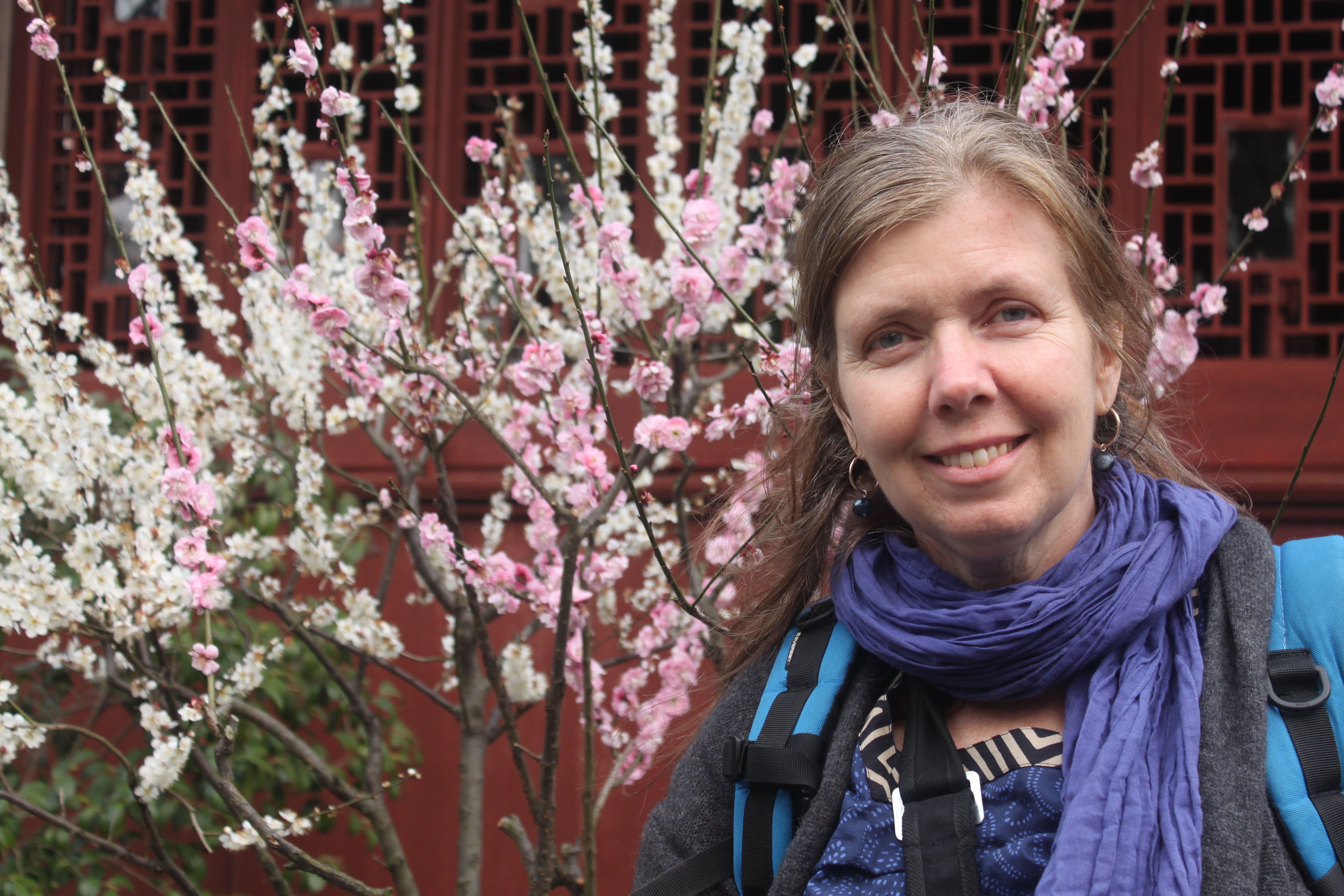 Last year in the last week of February my dear friend, Ulrika, from Sweden came to visit us for a week and we tried to cram as much as we could into her visit brief visit. We were generally successful, to the extent that by the morning that she left I had to stay in bed, exhausted, rather than go with her to the airport. Richard went instead.











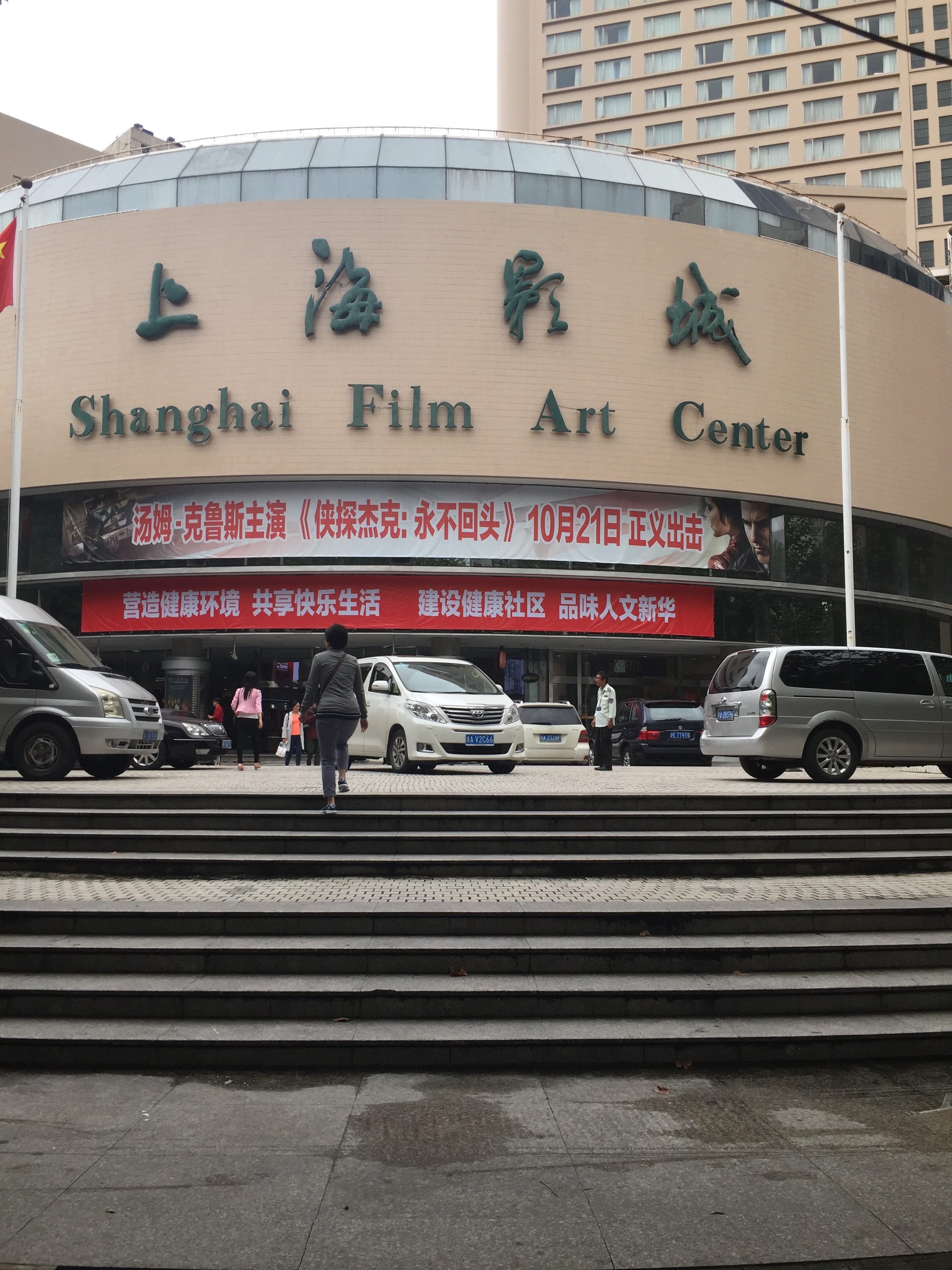 I’ve done the walk a couple of times – once as part of the Brits Abroad Walks Team who for a nominal gift to charity take members on 2 hour long walks around various areas of the city and once with Richard, one morning when we were short of time – needing to get back in time to let in the washing machine repair man. Richard loves the Former French Concession Area of town and found that this area, too, holds his fascination and has expressed a desire to go back again, saying that he could spend all day there wandering about.


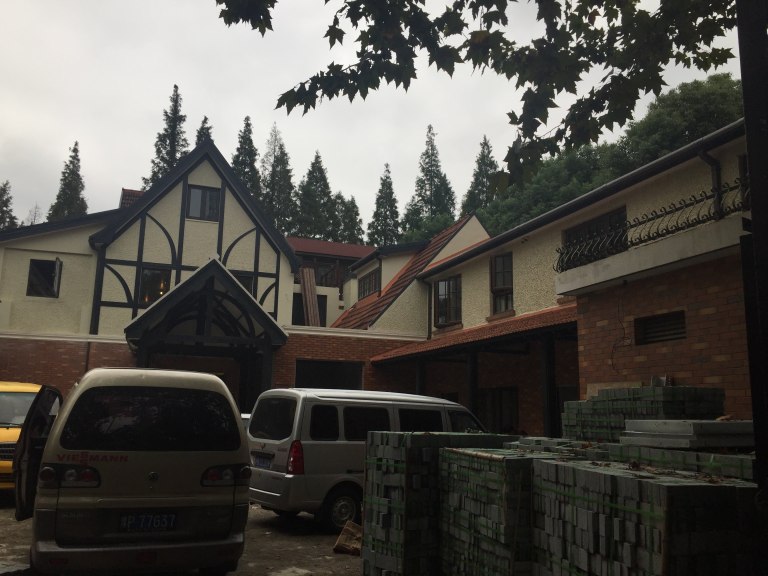 garden wall. Just around the corner is Ballard’s mock-Tudor childhood home, built in 1925. It’s currently undergoing one of its many refits and has indeed been rebuilt in concrete although the original carved banisters from the staircase are reported to still exist. Until recently it housed a members club called the Xin Yue Club. Quite what its next incumbents will be I do not know. All of the road names from the days of the the foreign settlement have
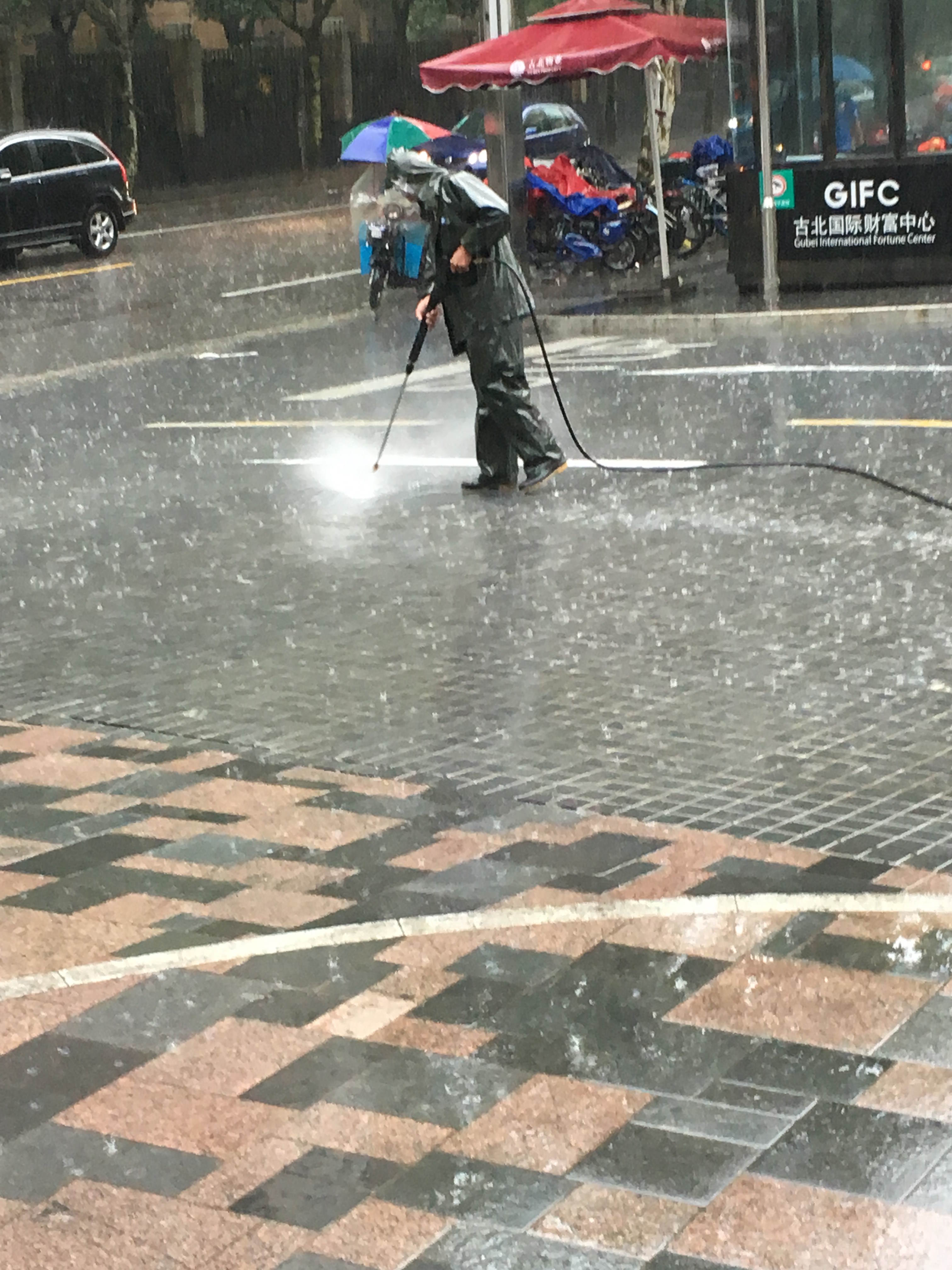
  been changed since the revolution and this area is no exception. This is a view of the back of the Ballard house, taken from what was once called Columbia Road, now known as Panyu Road. The front of the house is on a lane off what was once Amherst Avenue and is now Xinhua Road. The lane itself is pretty enough, but as Richard pointed out, what was the point in washing the lane whilst piles of rubbish are left to fester under the trees?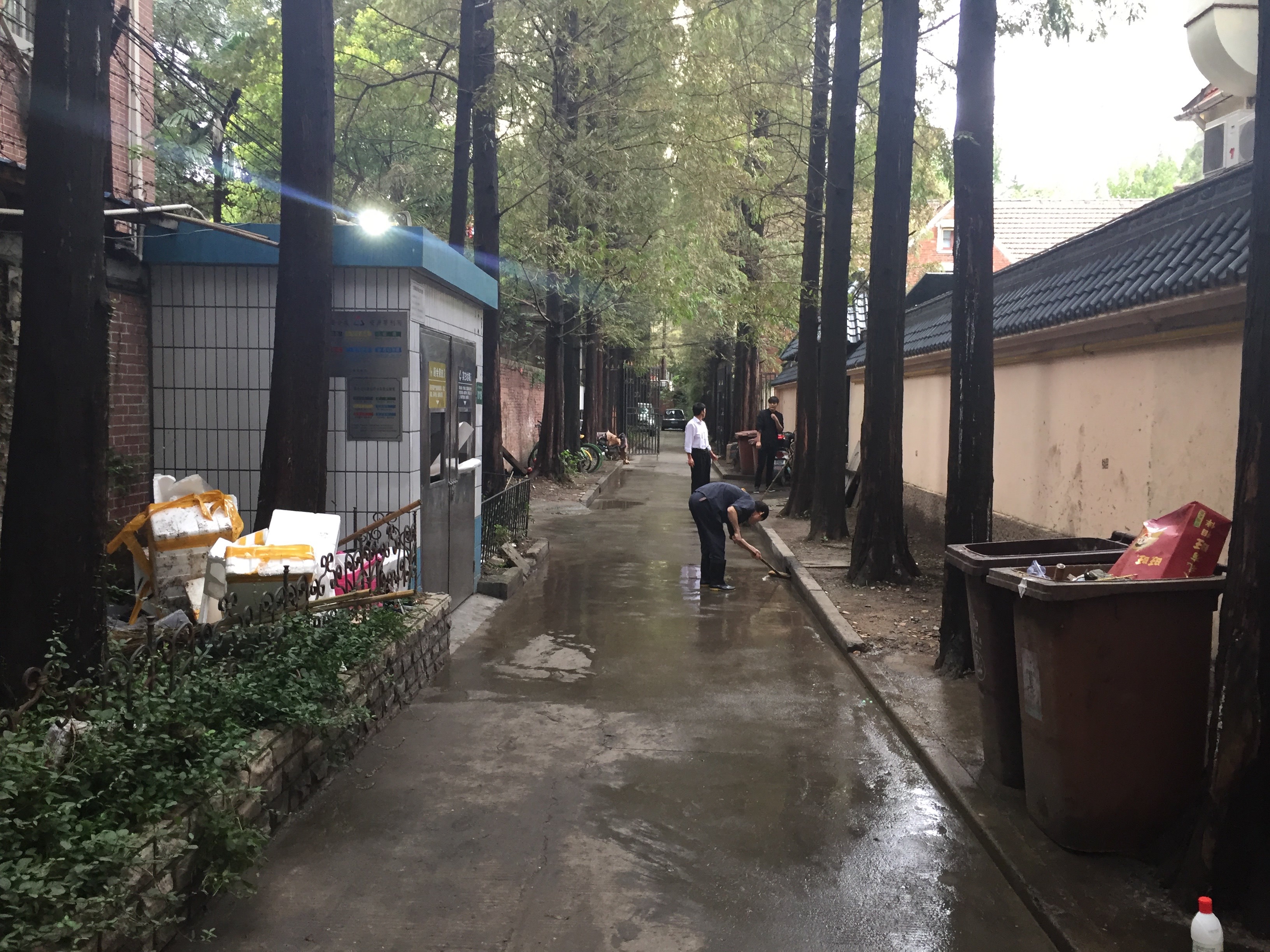
 Anyway back to The Bad Lands. The wealthy bankers, merchants, consuls and mill operators (Ballard’s father ran a cotton mill) that lived here employed western architects to build their mansions. The Ballards’ was designed by a British Architect. The next house we stopped to look at was designed by an Hungarian Architect who made his name in Shanghai, Laslo Hudec. He designed a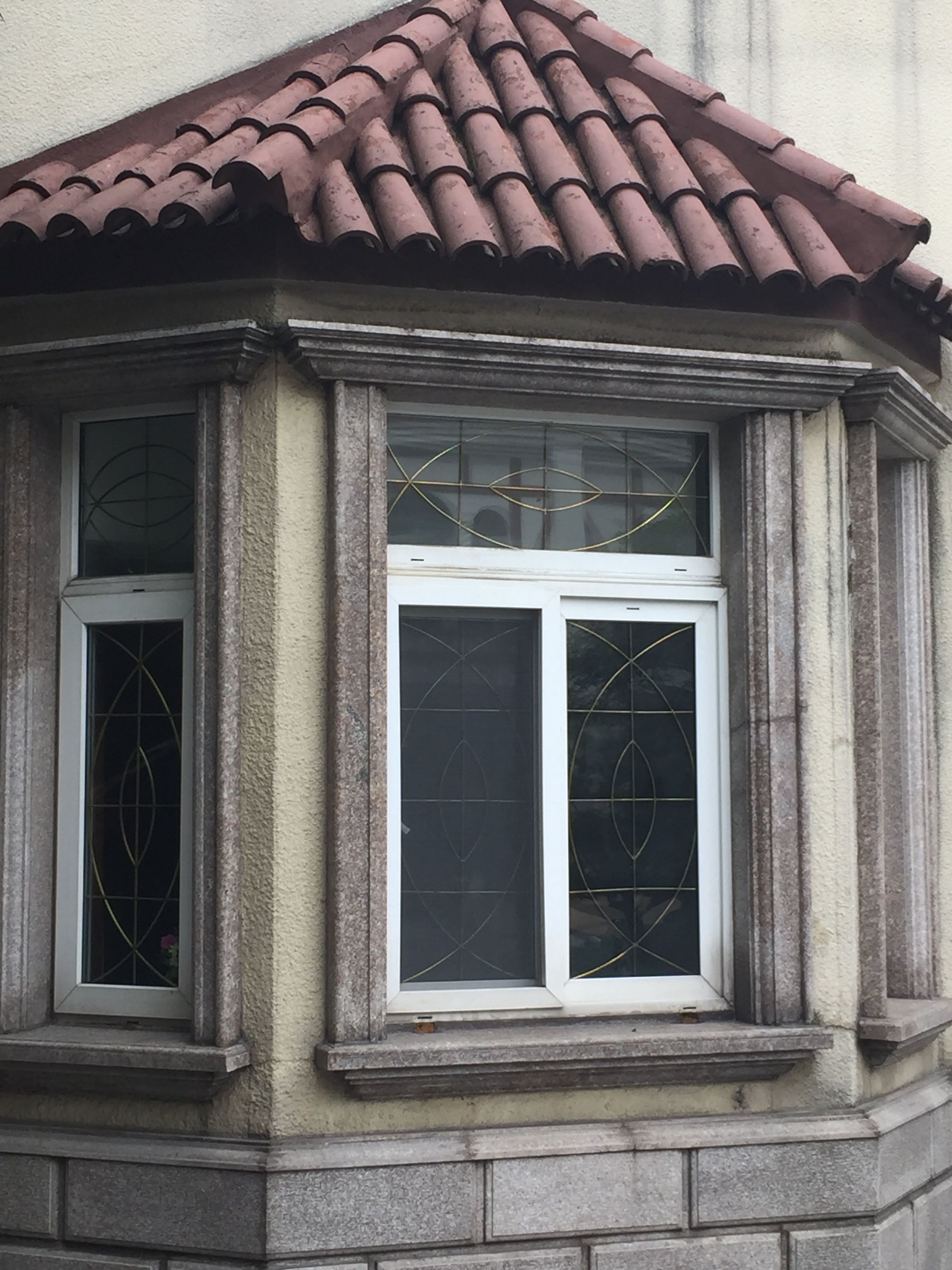
 number of houses in this area as well as more Gotham-style buildings such as the flat-iron Normandie Mansions on Huaihai Road, and The Park Hotel which overlooks People’s Square.


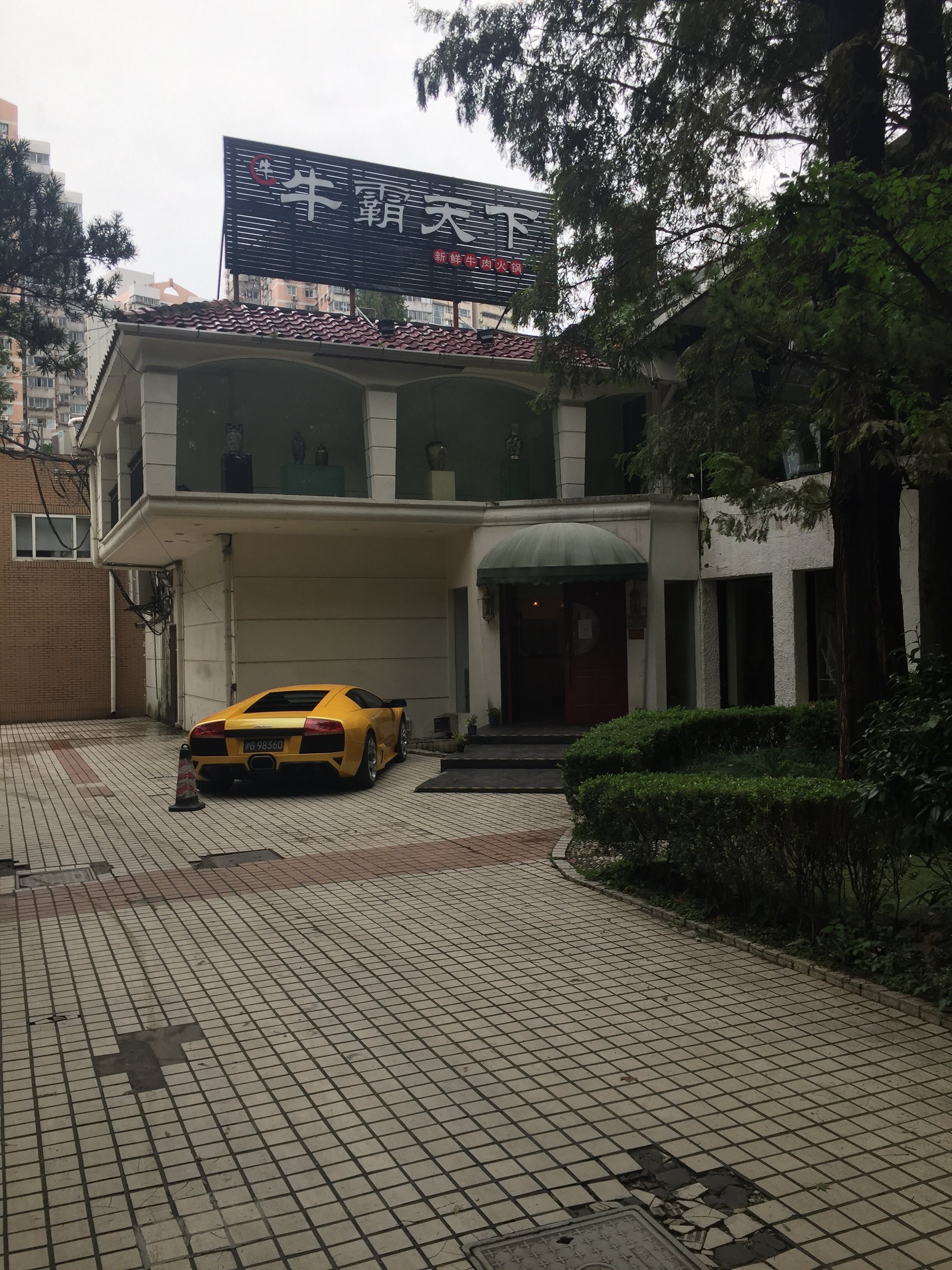 and in a mixture of Western and Eastern Chinese styles the former home of the Chinese political chief Chen Guofu, who belonged to one of the four important families of 1920s Shanghai.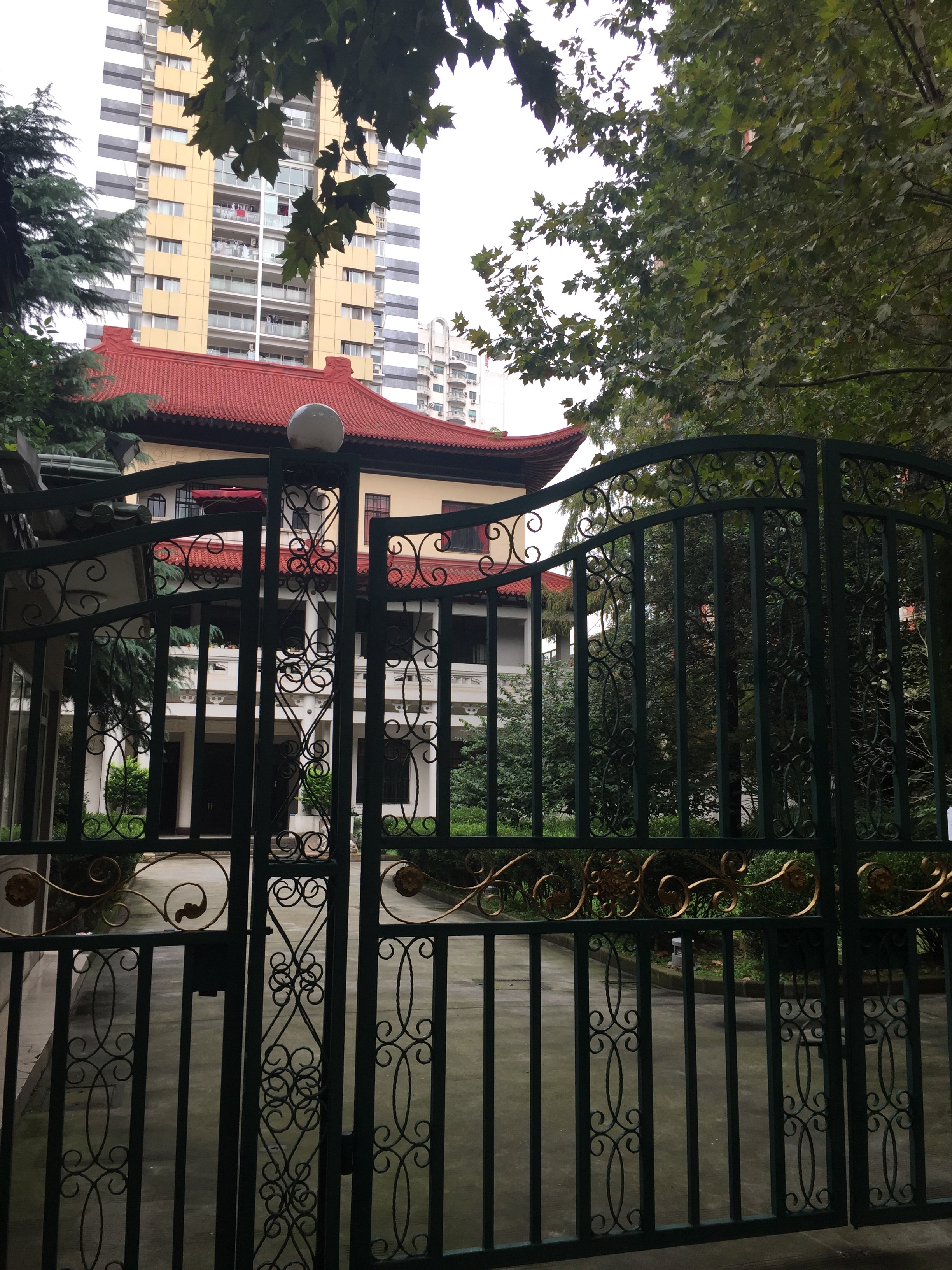


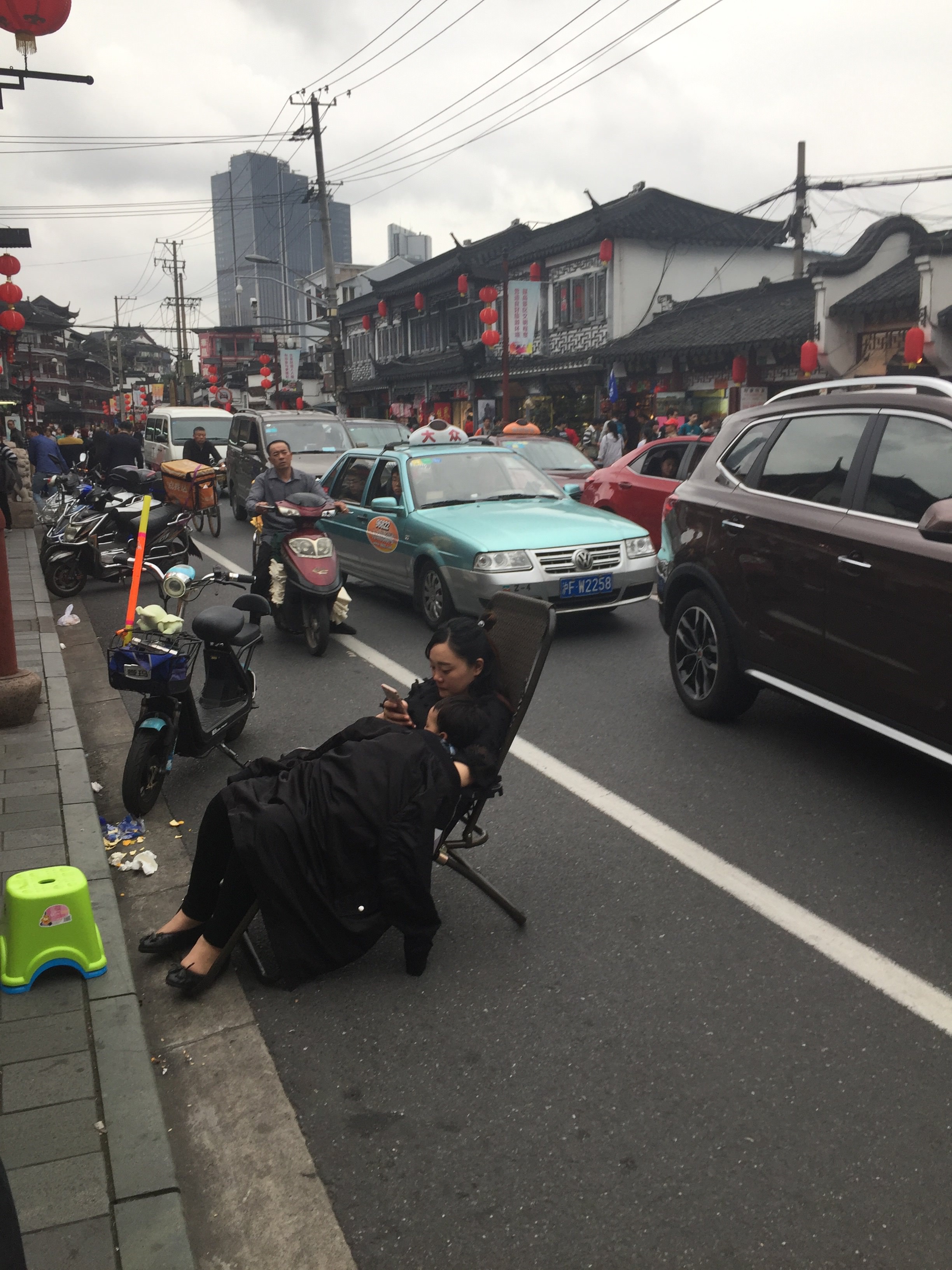
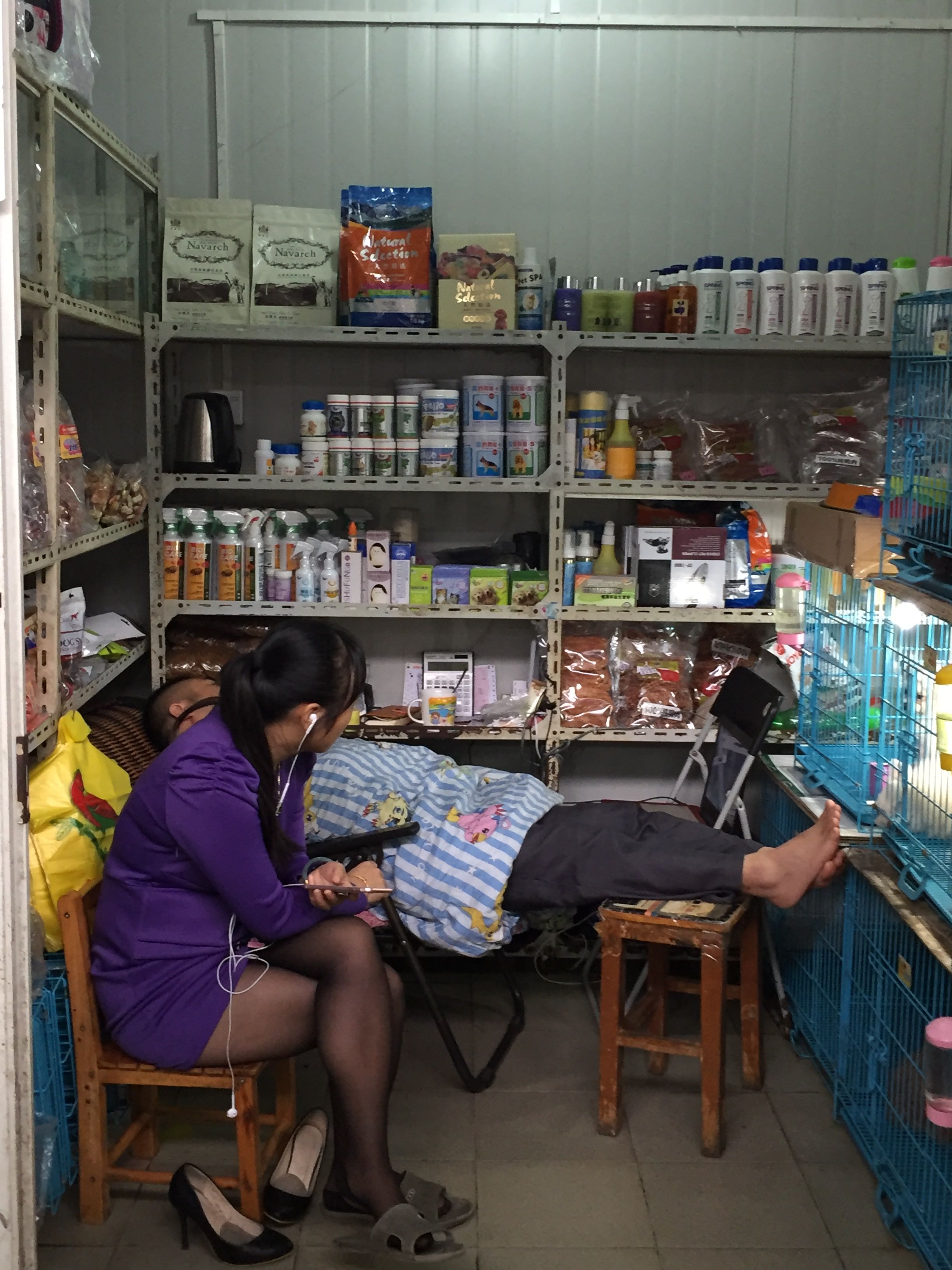
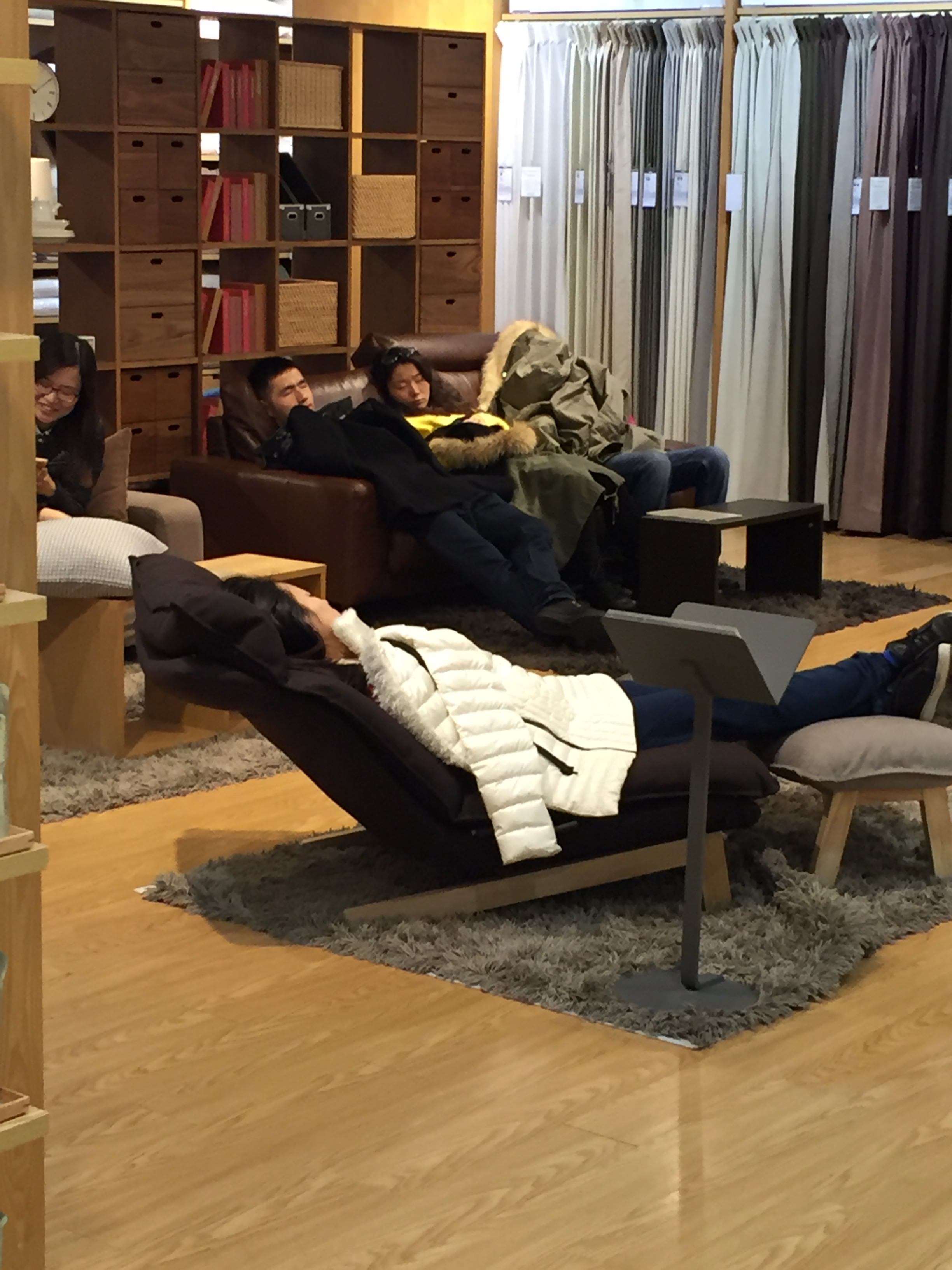
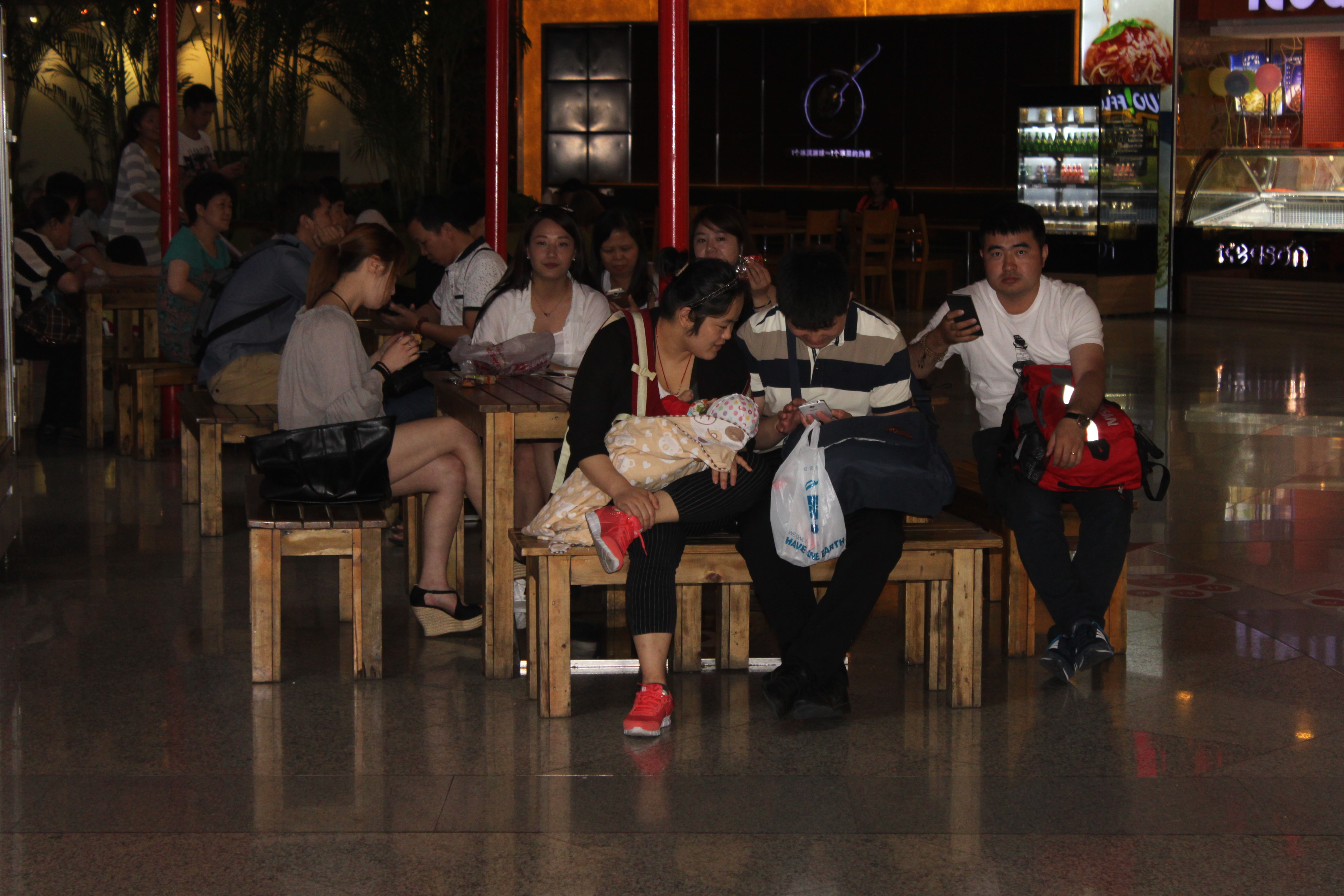 Often on the metro I’ll watch toddlers dropping off to sleep in their Mother’s (usually it is the mother) arms. It takes them next to no time to fall asleep and there is usually very little fuss made by the child. Boy or girl, it usually just gently falls asleep. Whether this is because parents usually only ever have one child and so their life revolves around that child’s body clock or whether it is because these infants are carried everywhere (there are very, very few prams to be seen in this city, although over the last few months we have noticed a marked increase) I don’t know. Children up to the age of about 2 are always in their parents arms. None of them seem to toddle anywhere outside, unless they are playing very close to home.
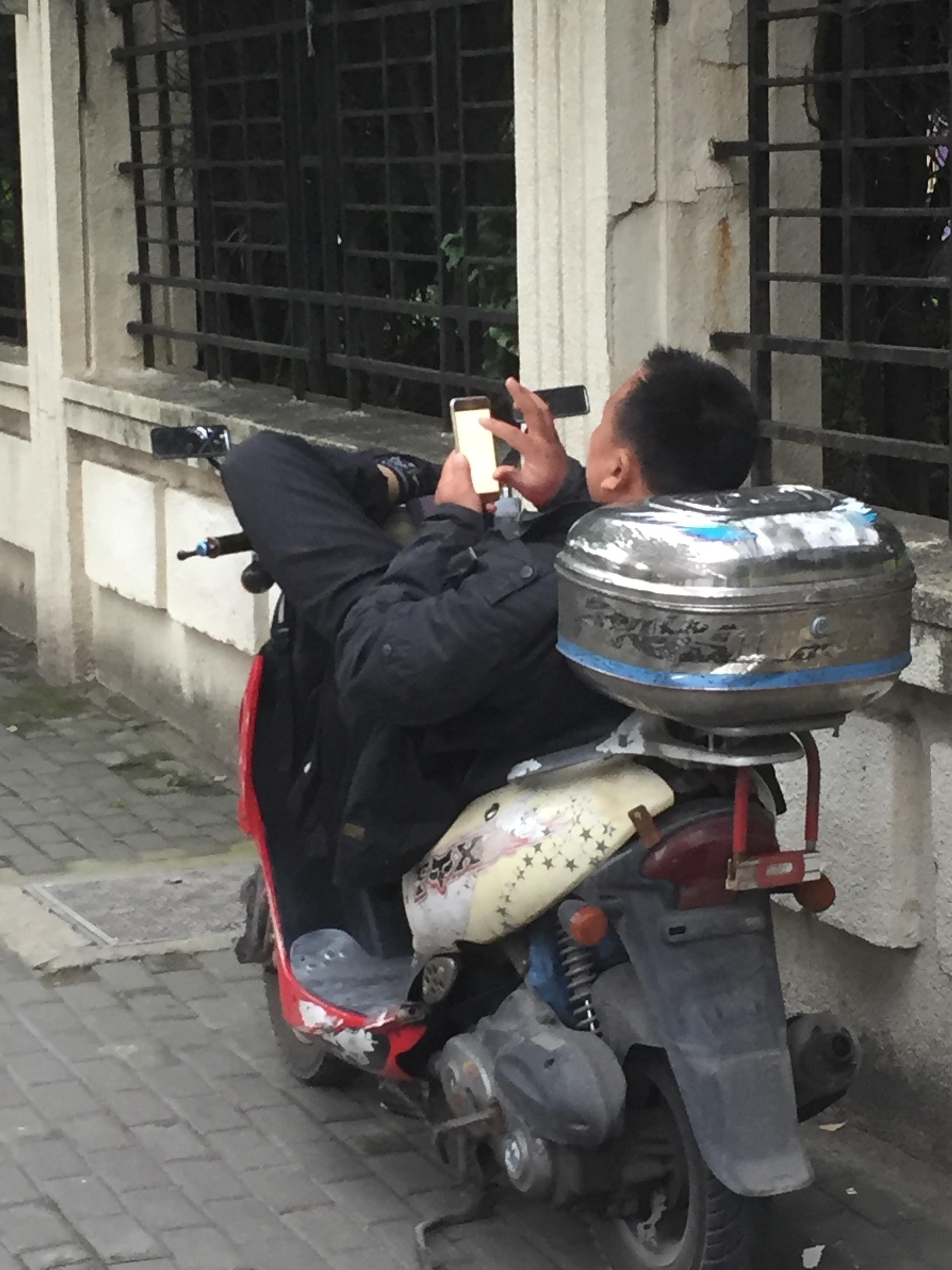
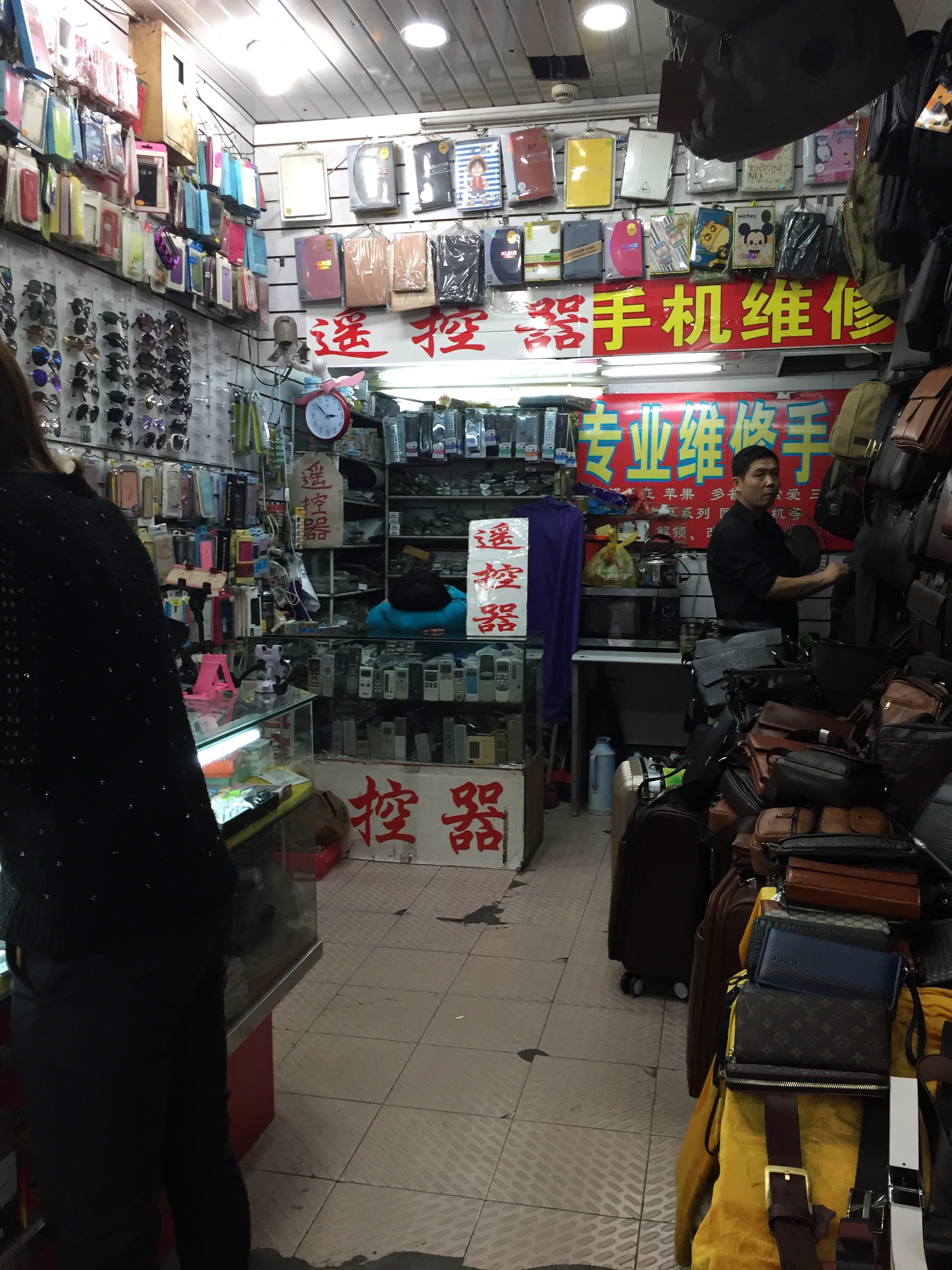
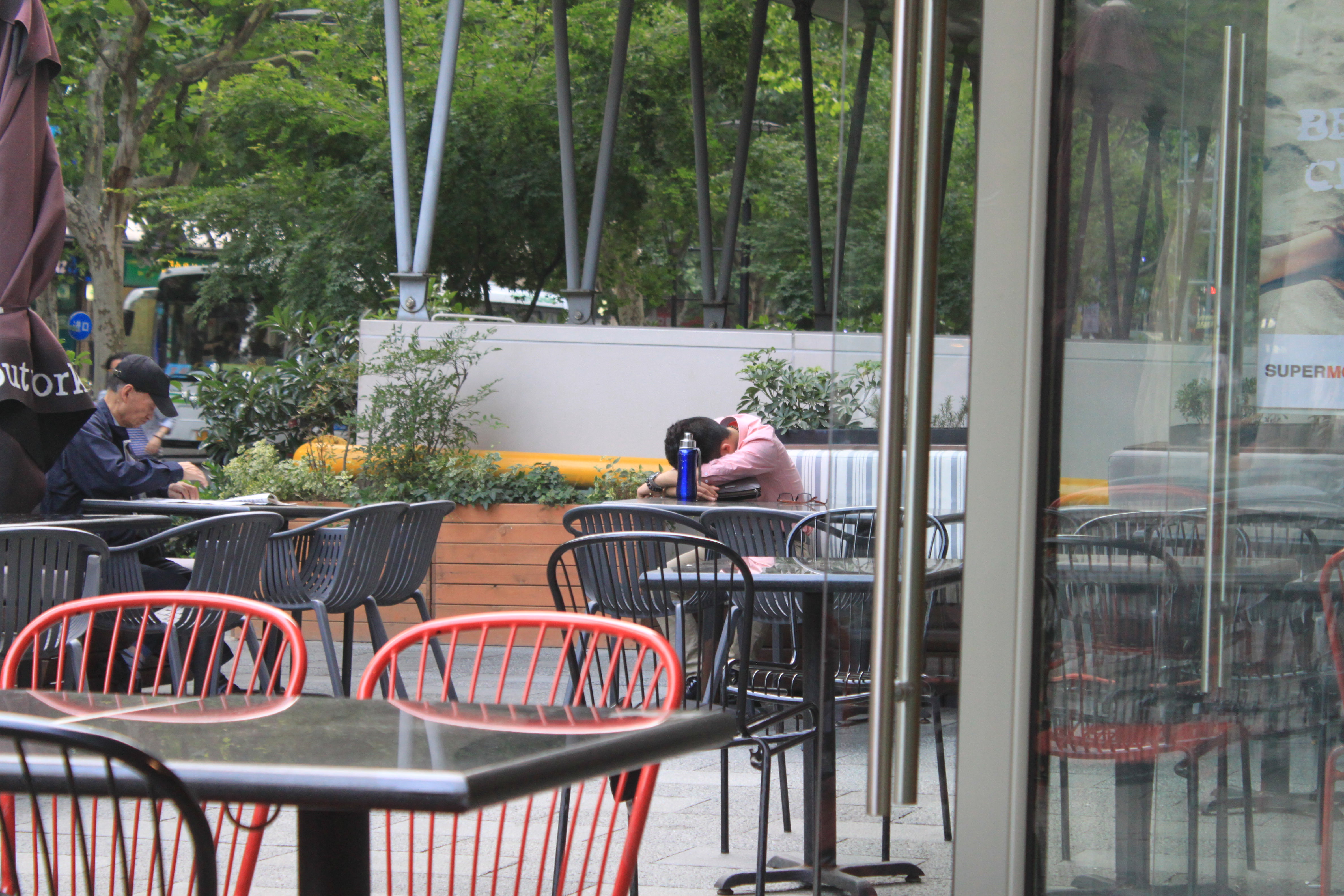 Anyway something in their upbringing means that this ability to fall asleep just about anywhere, at anytime, without it appearing to feeling vulnerable, carries on into adulthood. Richard says that at work, after lunch, many will put their heads down on their desks and go to sleep for half and hour or so.









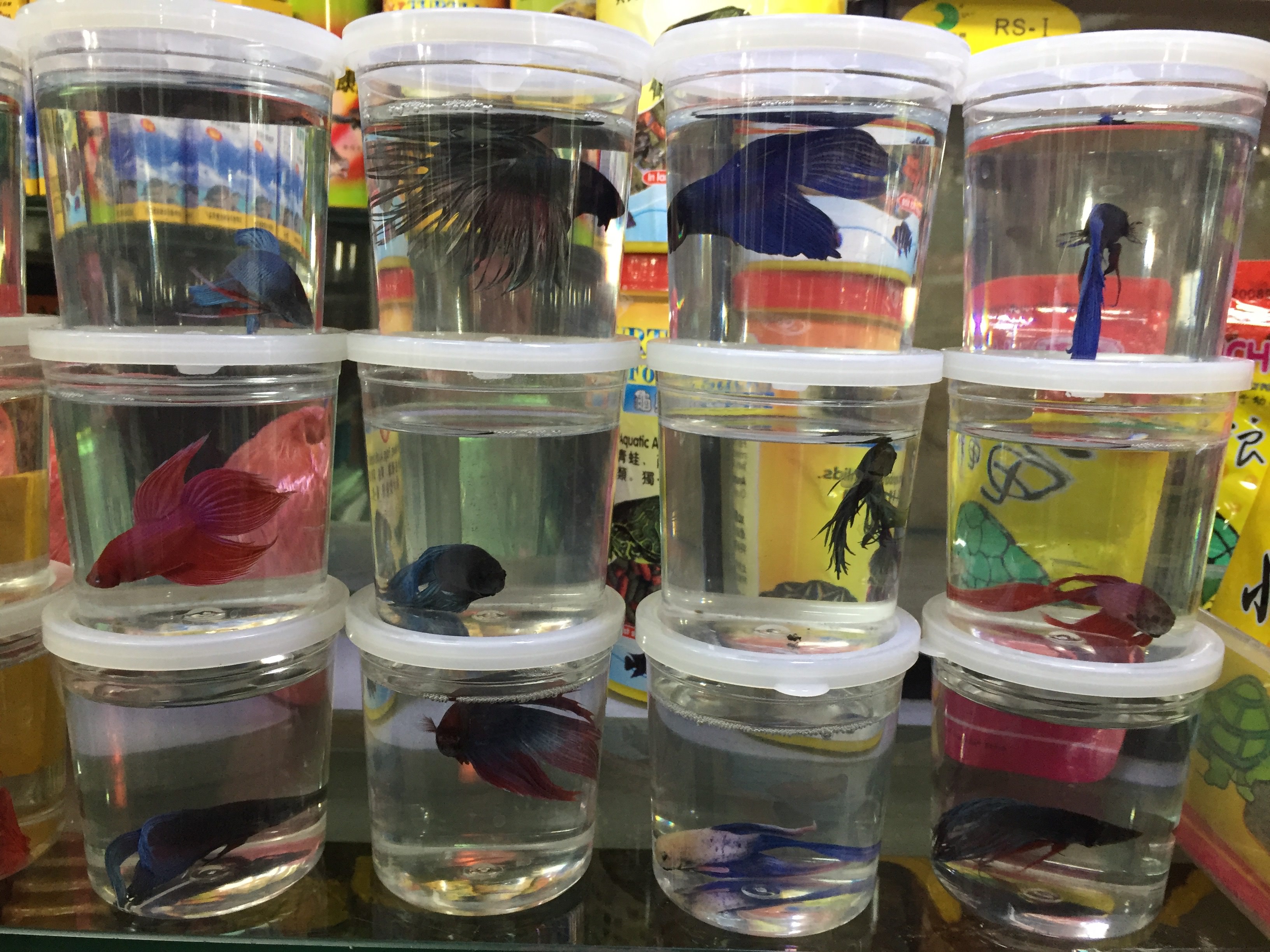
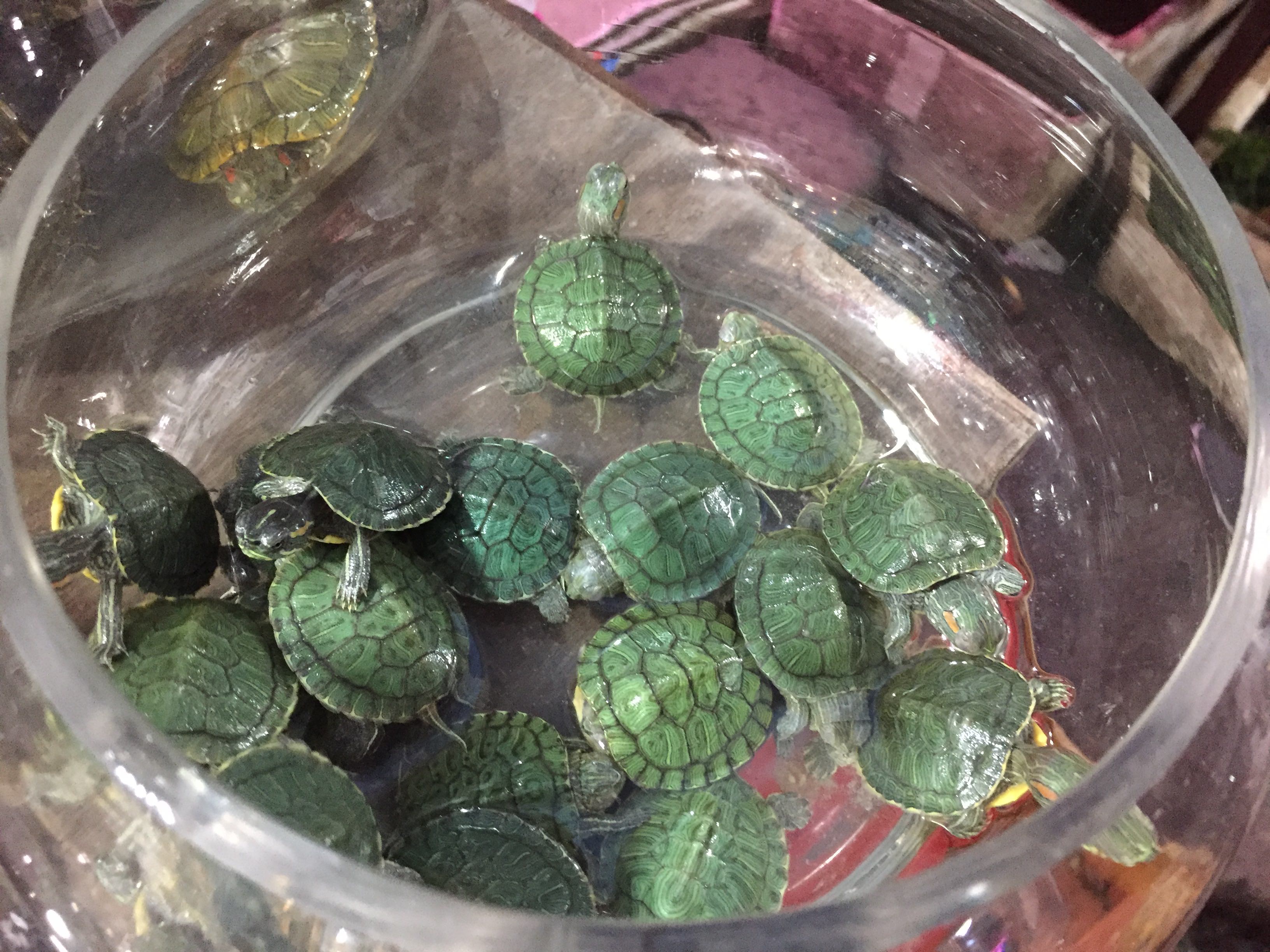
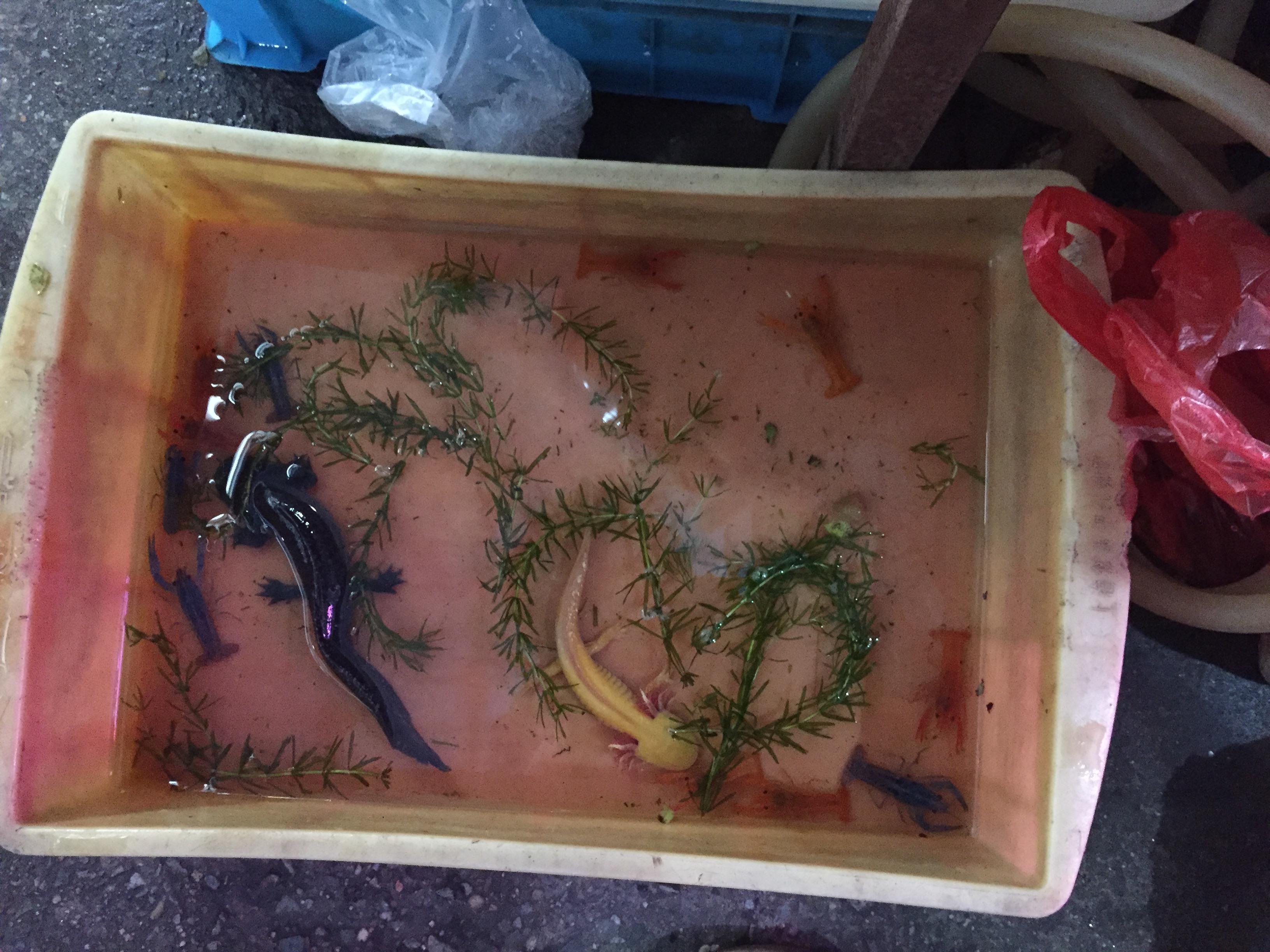
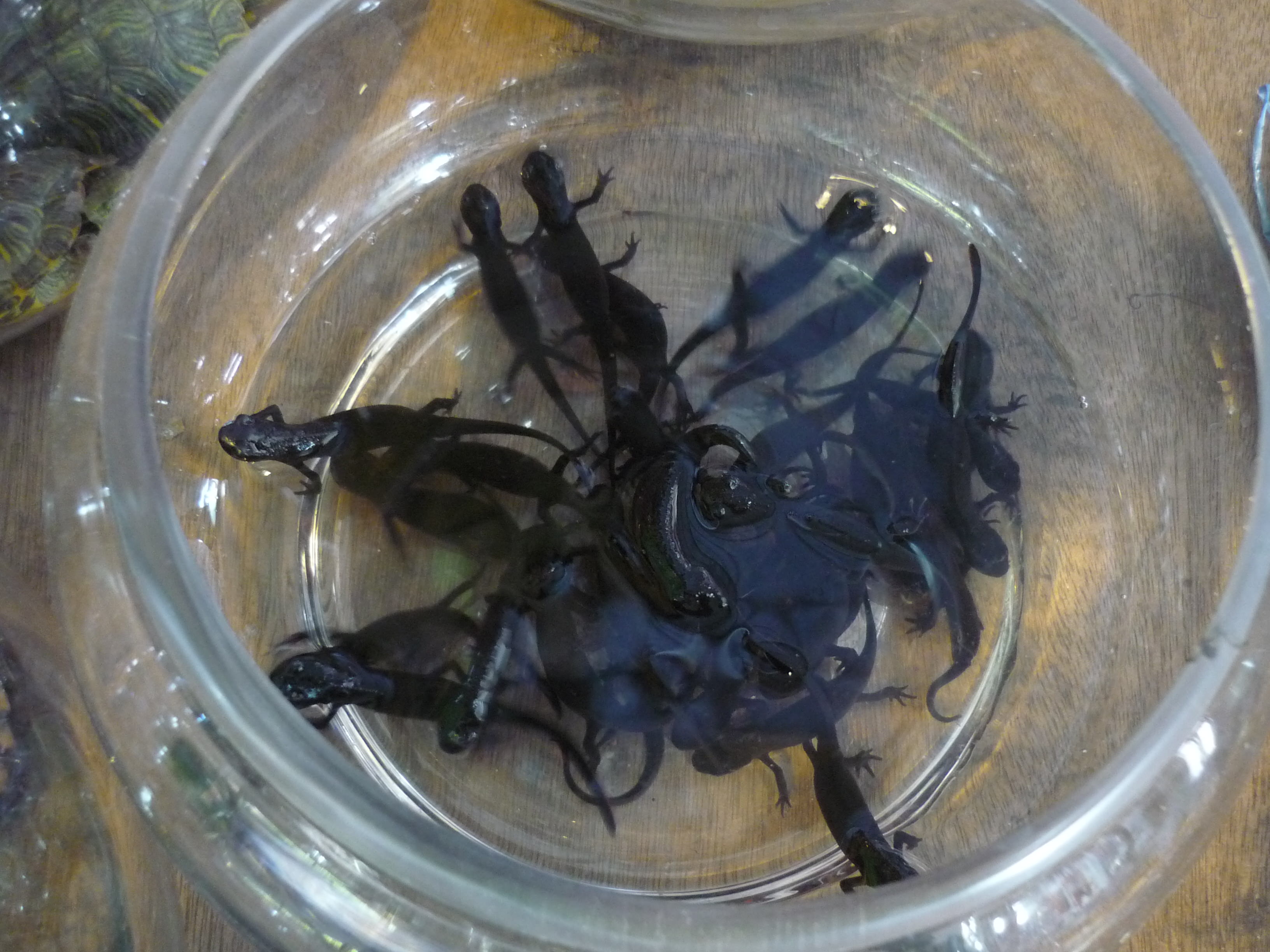
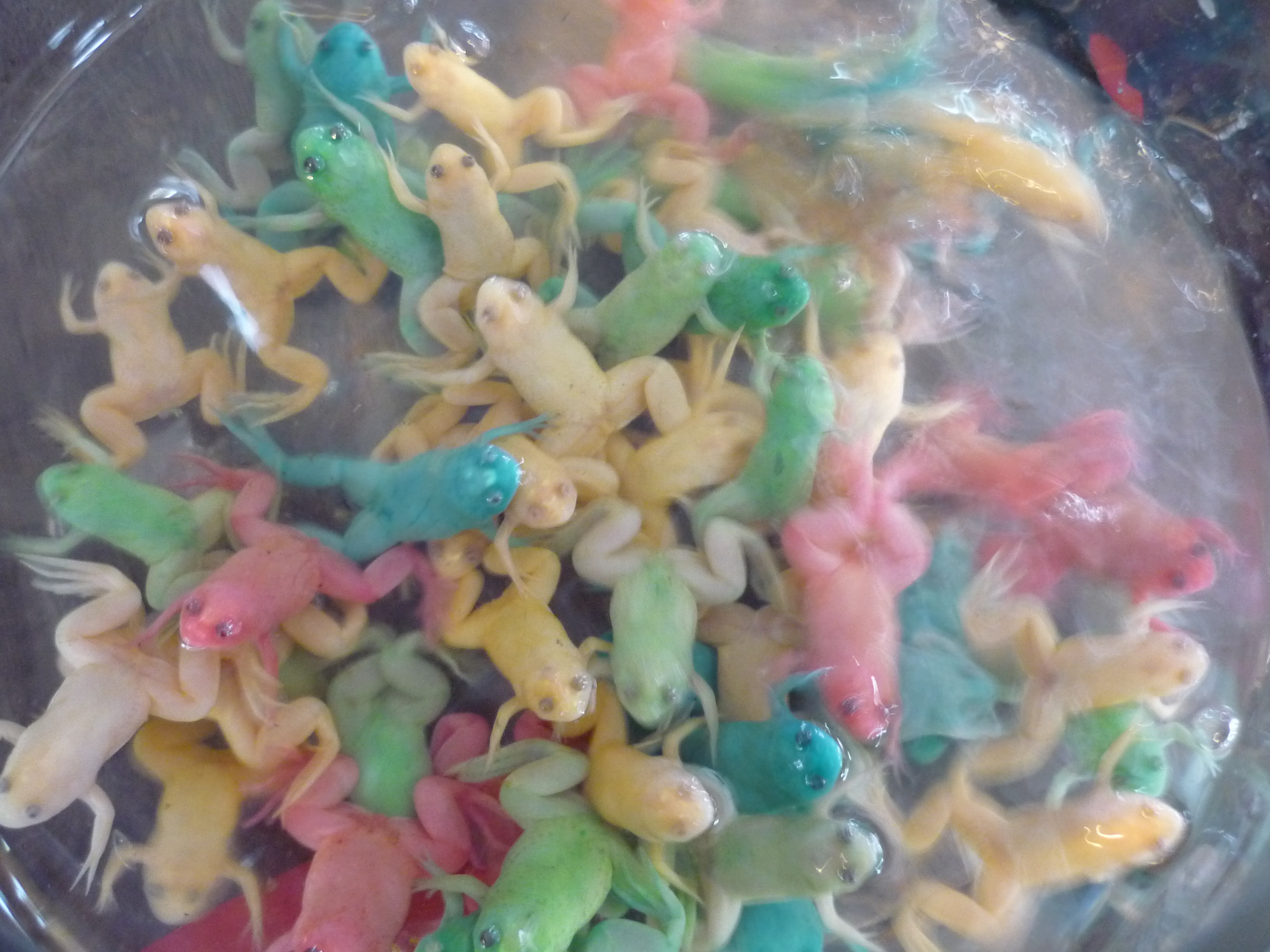
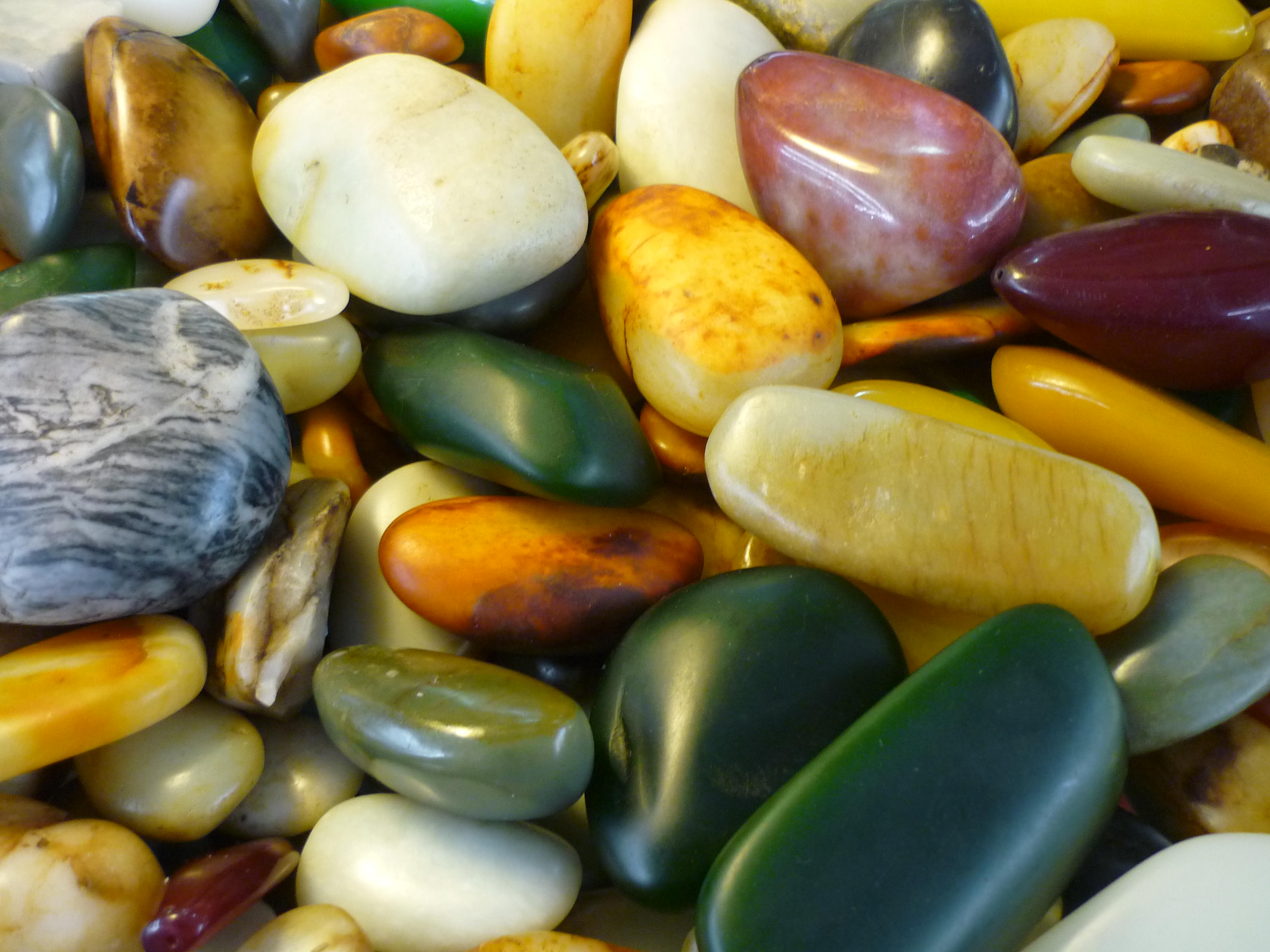
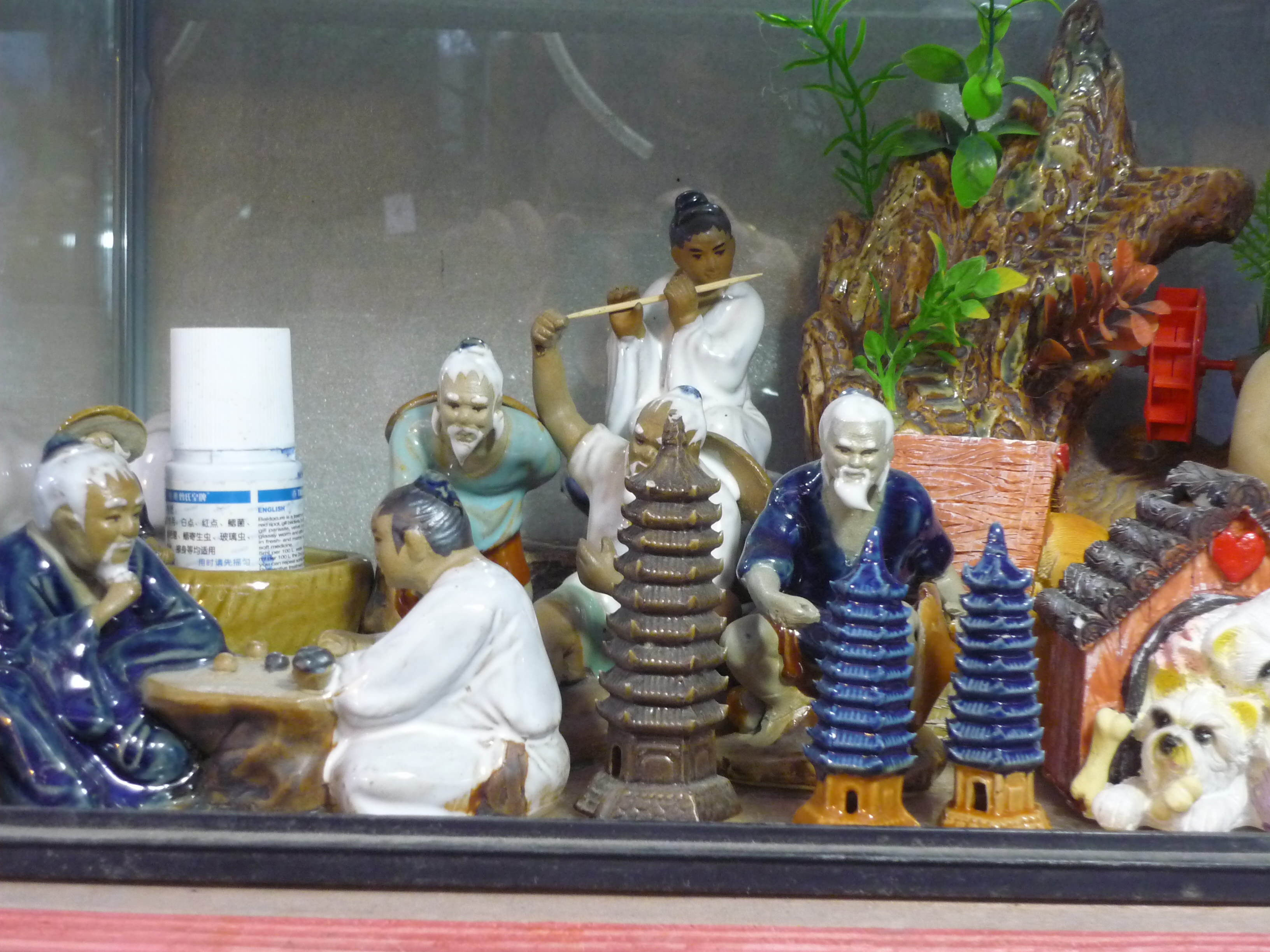
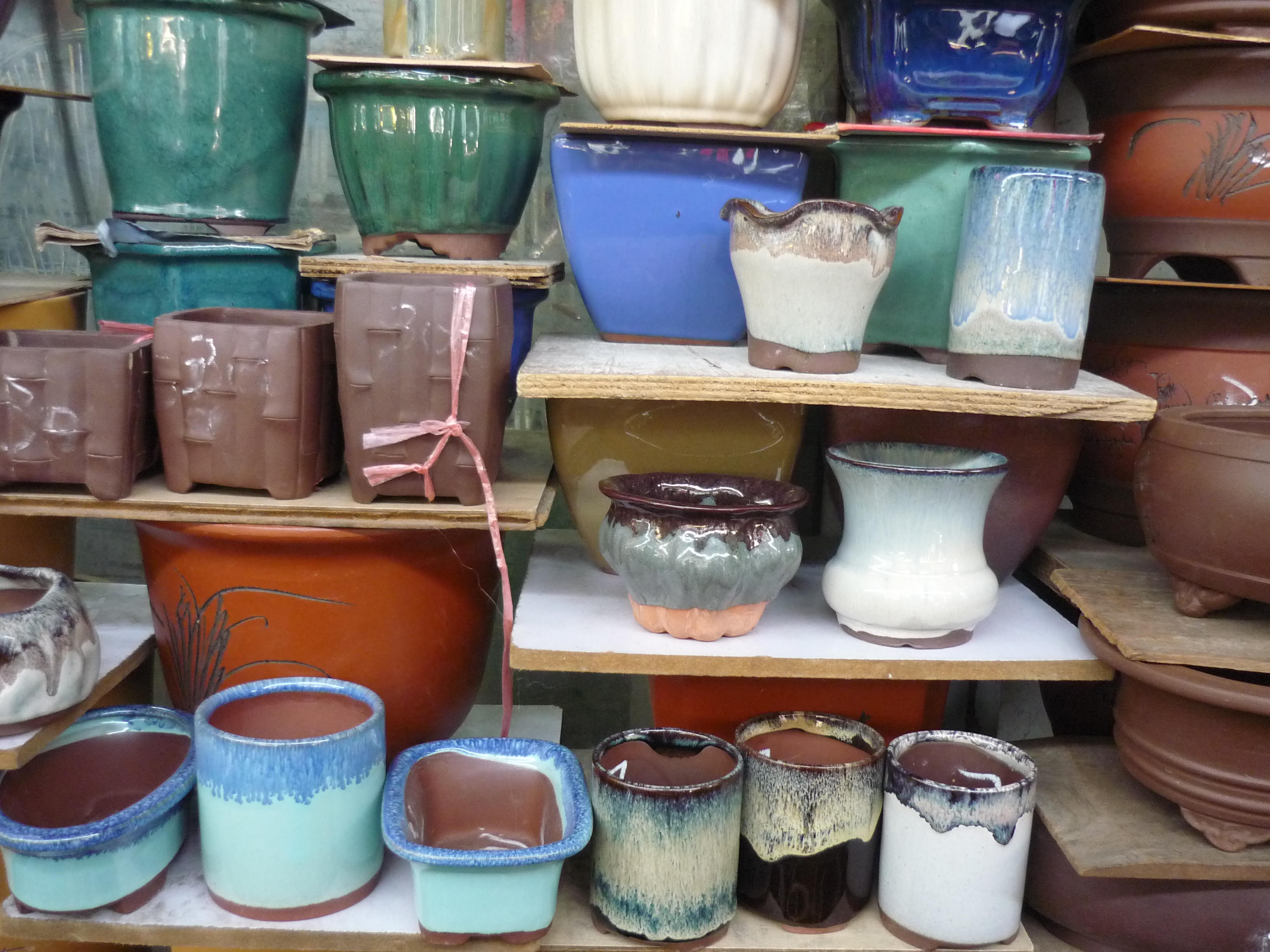
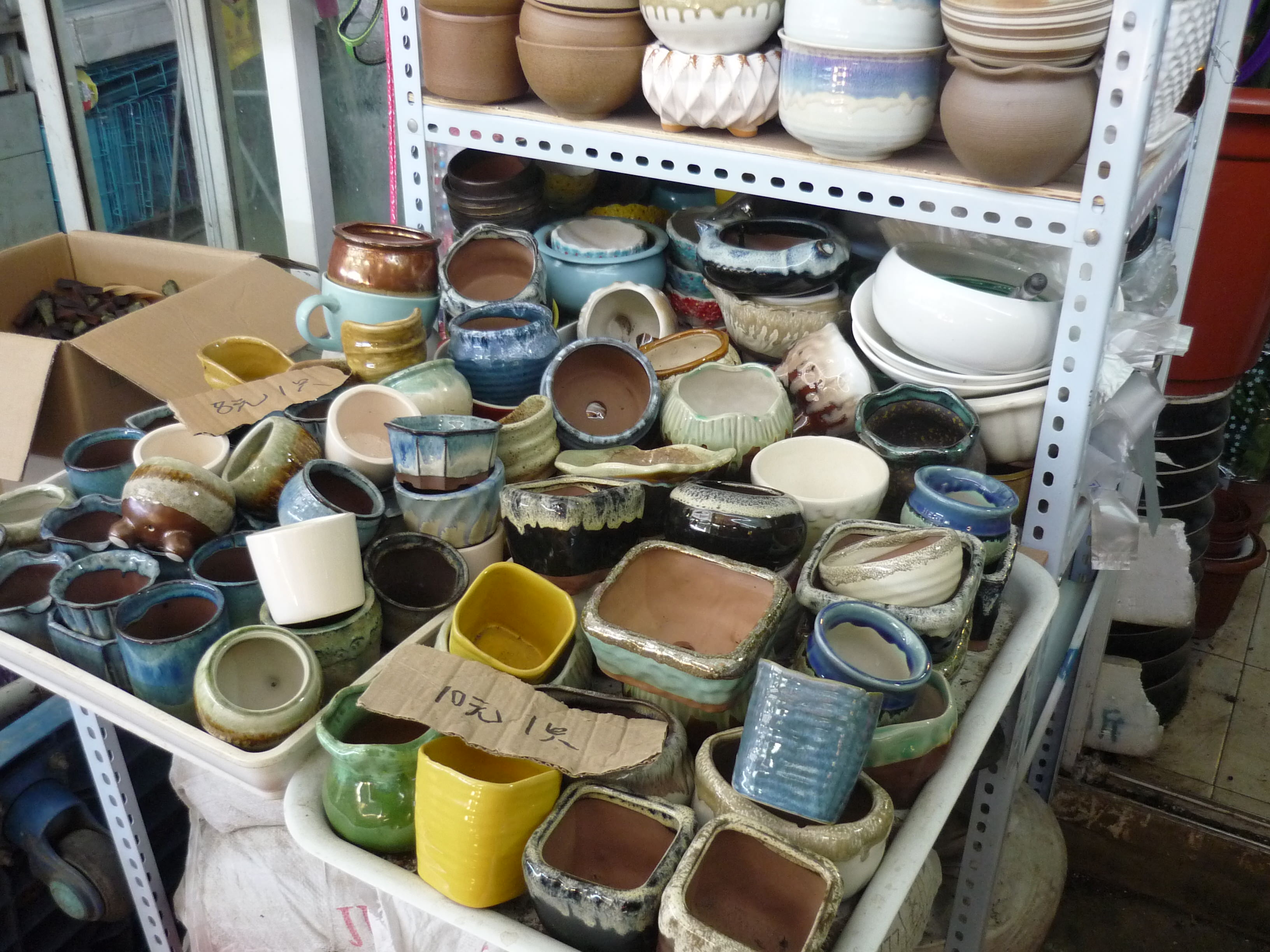
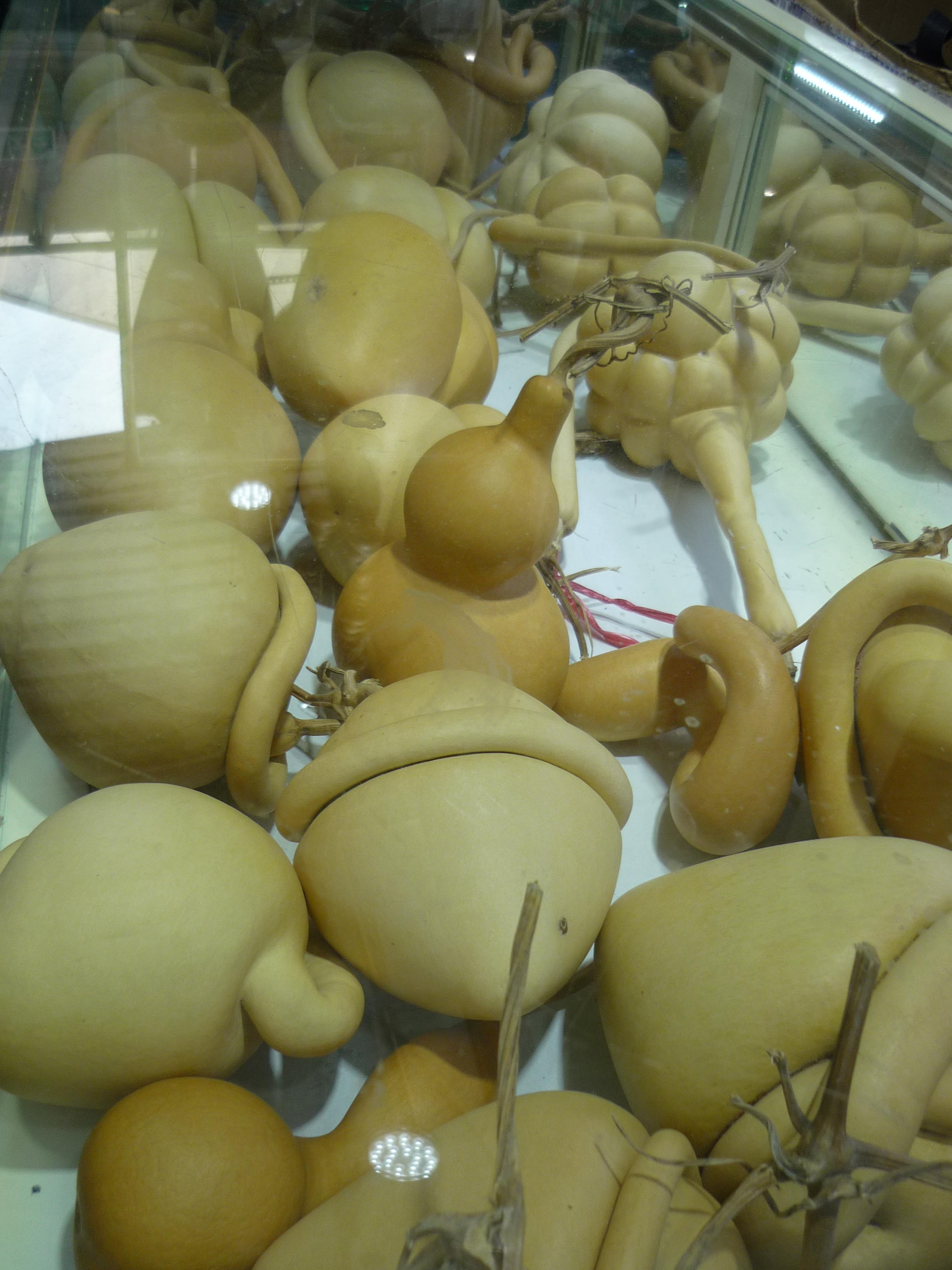
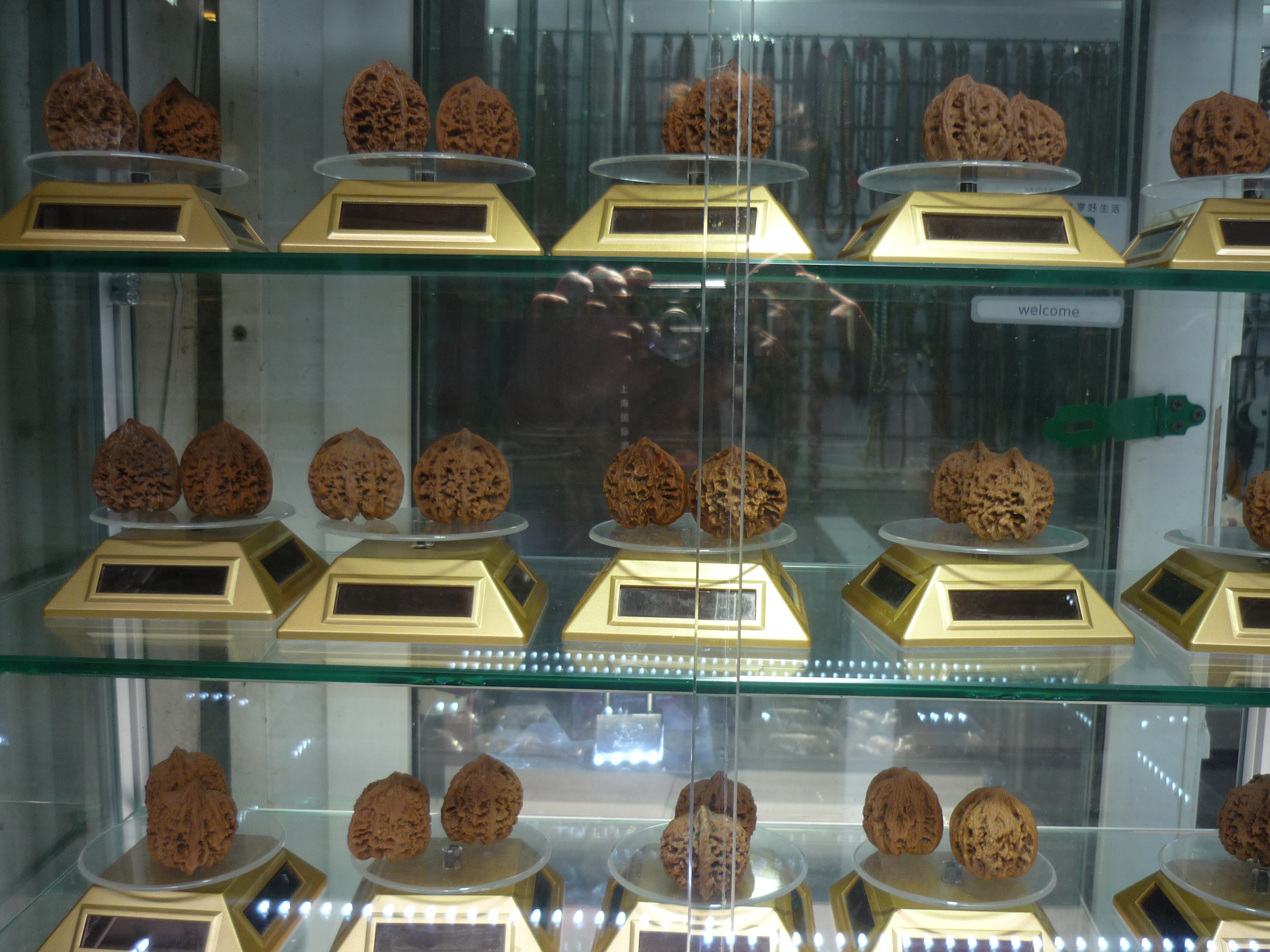


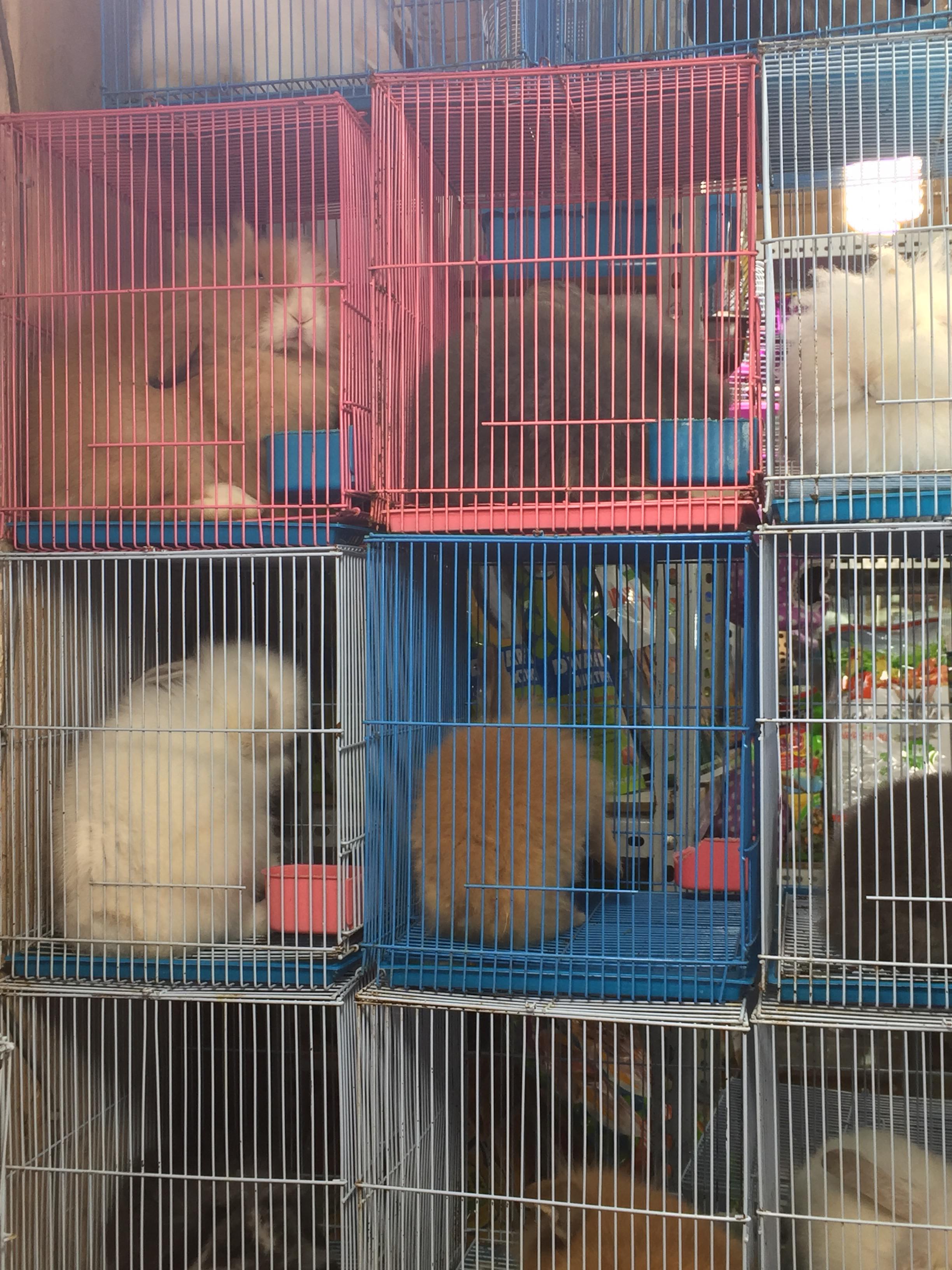
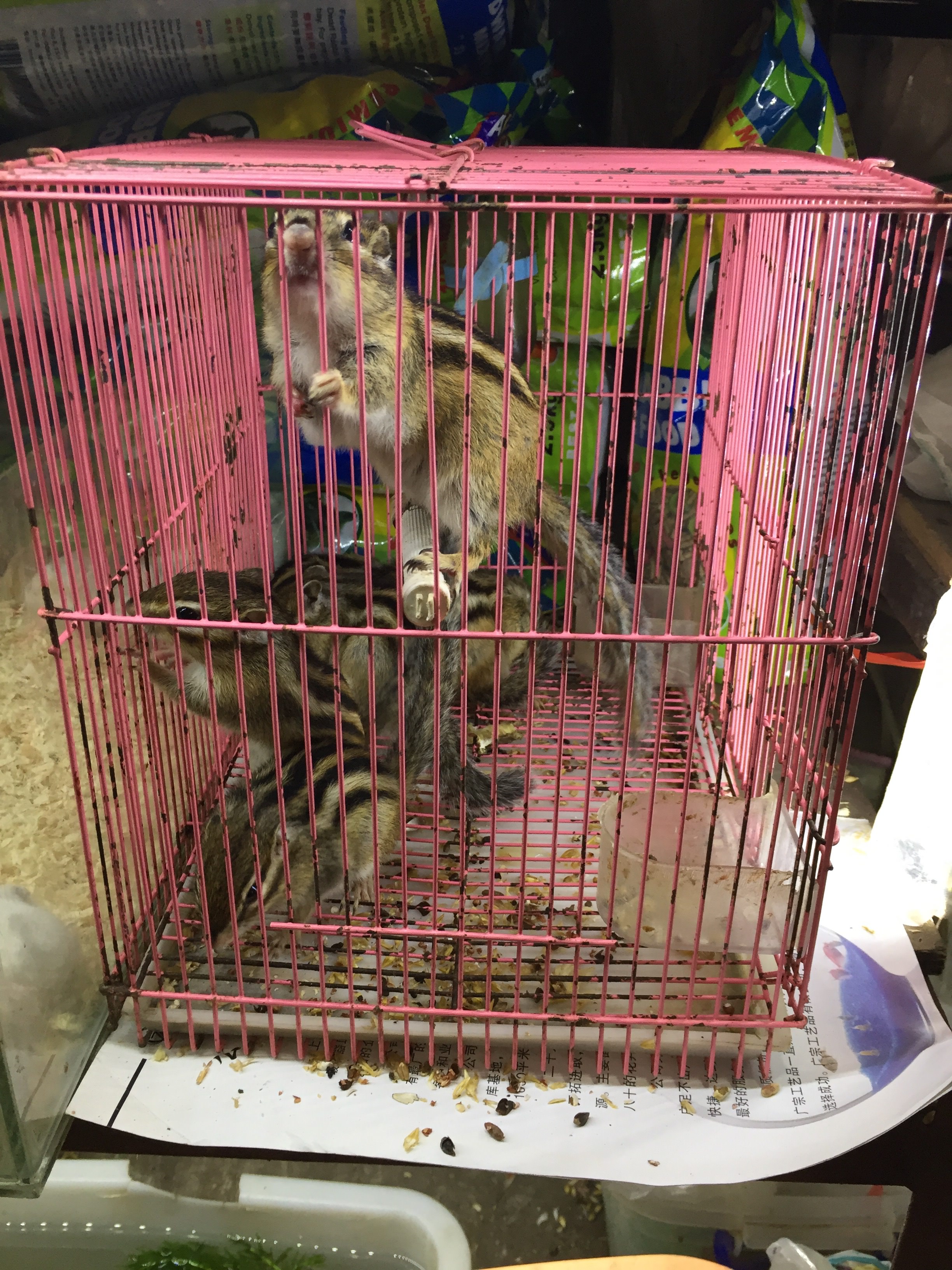
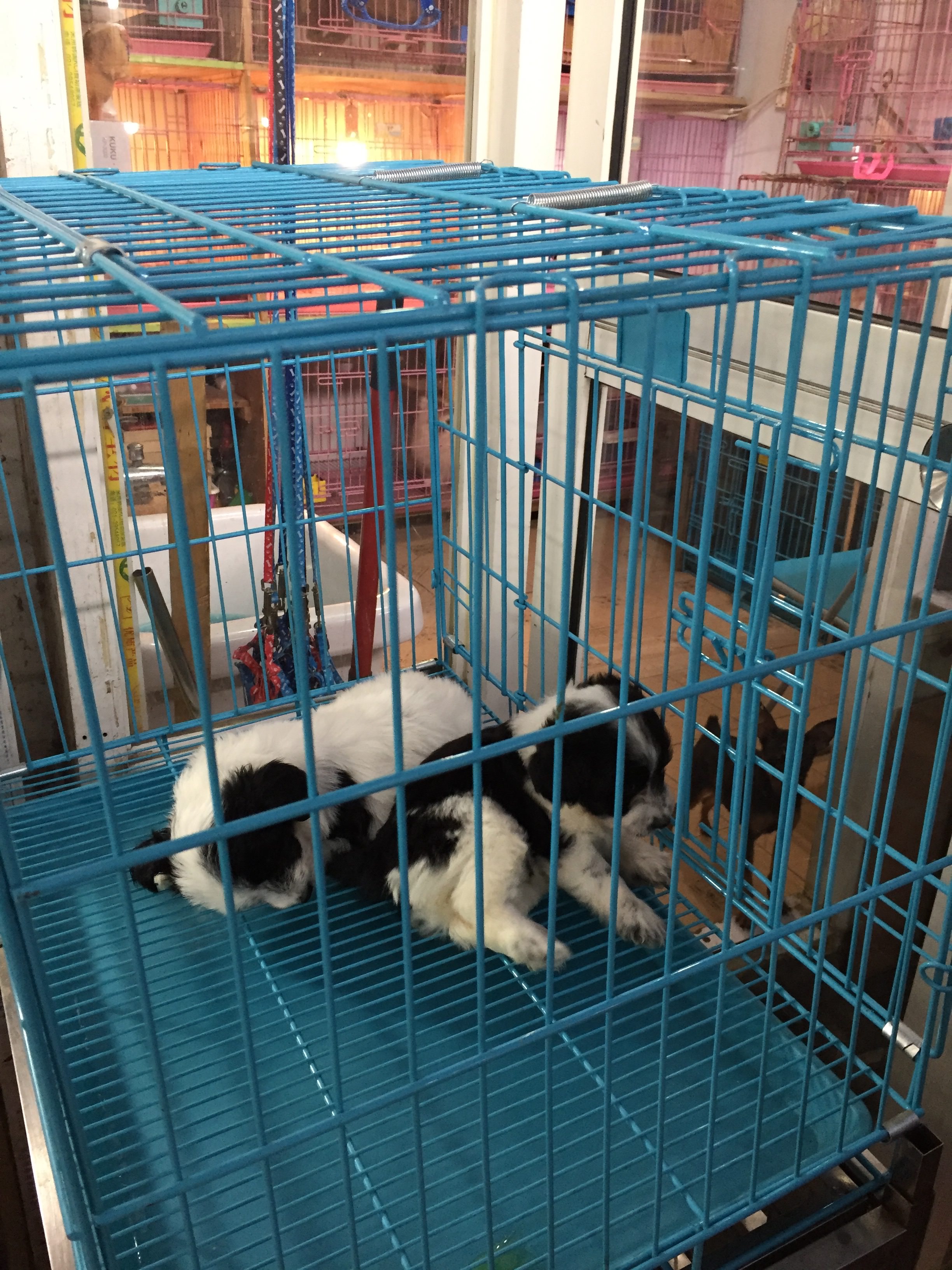
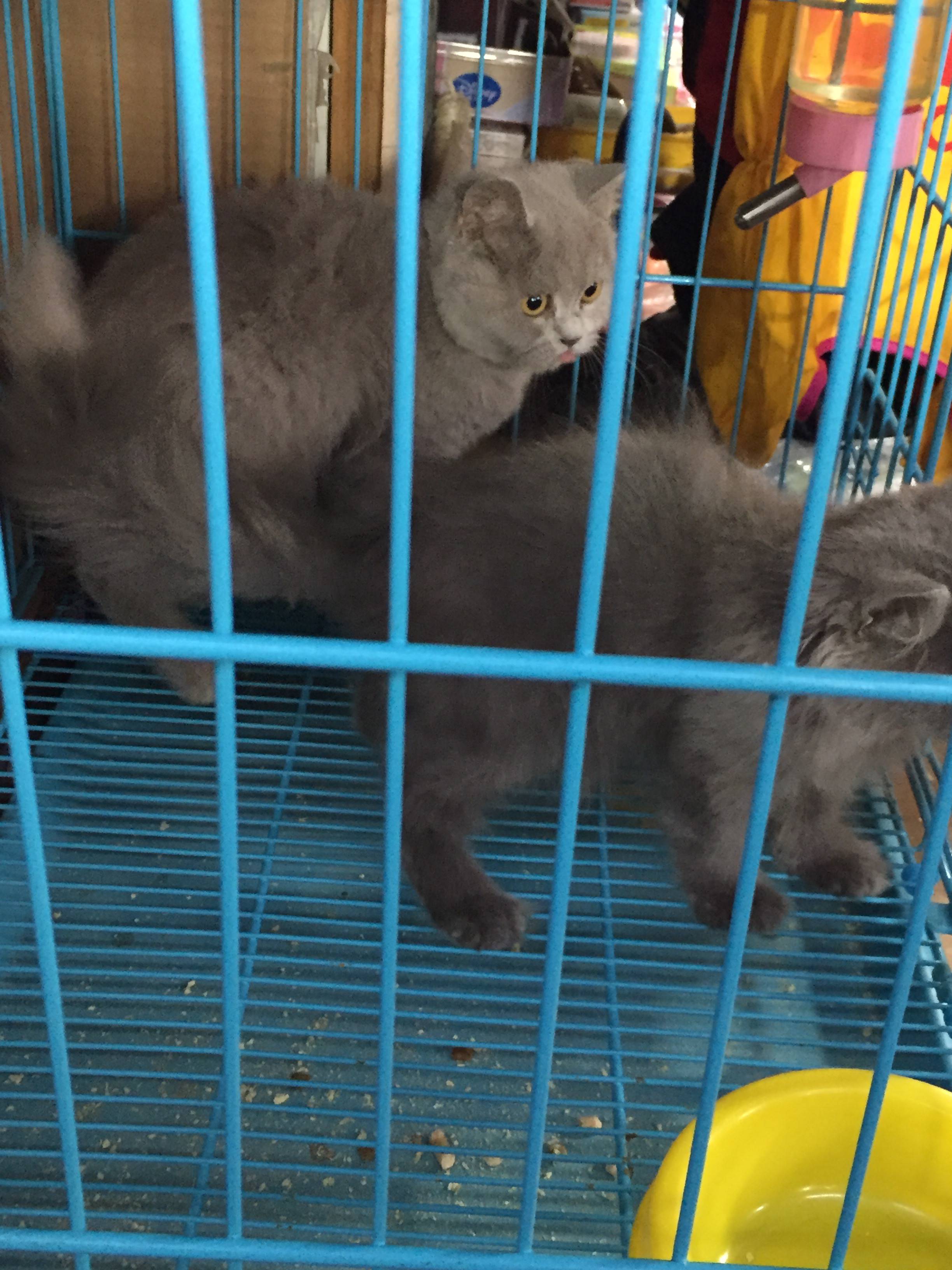
 some far too young:
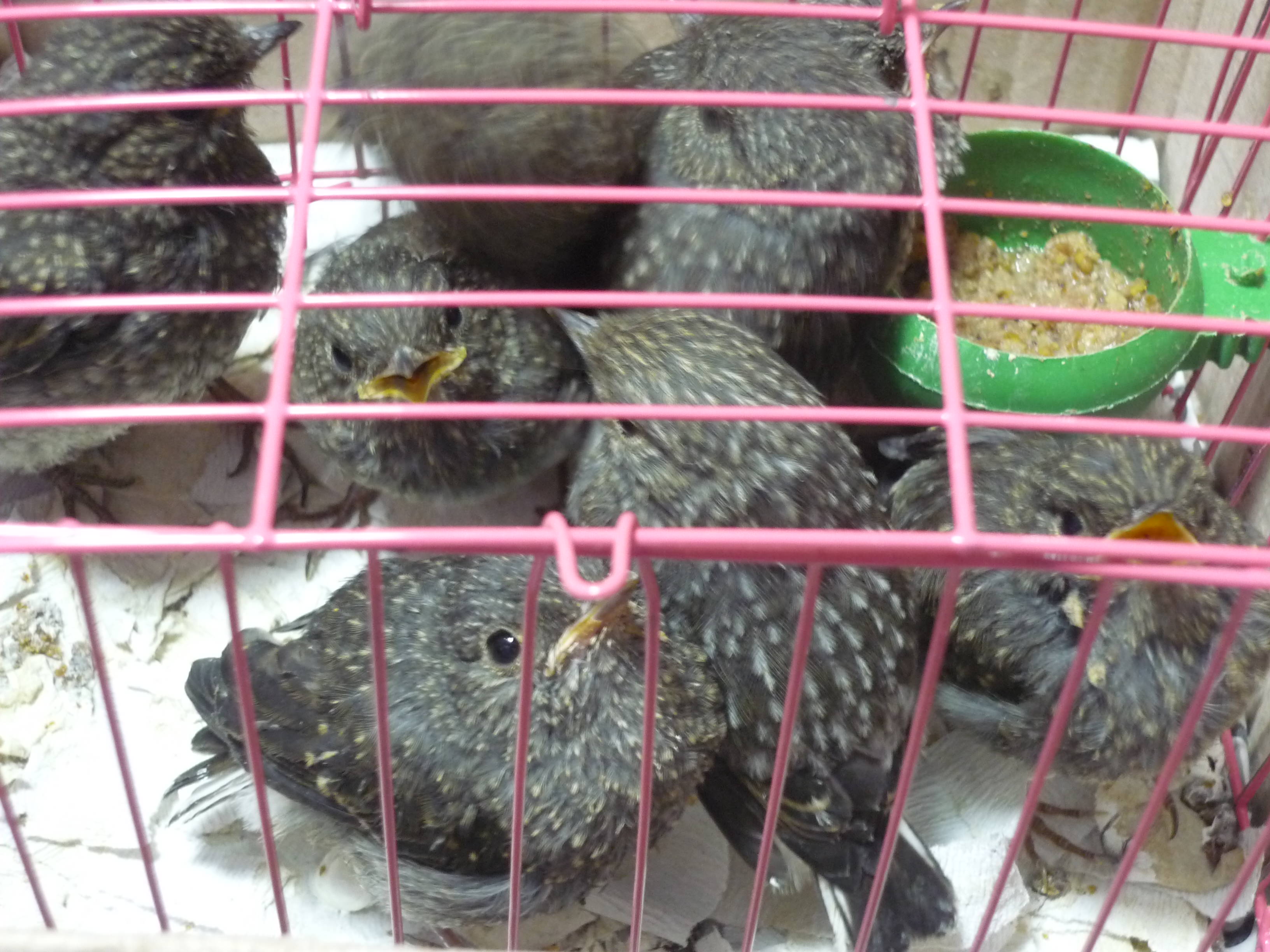 or the “pet” ones that are chained to their perch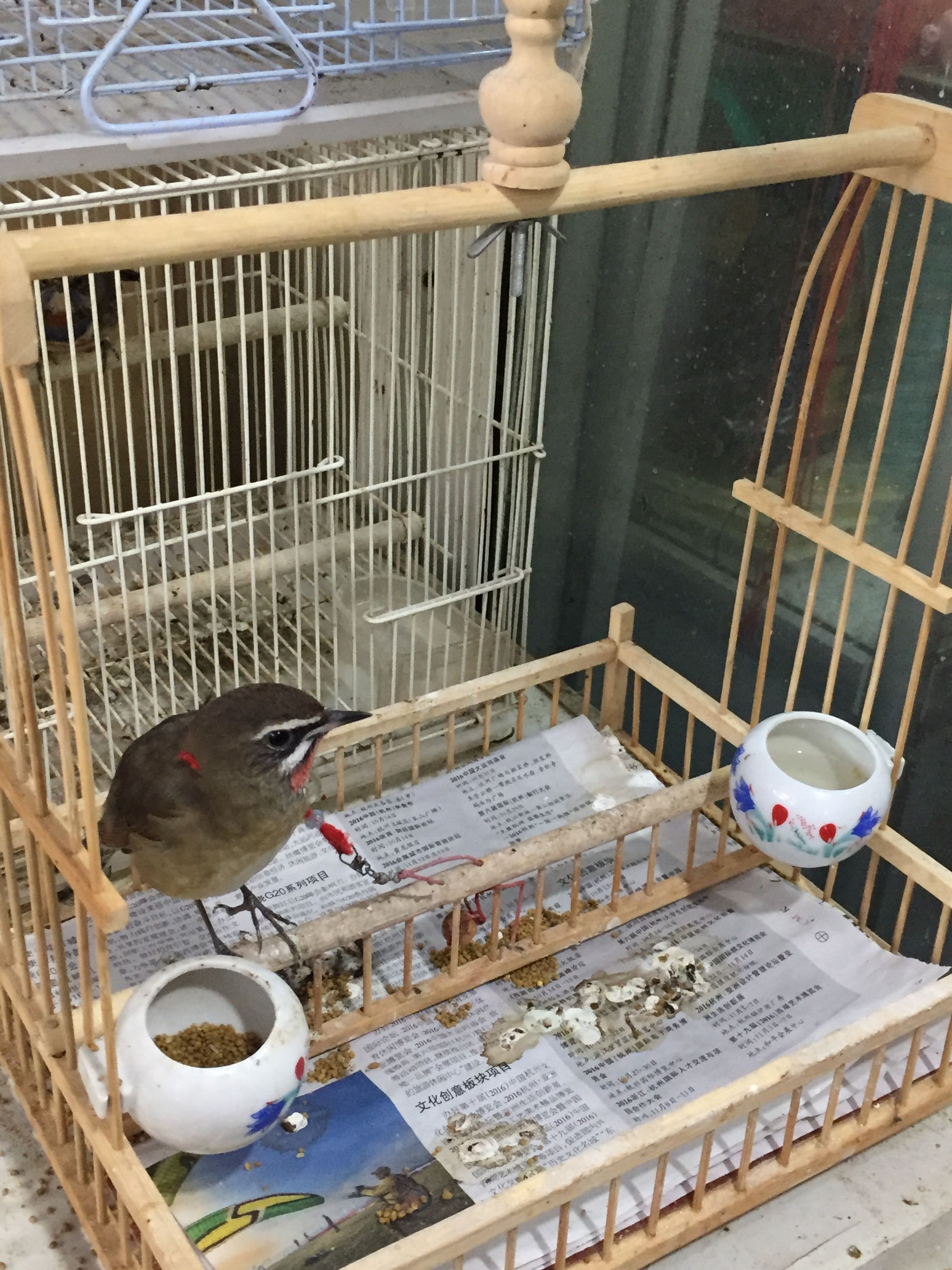

 Pearls From The Orient